

Archive position — measured, not model output
1 like on Devpost
505 of the 7,850 archived projects have more likes, and 1,758 share exactly 1 — so this project's #2,126 place in the like-ranked listing is a tie-break inside that group, not a ranking.
Projects (log scale)
Likes on Devpost. ▲ marks this project's group.
Show the figures
| Likes | Projects | Share of archive |
|---|---|---|
| 0 | 5,587 | 71.2% |
| 1 | 1,758 | 22.4% |
| 2 | 284 | 3.6% |
| 3–4 | 132 | 1.7% |
| 5–9 | 75 | 1.0% |
| 10+ | 14 | 0.2% |
 User Stories BotA demo video on every pull request
Get a demo video on every new feature
GitHub App that watches your pull requests and records a narrated, captioned demo.
Save time on demo prep and make informed decisions faster with a video walkthrough of every new feature.
Executive Summary
What the company appears to be
Truth Harness is a self-reported local-first verification and evidence layer for AI agents like Codex, designed to make mathematical claims from AI systems routable through deterministic engines that return conservative trust labels with replayable evidence.
What changed
The author states they began developing Truth Harness while building a Rust game engine, frustrated by needing to inspect and replay every important answer in technical work. The system is presented as an evolution of how AI agents interact with mathematical reasoning — not just accepting outputs but verifying them through local tools.
Single most important open question
Is there any evidence that Truth Harness has been used beyond the author's own development and demonstration, or that it has been integrated into real-world workflows?
What The Product Actually Is
The description states that Truth Harness is a local-first verification and evidence layer for Codex and other AI agents. It routes scoped mathematical claims through deterministic engines and returns conservative trust labels such as:
- exact-computed
- cross-checked
- smt-checked
- refuted
- unverified
- proved
Each result includes input, assumptions, backend, output, evidence trace, limitations, replay command, and local artifact references.
It provides interfaces including:
- CLI
- MCP server
- Local API
- Docker verification profiles
- Browser workbench
The system is built as a TypeScript monorepo with a shared verification core used by all interfaces. Verification adapters connect to exact arithmetic routines like SymPy, Maxima, Z3, cvc5, Lean 4, and SageMath.
It stores generated evidence locally under a .truth-harness workspace, using Docker services with disabled networking, dropped capabilities, and narrowly scoped writable storage.
Inference The product is described as a tool for inspecting AI-generated math claims by routing them through deterministic verifiers and returning evidence-backed results. It is not an AI model itself but a verification infrastructure layer.
Positioning & Claim Evolution
The author states that Truth Harness began with the question:
“What if an AI answer were treated as a claim to verify, rather than a conclusion to trust?”
This reflects a shift from traditional AI use where outputs are accepted at face value to one where AI-generated claims must be verified.
Key positioning elements:
- It is designed to work underneath Codex, allowing agents to propose claims, call the harness, inspect receipts, correct refuted steps, and continue from evidence-backed checkpoints.
- The system emphasizes conservative trust labels, refusing to make stronger claims than its evidence supports.
- It distinguishes between:
- Calculation vs. proof
- Benchmark vs. theorem
- Simulation vs. reality
- Source citation vs. independent validation
Inference The positioning is that Truth Harness is a verification infrastructure layer for AI agents, not a replacement or enhancement of the agent itself — it’s about ensuring trustworthiness in AI-generated math.
Target Customer & ICP
The description does not explicitly name target customers or personas. However, based on its architecture and use case:
- Primary users appear to be:
- Developers working with AI agents (especially Codex)
- Researchers or engineers needing rigorous verification of mathematical claims
- Students or educators who want to inspect how AI-generated math is derived
The system supports both humans and agents, suggesting a dual-purpose audience.
It also targets users who are building systems where correctness matters — such as game engines, scientific simulations, or engineering tools.
Inference The ICP likely includes developers, researchers, engineers, and educators working in technical domains requiring high-fidelity mathematical reasoning. It is not yet clear if there are specific commercial customers beyond the author’s own use cases.
Business Model & Pricing Evidence
There is no evidence of a business model or pricing structure in the description.
The project is presented as an open-source tool built during a hackathon, with no mention of monetization, licensing, or paid features.
Inference No commercial business model or pricing has been evidenced. The system appears to be a prototype or proof-of-concept, not yet a product intended for sale.
Technical & Delivery Signals
The system is described as:
- Built using TypeScript monorepo
- Uses Docker for isolation and verification
- Integrates with multiple deterministic engines: SymPy, Maxima, Z3, cvc5, Lean 4, SageMath
- Provides CLI, MCP server, API, and browser interfaces
- Stores evidence locally in a
.truth-harnessworkspace - Supports replayable receipts, claim lineage, validation plans, and agent handoffs
It includes:
- 753 passing automated tests across 86 test files
- A release audit with 21 passing checks and no warnings or failures
- Real Docker-isolated verification evidence
- External engine case validation for Rust geometry predicates
- Printable reports and teaching packets generated from recorded evidence
Inference The technical foundation is solid, built around deterministic tools and isolation. It supports multiple delivery methods and includes testing and audit capabilities.
Traction & Maturity Signals
The description states:
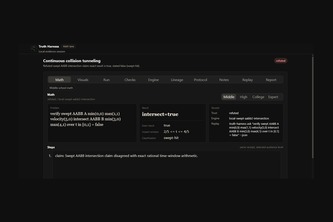
- A working demonstration that catches a realistic continuous collision error using exact arithmetic
- 753 passing automated tests across 86 test files
- A release audit with 21 passing checks and no warnings or failures
- Real Docker-isolated verification evidence
- External engine case validation for Rust geometry predicates
However, there is no evidence of revenue, customers, user adoption, or product-market fit beyond the author’s own development.
The system was submitted to a hackathon, indicating it is likely in early-stage development.
Inference The project shows technical maturity and has been tested in a real-world scenario, but there is no evidence of traction or commercial adoption.
Competitive Context
There is no mention of competitors or direct market context in the description. The author does not reference existing tools for AI verification or mathematical reasoning.
The system appears to be positioned as a verification layer that sits beneath AI agents like Codex, rather than competing with other AI systems or math engines directly.
It seems to address a niche need: verifying AI-generated math claims in technical workflows, which may overlap with areas such as:
- Formal verification tools
- AI agent frameworks
- Scientific computing environments
But no direct comparison or competitive positioning is made.
Inference No clear competitive landscape is described. The system appears to be unique in its approach of combining AI agents with deterministic verification layers, but it lacks evidence of market presence or competition.
Open Questions & Risks
- No commercial traction or adoption: The project is presented as a hackathon submission and has no evidence of real-world usage.
- Single-person team: Only one member (Ocean Bennett) is listed, which may limit scalability or long-term development capacity.
- Unproven trust model: While the system claims to be conservative in labeling, there is no external validation or feedback from users or mathematicians.
- Limited interfaces: The system is described as supporting CLI, MCP, API, and browser workbench — but no evidence of integration into larger platforms or workflows.
- No pricing or monetization strategy: No indication of how the product would be sold or monetized if it were to evolve.
Inference The main risk is that this remains a prototype or personal project with no clear path to commercial viability or market traction.
Questions the description leaves open
- Has Truth Harness been used beyond the author’s own development and demo?
- What kind of feedback have you received from users or collaborators in technical domains (e.g., engineering, research)?
- How does Truth Harness handle edge cases where verification fails or is inconclusive?
- Are there any plans to support more types of mathematical claims or integrate with additional tools beyond those listed?
- What are the limitations of the current Docker-based isolation approach, and how might they scale?
- Have you considered integrating with existing AI agent frameworks or platforms (e.g., LangChain, AutoGen)?
- How do you plan to evolve the trust labeling system over time?
Overall Assessment
Not evidenced: There is no evidence of revenue, customers, traction, or a clear business model.
The project is described as a hackathon submission, built by one person, and lacks any indication of commercial viability or market demand.
It shows strong technical execution and a compelling idea for a verification layer in AI workflows, but there is no evidence that it has moved beyond prototype or gained traction in real-world use.
Inference This is likely an early-stage project with potential — but not yet ready for investment or partnership unless further development and adoption are demonstrated.
User Stories BotA demo video on every pull request
Get a demo video on every new feature
GitHub App that watches your pull requests and records a narrated, captioned demo.
Save time on demo prep and make informed decisions faster with a video walkthrough of every new feature.
Source
Submitted to the OpenAI 2026 hackathon on Devpost. Project home on Devpost. Back to the full gallery on Devpost.
This competitive analysis was produced by top-founders.com (opens in a new tab)
Generated by a language model from this project's public Devpost page — its tagline, the author's own write-up and any built-with tags listed there — as captured in August 2026. Short quotations are the author's words. It is an opinion on the idea as a business, not on the people behind it, and it reflects the description as published then. If the project has moved on, request a correction below. The analysis is not independent research and contains no verified traction, revenue or customer data.
An independent guide by KFG International LLC — not affiliated with, endorsed by, or connected to Devpost or OpenAI.