

Archive position — measured, not model output
0 likes on Devpost
2,263 of the 7,850 archived projects have more likes, and 5,587 share exactly 0 — so this project's #7,387 place in the like-ranked listing is a tie-break inside that group, not a ranking.
Projects (log scale)
Likes on Devpost. ▲ marks this project's group.
Show the figures
| Likes | Projects | Share of archive |
|---|---|---|
| 0 | 5,587 | 71.2% |
| 1 | 1,758 | 22.4% |
| 2 | 284 | 3.6% |
| 3–4 | 132 | 1.7% |
| 5–9 | 75 | 1.0% |
| 10+ | 14 | 0.2% |
 User Stories BotA demo video on every pull request
Get a demo video on every new feature
GitHub App that watches your pull requests and records a narrated, captioned demo.
Save time on demo prep and make informed decisions faster with a video walkthrough of every new feature.
Executive Summary
TRIAL//ZERO is a self-reported prototype for a clinical trial protocol rehearsal system that aims to surface operational risks before launch. The author describes it as a "governed protocol-delivery rehearsal system" that uses AI-assisted review workflows with deterministic checks and human authority at key gates.
The project is presented as a single-person build (team size: 1) using Next.js, TypeScript, GPT-5.6, and other technologies. It includes an 11-seat council runtime for specialist review and a focus on auditability and reproducibility.
Key commercial signals are absent from the description — no revenue, customers, pricing or traction data are provided. The author states this is a "synthetic, governance-first workflow demonstration" with deterministic fixtures and bounded AI assistance.
The single most important open question: What is the actual market need for this type of protocol rehearsal system, and how does it differ from existing tools or processes used by clinical trial teams?
What The Product Actually Is
The description states that TRIAL//ZERO is a "governed protocol-delivery rehearsal system" built to test operational assumptions before a clinical trial starts.
It implements:
- Protocol dossier ingestion and scoping with human-defined review scope
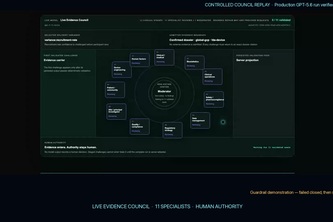
- An 11-seat Evidence Council with independent specialist perspectives (clinical, operations, statistics, safety, regulatory)
- Cross-examination and variance-aware focus on findings
- Human-governed progression with explicit gates for acceptance/disposition/ready
- Protocol Autopsy output showing decision lineage, findings, dissent, and assumption-risk connections
The prototype is described as:
- A synthetic, governance-first workflow demonstration
- Using deterministic fixtures for stable rehearsal
- Bounded AI assistance for review narration and interpretation
- Built with Next.js + TypeScript, strict schemas, and clear boundaries between deterministic and AI-assisted components
Positioning & Claim Evolution
The author states that TRIAL//ZERO "pairs AI specialist review with deterministic checks to surface operational risks" and produces a "human-reviewed, auditable roadmap."
It is positioned as:
- A system that surfaces critical operational risks earlier in the trial process
- A way to test assumptions before execution begins
- A tool to make better decisions before day one of a trial
- A "governance-first workflow demonstration"
The claim evolution shows:
- Initial problem: Teams discover operational risks only after execution starts
- Proposed solution: Early risk identification through structured review
- Current state: Prototype with 11-seat council and deterministic checks
- Future vision: Sponsor-led companion for real planning teams
Target Customer & ICP
The description states that the target users are "clinical trial biostatistician[s] and AI/ML scientist[s]" who have seen failures in clinical trials due to wrong assumptions, underestimated feasibility, misunderstood site readiness, and coordination issues.
The author identifies the primary user as:
- Clinical trial biostatisticians
- AI/ML scientists with clinical trial experience
The ICP is described as teams that:
- Experience protocol amendments that are expensive, extend timelines, and affect quality
- Want to surface risks earlier with evidence and structure
- Need practical ways to make better decisions before day one
Business Model & Pricing Evidence
Not evidenced.
The description does not contain any information about pricing models, revenue streams, customer acquisition costs, or monetization strategies. No commercial details are provided beyond the self-reported prototype development.
Technical & Delivery Signals
The author states that TRIAL//ZERO was built with:
- Next.js + TypeScript
- GPT-5.6 (via OpenAI API)
- Playwright, React, Supabase, Tailwind CSS, Vitest, Zod
- Typed core models for dossiers, evidence, findings, dissent, and run provenance
- Multi-seat council runtime with independent review generation and explicit role identity
- Robust parse/validation/repair logic
- Deterministic fixture paths for stable offline rehearsal
- Live review wiring for bounded GPT use under governance constraints
- Persisted run state and stage events for auditability
The system is described as:
- Focused on reproducibility and traceability
- Built with strict schemas and clear boundaries between deterministic and AI-assisted components
- Designed to be auditable from start to finish
- Implemented with validation boundaries, deterministic checks, and role-level contracts
Traction & Maturity Signals
Not evidenced.
The description contains no information about:
- Revenue or ARR
- Customer base or adoption
- Usage metrics or engagement data
- Product-market fit indicators
- Market traction or growth signals
- Any form of commercial validation
The author explicitly states this is a "synthetic, governance-first workflow demonstration" and that the prototype is "explicit about its boundaries."
Competitive Context
Not evidenced.
The description does not contain any information about:
- Direct competitors
- Indirect substitutes
- Market size or TAM
- Competitive positioning
- Existing tools in the clinical trial protocol space
- Market dynamics or barriers to entry
Open Questions & Risks
Inferences based on self-reported information:
- Single-person build: The team size is listed as 1, which raises questions about scalability and long-term maintenance of a complex system.
- Prototype-only status: The description explicitly states this is a "synthetic, governance-first workflow demonstration" with deterministic fixtures, suggesting it's not yet in production use.
- AI dependency without clear commercialization path: The system relies heavily on GPT-5.6 and AI assistance, but there's no evidence of how this would be monetized or scaled beyond the prototype.
- Governance complexity vs. practical adoption: The focus on "human authority at each critical stage" may create friction for adoption if it doesn't align with existing workflows or decision-making structures in clinical trial teams.
- Market need uncertainty: There's no evidence of market demand or validation for this specific type of protocol rehearsal system.
Questions the description leaves open
- What specific operational risks do you observe in clinical trials that this system addresses, and how do they manifest in practice?
- How does your proposed 11-seat council workflow integrate with existing clinical trial team structures and decision-making processes?
- What is the actual market need for this type of protocol rehearsal system? Have you spoken to potential users or sponsors?
- How do you plan to transition from a prototype to a scalable, commercial product?
- What are the key assumptions about AI's role in clinical trial planning that you're testing with this system?
- How does your system handle edge cases or unexpected findings during protocol review?
- What is the expected timeline for moving beyond the current prototype stage?
- How do you plan to validate that your deterministic checks and AI assistance actually improve decision quality?
- What are the key challenges in getting clinical trial teams to adopt this type of governance-first approach?
- How does your system's auditability translate into regulatory compliance or stakeholder confidence?
Overall Assessment
Not evidenced.
The description provides no information about:
- Financial performance or projections
- Valuation or funding history
- Strategic fit for potential partners
- Commercial viability indicators
- Exit scenarios or investment thesis
The author states this is a prototype built during a hackathon, with no revenue, customers, or traction data. The system is described as "synthetic" and "demonstration-only," indicating it has not yet reached commercial maturity.
The single most important open question remains: What is the actual market need for this type of protocol rehearsal system, and how does it differ from existing tools or processes used by clinical trial teams?
User Stories BotA demo video on every pull request
Get a demo video on every new feature
GitHub App that watches your pull requests and records a narrated, captioned demo.
Save time on demo prep and make informed decisions faster with a video walkthrough of every new feature.
Source
Submitted to the OpenAI 2026 hackathon on Devpost. Project home on Devpost. Back to the full gallery on Devpost.
This competitive analysis was produced by top-founders.com (opens in a new tab)
Generated by a language model from this project's public Devpost page — its tagline, the author's own write-up and any built-with tags listed there — as captured in August 2026. Short quotations are the author's words. It is an opinion on the idea as a business, not on the people behind it, and it reflects the description as published then. If the project has moved on, request a correction below. The analysis is not independent research and contains no verified traction, revenue or customer data.
An independent guide by KFG International LLC — not affiliated with, endorsed by, or connected to Devpost or OpenAI.