

Archive position — measured, not model output
0 likes on Devpost
2,263 of the 7,850 archived projects have more likes, and 5,587 share exactly 0 — so this project's #3,463 place in the like-ranked listing is a tie-break inside that group, not a ranking.
Projects (log scale)
Likes on Devpost. ▲ marks this project's group.
Show the figures
| Likes | Projects | Share of archive |
|---|---|---|
| 0 | 5,587 | 71.2% |
| 1 | 1,758 | 22.4% |
| 2 | 284 | 3.6% |
| 3–4 | 132 | 1.7% |
| 5–9 | 75 | 1.0% |
| 10+ | 14 | 0.2% |
 User Stories BotA demo video on every pull request
Get a demo video on every new feature
GitHub App that watches your pull requests and records a narrated, captioned demo.
Save time on demo prep and make informed decisions faster with a video walkthrough of every new feature.
Executive Summary
Company: Computer Charades
Self-reported basis: The entire analysis is based on a single project description submitted by the author to the OpenAI 2026 hackathon on Devpost. No independent verification, revenue, customer data or traction evidence is available.
What it appears to be: A proof-of-concept application combining AI image recognition with a custom RPC framework (Canopy) for low-latency distributed compute, intended to play a charades-style game where an AI guesses film titles from video input. The project also includes a broader framework for secure, efficient inter-language communication.
What changed: The author describes this as a hackathon submission, indicating it is not yet a product or service in production. The project is described as experimental and incomplete, with the author noting “ran out of time” and “getting something to work at all.”
Most important open question: Is there any evidence that the author intends to develop this beyond a hackathon prototype, or that the underlying framework (Canopy) has potential for commercial traction?
What The Product Actually Is
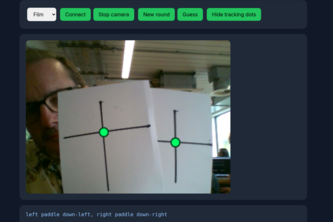
The description states that Computer Charades is a simple app that:
- Takes a video stream from a browser
- Passes it via websocket gateway to an image recognition engine
- Telemetry from the engine is passed to a language model (LLM)
- The LLM attempts to guess if the input is a book, film or play
Additionally, the author describes "Canopy" as:
- A universal low-latency RPC framework
- Serialization and transport agnostic
- Supporting SOAP, REST, WebSockets, JSON-RPC
- Compatible with blocking and asynchronous IO using coroutines
- Designed to reduce boilerplate code in distributed systems
- Supports secure compute via Intel SGX
- Metadata-driven, able to convert OpenAPI/Swagger files to Canopy IDL
- Has partial implementations for Node.js and Rust
Inference: The app is a demonstration of the framework (Canopy) in action, not a standalone product. The core functionality appears to be experimental and incomplete.
Positioning & Claim Evolution
The author states:
- The project combines “confidential computing,” “ultra-low latency development,” and “RPC” concepts
- It aims to democratize complex distributed compute through Canopy
- The framework is positioned as a way to reduce boilerplate code in C++ and other languages
- It supports secure, attested communication over untrusted links using Intel SGX
Inference: The author positions the project as a technical demonstration of a framework that could be used for secure, low-latency distributed systems. However, there is no evidence of commercial positioning or market traction.
Target Customer & ICP
The description does not identify any specific customer segment or ideal customer profile (ICP). It only states:
- The author has experience in confidential computing and banking
- The framework targets developers working with low-latency distributed systems
- It is intended for use in secure compute environments
Inference: The target audience appears to be developers building systems that require secure, efficient inter-language communication. However, no evidence of actual customers or user personas is provided.
Business Model & Pricing Evidence
The description does not mention any pricing model, revenue streams, or monetization strategy. It only describes the technical components and use case.
Inference: No business model or pricing evidence is available. The project appears to be a prototype with no indication of commercial intent.
Technical & Delivery Signals
The author states:
- Built using C++, CMake, JavaScript
- Uses coroutines, gRPC, REST, WebSockets, JSON, MCP
- Implements low-latency networking and vision models
- Integrates with secure compute environments (Intel SGX)
- Supports metadata-driven IDL conversion between formats like OpenAPI/Swagger and MCP
Inference: The technical stack is advanced for a hackathon project. However, the author notes they “ran out of time” and had difficulty with server processing, suggesting incomplete implementation.
Traction & Maturity Signals
The description states:
- This is a hackathon submission
- “Ran out of time”
- “Getting something to work at all”
- “What’s next for Computer Charades” includes plans for WebRTC and OpenCV
Inference: No traction or maturity evidence is present. The project is described as experimental, incomplete, and not yet in production.
Competitive Context
The description does not mention any competitors or market context. It only describes the author’s own technical approach and framework (Canopy).
Inference: No competitive landscape is evident from the self-reported description.
Open Questions & Risks
- Incomplete implementation: The author admits to running out of time and difficulty with server processing.
- No commercial traction or revenue: This is a hackathon project, not a product.
- Unproven market demand: No evidence of customer need or interest beyond the author’s own experimentation.
- Highly technical prototype: The framework (Canopy) may be too niche or abstract for mainstream adoption.
- Single founder: Team size is listed as 1, which raises questions about execution capacity.
Questions the description leaves open
- What is the intended commercial application of Canopy beyond this hackathon prototype?
- Are there any existing users or partners interested in the framework?
- How does Canopy differentiate from other RPC frameworks (e.g., gRPC, REST, etc.) in practical use cases?
- Is there a plan to move beyond the experimental phase and into product development?
- What are the specific performance or security benefits of Canopy compared to existing solutions?
Overall Assessment
Not evidenced: The description does not provide any evidence of commercial viability, traction, or a clear path to monetization.
Confidence level: Low — this is a self-reported, unverified hackathon project with no revenue, customers, or product-market fit data. The framework (Canopy) may be technically interesting but lacks any demonstration of real-world application or demand.
Inference: This project is not ready for investment or partnership consideration at this stage. It is a technical experiment, not a business.
User Stories BotA demo video on every pull request
Get a demo video on every new feature
GitHub App that watches your pull requests and records a narrated, captioned demo.
Save time on demo prep and make informed decisions faster with a video walkthrough of every new feature.
Source
Submitted to the OpenAI 2026 hackathon on Devpost. Project home on Devpost. Back to the full gallery on Devpost.
This competitive analysis was produced by top-founders.com (opens in a new tab)
Generated by a language model from this project's public Devpost page — its tagline, the author's own write-up and any built-with tags listed there — as captured in August 2026. Short quotations are the author's words. It is an opinion on the idea as a business, not on the people behind it, and it reflects the description as published then. If the project has moved on, request a correction below. The analysis is not independent research and contains no verified traction, revenue or customer data.
An independent guide by KFG International LLC — not affiliated with, endorsed by, or connected to Devpost or OpenAI.