

Archive position — measured, not model output
1 like on Devpost
505 of the 7,850 archived projects have more likes, and 1,758 share exactly 1 — so this project's #2,113 place in the like-ranked listing is a tie-break inside that group, not a ranking.
Projects (log scale)
Likes on Devpost. ▲ marks this project's group.
Show the figures
| Likes | Projects | Share of archive |
|---|---|---|
| 0 | 5,587 | 71.2% |
| 1 | 1,758 | 22.4% |
| 2 | 284 | 3.6% |
| 3–4 | 132 | 1.7% |
| 5–9 | 75 | 1.0% |
| 10+ | 14 | 0.2% |
 User Stories BotA demo video on every pull request
Get a demo video on every new feature
GitHub App that watches your pull requests and records a narrated, captioned demo.
Save time on demo prep and make informed decisions faster with a video walkthrough of every new feature.
Executive Summary
What the company appears to be
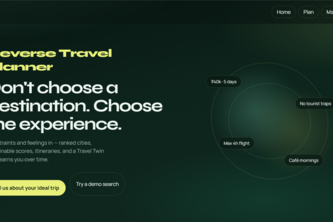
Travelling Tom is a self-described reverse travel planner that uses constraints and traveler preferences to recommend destinations rather than starting with a destination and building an itinerary. The author states it is built using a hybrid system combining hard/soft constraints, a "Destination Genome", and LLMs for explanations and experience search.
What changed
The project description shows a shift from traditional travel tools that begin with a destination to one that starts with traveler intent and constraints. It was submitted as part of an OpenAI hackathon.
Single most important open question
Is there evidence of any commercial traction, revenue, or customer adoption beyond the author's personal experience and demo?
What The Product Actually Is
The description states Travelling Tom is a "reverse travel planner" that recommends destinations based on traveler constraints and preferences. It uses:
- A hybrid system combining hard/soft constraints (budget, flight time, visa, weather)
- A "Destination Genome" with feature vectors for cafés, crowds, nature, walkability, etc.
- LLMs only for explanations, experience search, and itineraries
- Backend: FastAPI + ranking engine
- Frontend: React (Vite) product flow
The system is described as a "complete product loop" including experience search → ranked matches → What If → compare → itinerary / Concierge → Travel Twin + saved trips.
Evidence Self-reported, unverified. No evidence of actual product usage or commercial deployment.
Positioning & Claim Evolution
The author states the positioning is to help travelers find "those kinds of places — not only the famous postcard cities, but destinations that fit their budget, time, energy, and vibe" so they can feel the same joy as trips to Hong Kong, Singapore, Bali, and Bhutan.
The claim evolution appears to be:
- From traditional travel tools (which start with destination)
- To a reverse funnel approach where constraints and feelings choose the destination
- With emphasis on personalization and explainability ("a travel friend who knows you, not a brochure")
Evidence Self-reported claims about positioning and intent. No evidence of market validation or customer feedback.
Target Customer & ICP
The author describes the target as "travelaholics" who want to find destinations that match their budget, time, energy, and vibe — not just checklists but experiences that feel transformative.
Evidence Self-reported description of target audience. No evidence of actual customers or user research.
Business Model & Pricing Evidence
No business model or pricing information is provided in the description. The author mentions no revenue streams, monetization strategy, or pricing tiers.
Evidence Not evidenced.
Technical & Delivery Signals
The system uses:
- Codex agentically for rapid development
- FastAPI + ranking engine (matcher.py)
- React/Vite frontend
- LLMs only for explanations and experience search
- Offline fallbacks to ensure demo reliability
- A "Destination Genome" dataset with curated global destinations
The author claims the product was built in "Build Week time" and includes a complete loop from experience search to saved trips.
Evidence Self-reported technical architecture. No evidence of production deployment or scalability.
Traction & Maturity Signals
There is no evidence of traction, revenue, customers, or adoption beyond the author's personal experience and demo. The project was submitted as a hackathon entry.
Evidence Not evidenced.
Competitive Context
The author states that inspiration came from not wanting to build "another itinerary generator" but rather a system where constraints and feelings choose the destination — implying a differentiation from existing tools that start with a destination.
Evidence Self-reported claim about competitive positioning. No evidence of market analysis or competitor data.
Open Questions & Risks
- No commercial traction: The project is described as a hackathon submission with no evidence of revenue, customers, or adoption.
- Unproven business model: No pricing or monetization strategy is mentioned.
- Limited scope: The system uses curated sample data and lacks live booking APIs.
- Dependency on LLMs: While fallbacks exist, the product relies heavily on AI for explanations, which may not scale without consistent access.
- Single founder: Only one team member is listed.
Evidence Inferences based on self-reported description. No external validation or data to support these risks.
Questions the description leaves open
- What specific constraints or preferences are currently supported in the system?
- How does the "Destination Genome" dataset get updated and maintained?
- Has there been any user feedback or testing beyond personal experience?
- Are there plans to integrate with real travel APIs (e.g., Amadeus, Skyscanner)?
- What is the current plan for monetization or scaling the business?
- How would you validate that your recommendation engine actually improves user outcomes?
Evidence These are questions based on the self-reported description and gaps in information.
Overall Assessment
The project is described as a hackathon submission with no evidence of commercial traction, revenue, or customer adoption. It shows technical capability but lacks any demonstration of market demand or scalability.
Confidence level Low — this analysis is based entirely on self-reported information without independent verification.
Assessment Not ready for investment or partnership consideration at this stage. The author states the project was built in a short timeframe and includes no commercial data, pricing, or user feedback.
Evidence Self-reported only. No external validation or traction data provided.
User Stories BotA demo video on every pull request
Get a demo video on every new feature
GitHub App that watches your pull requests and records a narrated, captioned demo.
Save time on demo prep and make informed decisions faster with a video walkthrough of every new feature.
Source
Submitted to the OpenAI 2026 hackathon on Devpost. Project home on Devpost. Back to the full gallery on Devpost.
This competitive analysis was produced by top-founders.com (opens in a new tab)
Generated by a language model from this project's public Devpost page — its tagline, the author's own write-up and any built-with tags listed there — as captured in August 2026. Short quotations are the author's words. It is an opinion on the idea as a business, not on the people behind it, and it reflects the description as published then. If the project has moved on, request a correction below. The analysis is not independent research and contains no verified traction, revenue or customer data.
An independent guide by KFG International LLC — not affiliated with, endorsed by, or connected to Devpost or OpenAI.