

Archive position — measured, not model output
1 like on Devpost
505 of the 7,850 archived projects have more likes, and 1,758 share exactly 1 — so this project's #2,115 place in the like-ranked listing is a tie-break inside that group, not a ranking.
Projects (log scale)
Likes on Devpost. ▲ marks this project's group.
Show the figures
| Likes | Projects | Share of archive |
|---|---|---|
| 0 | 5,587 | 71.2% |
| 1 | 1,758 | 22.4% |
| 2 | 284 | 3.6% |
| 3–4 | 132 | 1.7% |
| 5–9 | 75 | 1.0% |
| 10+ | 14 | 0.2% |
 User Stories BotA demo video on every pull request
Get a demo video on every new feature
GitHub App that watches your pull requests and records a narrated, captioned demo.
Save time on demo prep and make informed decisions faster with a video walkthrough of every new feature.
Executive Summary
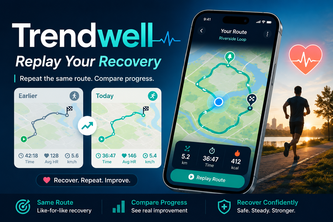
What the company appears to be: Trendwell Route Replay is a self-reported Apple Watch and iPhone app built by one developer (Claes Parflo) for people recovering from surgery. It allows users to repeat previously recorded workouts, compare performance over time using route-aligned metrics, and provides live navigation within the app without uploading data.
What changed: The author states that before Build Week, Trendwell already supported Apple Health analysis, route discovery, and GPX export. During Build Week, they added Route Replay (replaying saved routes inside the app), Same Route Comparison (aligning workouts by distance along a reference track), and a Live Activity for Lock Screen/Dynamic Island presentation.
The single most important open question: Is there any evidence of user adoption or revenue generation beyond the author's own use case? The description contains no data on customers, pricing, or monetization — only claims about functionality.
What The Product Actually Is
- The description states that Trendwell is a native iPhone app written in Swift and SwiftUI.
- It uses Apple technologies including HealthKit, MapKit, Core Location, ActivityKit, WidgetKit, and UserNotifications.
- It supports repeating workouts (walking, hiking, running, cycling) using previously recorded routes from Apple Health.
- It provides route previews, directions to start points, live progress tracking, turn guidance, off-route detection, rejoin handling, foreground haptics, and Lock Screen/Dynamic Island Live Activity.
- It compares workouts based on aligned distance along the reference track (moving time, elapsed time, speed, heart rate, elevation, terrain).
- The app does not upload data or use external services; all processing is private and on-device.
- Features like Route Replay and Same Route Comparison are described as working without subscription.
Inference: Based on the author's own account, this is a personal tool that has been extended for public use during a hackathon. It is not a commercial product with users or monetization yet.
Positioning & Claim Evolution
- The tagline says: “Trendwell helps people recovering from surgery repeat the same route and compare performance over time, turning each workout into a like-for-like measure of recovery.”
- The author claims that Trendwell was initially built as a private tool for personal use after cardiac ablation.
- Before Build Week, it supported Apple Health analysis, route discovery, and GPX export.
- During Build Week, the focus shifted to making the repeat-route experience self-contained within the app.
- The new features do not require a subscription, suggesting an early-stage product with no paid model yet.
Inference: This is a personal project that evolved into a prototype during a hackathon. There is no evidence of positioning toward a broader market or commercial intent beyond the author’s own use case.
Target Customer & ICP
- The description states that Trendwell is designed around older users.
- It targets people recovering from surgery, particularly those who want to monitor their recovery through structured exercise data.
- Users are expected to have Apple Health data and an iPhone with Apple Watch support.
Inference: The target customer segment appears to be limited to individuals in post-surgical recovery, especially those using Apple devices. No evidence of broader market targeting or segmentation beyond this group.
Business Model & Pricing Evidence
- The description states that the new Route Replay and Same Route Comparison features do not require a subscription.
- There is no mention of pricing plans, monetization strategies, or revenue models.
- No evidence of paid tiers, freemium offerings, or customer acquisition costs.
Inference: No business model or pricing information is provided. The app seems to be free to use and lacks any indication of commercial intent or monetization.
Technical & Delivery Signals
- Built with Swift, SwiftUI, and Apple ecosystem tools (HealthKit, MapKit, ActivityKit, WidgetKit).
- Uses GPT-5.6 and Codex for development assistance but not as runtime dependencies.
- Includes deterministic regression tests (38 Swift package tests passing).
- Implements off-route hysteresis, rejoin behavior, turn guidance from track geometry.
- Designed to avoid uploading routes or Health data; all processing is on-device.
- Verified functionality on physical iPhone.
Inference: The technical stack and implementation approach suggest a native iOS app built with modern Apple technologies. However, there is no evidence of scalability, infrastructure, or delivery beyond the author’s own device.
Traction & Maturity Signals
- The project was submitted to an OpenAI Build Week hackathon.
- It includes a pre-feature baseline (build-week-baseline-2026-07-16) and dated commits separating new work from existing product.
- The app supports core features like route replay, comparison, and Live Activity.
- No evidence of user base, customer feedback, or usage metrics.
Inference: This is a prototype developed in a short timeframe (Build Week). There is no evidence of traction, adoption, or real-world usage beyond the author’s own testing.
Competitive Context
- The description does not mention competitors or similar products.
- It focuses on Apple Health integration and repeat-route functionality.
- No evidence of market analysis, competitive positioning, or differentiation from other fitness apps or wearables.
Inference: No competitive context is provided. The app appears to be unique in its approach to route alignment and recovery comparison but lacks any indication of how it fits into the broader market landscape.
Open Questions & Risks
- The app is built by a single person (team size: 1).
- It is not verified or independently audited.
- No evidence of user feedback, product-market fit, or commercial viability.
- The author describes it as a personal tool that evolved into a prototype — no signs of scaling or growth.
- Features are described as working but without any validation from external users or data.
Inference: Risk of limited scalability and lack of traction. The project is in early stages with no evidence of market demand or sustainable business model.
Questions the description leaves open
- What specific feedback have you received from users beyond yourself?
- How do you plan to scale beyond one developer?
- Are there any plans for monetization or subscription models?
- Have you validated the need for this tool in a broader market?
- What are your long-term goals for Trendwell beyond Build Week?
Overall Assessment
- The project is self-reported and unverified.
- It lacks evidence of revenue, customers, traction, or commercial viability.
- It is described as a personal tool that evolved into a prototype during a hackathon.
- No signs of product-market fit, scalability, or monetization strategy.
Assessment: Not evidenced. This is a very early-stage idea with no demonstrated traction or business model. The description does not support any conclusion about investment or partnership potential.
User Stories BotA demo video on every pull request
Get a demo video on every new feature
GitHub App that watches your pull requests and records a narrated, captioned demo.
Save time on demo prep and make informed decisions faster with a video walkthrough of every new feature.
Source
Submitted to the OpenAI 2026 hackathon on Devpost. Project home on Devpost. Back to the full gallery on Devpost.
This competitive analysis was produced by top-founders.com (opens in a new tab)
Generated by a language model from this project's public Devpost page — its tagline, the author's own write-up and any built-with tags listed there — as captured in August 2026. Short quotations are the author's words. It is an opinion on the idea as a business, not on the people behind it, and it reflects the description as published then. If the project has moved on, request a correction below. The analysis is not independent research and contains no verified traction, revenue or customer data.
An independent guide by KFG International LLC — not affiliated with, endorsed by, or connected to Devpost or OpenAI.