

Archive position — measured, not model output
0 likes on Devpost
2,263 of the 7,850 archived projects have more likes, and 5,587 share exactly 0 — so this project's #4,076 place in the like-ranked listing is a tie-break inside that group, not a ranking.
Projects (log scale)
Likes on Devpost. ▲ marks this project's group.
Show the figures
| Likes | Projects | Share of archive |
|---|---|---|
| 0 | 5,587 | 71.2% |
| 1 | 1,758 | 22.4% |
| 2 | 284 | 3.6% |
| 3–4 | 132 | 1.7% |
| 5–9 | 75 | 1.0% |
| 10+ | 14 | 0.2% |
 User Stories BotA demo video on every pull request
Get a demo video on every new feature
GitHub App that watches your pull requests and records a narrated, captioned demo.
Save time on demo prep and make informed decisions faster with a video walkthrough of every new feature.
Executive Summary
What the company appears to be
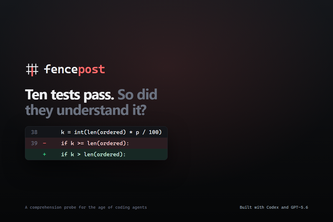
Fencepost is a tool designed for programming education that uses AI and code mutation to assess whether students truly understand their own code. The author states it takes a student-written line of code, makes one character change, runs the student's tests on that change, and if the tests don't catch the change, GPT-5.6 generates a test that does — revealing gaps in understanding.
What changed
The project is described as a hackathon submission (submitted to OpenAI 2026 hackathon) with no evidence of prior development or commercial traction. It is a self-contained prototype built by one person using tools like GPT-5.6, AST, Docker, and Python.
Single most important open question
Is there any evidence that this tool has been used in real educational settings, or that it has any adoption beyond the author’s own testing?
What The Product Actually Is
The description states that Fencepost:
- Takes a line of code written by a student (identified via Git)
- Changes one character in that line
- Runs the student's existing tests on the modified code
- If those tests don’t catch the change, GPT-5.6 generates a new test to show the difference
- A sandbox environment runs this test and reports the result
- The output is a short report for teachers to ask questions — not a grade or assessment
It uses:
- Codex with GPT-5.6 as the engine
- AST (Abstract Syntax Tree) for code manipulation
- Docker sandboxed execution
- Python, pytest, git, mutation testing concepts
The tool is described as being built in a way that avoids API keys and internet access — running locally on the teacher’s plan.
Inference The product appears to be a proof-of-concept prototype with no commercial or production deployment yet. It is not evidenced to have been used beyond the author's own testing.
Positioning & Claim Evolution
The author states:
- The tool is intended for use in CS courses where AI agents may be used to complete assignments
- It aims to detect whether students understand their code, rather than just whether it passes tests
- It avoids traditional AI detectors that are seen as unfair or ineffective
- It is framed as a way to prompt discussion with students, not to judge them
Inference The positioning is centered on educational integrity and understanding, not on AI detection or grading. The claim evolution shows an intent to move from a tool that simply checks code correctness to one that probes comprehension.
Target Customer & ICP
The description states:
- The primary users are teachers in CS courses
- It is intended for use in programming education contexts
- The author mentions “a real CS2 class this fall” as the next step, suggesting a classroom setting
Inference The target customer is likely educators or teaching assistants in computer science programs. The ICP (Ideal Customer Profile) appears to be early-stage educational institutions or individual instructors using it for assessment.
Business Model & Pricing Evidence
The description states:
- No pricing model is described
- It is MIT licensed
- The report stays local — no data leaves the user’s environment
- It runs on the teacher's own GPT-5.6 plan, with no API key required
Inference There is no evidence of a monetization strategy or pricing structure. The tool is self-hosted and open-source (MIT license), suggesting no commercial business model at this stage.
Technical & Delivery Signals
The description states:
- Built using GPT-5.6, AST, Docker, Python, pytest, git
- Uses mutation testing principles to generate meaningful test cases
- Runs in a sandboxed environment with no internet access
- The author walked through the product himself multiple times for design and validation
Inference Technical execution shows some sophistication (e.g., AST manipulation, sandboxing), but there is no evidence of scalability or production-grade delivery. It is a prototype built by one person.
Traction & Maturity Signals
The description states:
- Submitted to the OpenAI 2026 hackathon
- Built by one person (Kevin Soto Burgos)
- No revenue, customers, or adoption data are provided
- The demo was created with fake student data for demonstration purposes
- Next step is to use it in a real CS2 class
Inference There is no evidence of traction or commercial maturity. It is a hackathon project with no known users beyond the author.
Competitive Context
The description does not mention any competitors or existing tools in this space.
Inference No competitive landscape is described, nor is there any indication that similar tools exist or have been used in education. The author explicitly states they did not want to make another AI detector, which implies a niche or underserved area.
Open Questions & Risks
- No commercial traction or adoption: The tool is a hackathon submission with no evidence of real-world use.
- Single-person development: No team or external support is evident.
- Unproven educational impact: There is no data on effectiveness in real classrooms.
- Limited scalability: The product appears to be built for local, single-user use.
- No monetization strategy: No indication of how the tool would generate revenue.
Questions the description leaves open
- Has the tool been tested in a real classroom setting?
- What is the expected user experience for teachers and students?
- Are there any plans to scale beyond the MIT-licensed prototype?
- How does the tool handle edge cases or complex code changes?
- Is there any feedback from educators who have tried it?
- What are the technical limitations of running GPT-5.6 locally?
Overall Assessment
Not evidenced.
The project is described as a hackathon submission with no evidence of traction, revenue, or adoption. It is not demonstrated to be a product in development or a business model in progress. The author’s own account indicates it is a prototype built by one person, with no commercial strategy or team.
Confidence Low. This is a self-reported, unverified description of a prototype with no evidence of real-world use or commercial viability.
User Stories BotA demo video on every pull request
Get a demo video on every new feature
GitHub App that watches your pull requests and records a narrated, captioned demo.
Save time on demo prep and make informed decisions faster with a video walkthrough of every new feature.
Source
Submitted to the OpenAI 2026 hackathon on Devpost. Project home on Devpost. Back to the full gallery on Devpost.
This competitive analysis was produced by top-founders.com (opens in a new tab)
Generated by a language model from this project's public Devpost page — its tagline, the author's own write-up and any built-with tags listed there — as captured in August 2026. Short quotations are the author's words. It is an opinion on the idea as a business, not on the people behind it, and it reflects the description as published then. If the project has moved on, request a correction below. The analysis is not independent research and contains no verified traction, revenue or customer data.
An independent guide by KFG International LLC — not affiliated with, endorsed by, or connected to Devpost or OpenAI.