

Archive position — measured, not model output
3 likes on Devpost
128 of the 7,850 archived projects have more likes, and 93 share exactly 3 — so this project's #152 place in the like-ranked listing is a tie-break inside that group, not a ranking.
Projects (log scale)
Likes on Devpost. ▲ marks this project's group.
Show the figures
| Likes | Projects | Share of archive |
|---|---|---|
| 0 | 5,587 | 71.2% |
| 1 | 1,758 | 22.4% |
| 2 | 284 | 3.6% |
| 3–4 | 132 | 1.7% |
| 5–9 | 75 | 1.0% |
| 10+ | 14 | 0.2% |
 User Stories BotA demo video on every pull request
Get a demo video on every new feature
GitHub App that watches your pull requests and records a narrated, captioned demo.
Save time on demo prep and make informed decisions faster with a video walkthrough of every new feature.
Executive Summary
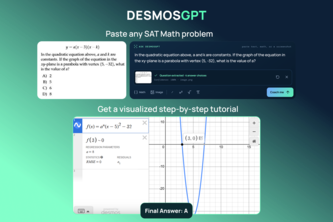
What the company appears to be: DesmosGPT is an AI-powered SAT Math tutor that teaches students how to solve problems using the fastest Desmos strategies. The author states it is built as a prototype and submitted to the OpenAI 2026 hackathon.
What changed: The project evolved from a ChatGPT + Lovable prototype to a more modular system using Codex, GPT-5.6, and AI coding agents (Cursor, Windsurf, Antigravity), with a redesigned UI and scalable technique engine.
The single most important open question: Is there evidence of any traction, revenue or customer adoption beyond the author's own development efforts?
What The Product Actually Is
The description states that DesmosGPT is an AI-powered SAT Math tutor focused on speed through Desmos. It allows students to input questions via text or screenshot and generates interactive step-by-step walkthroughs within a live Desmos calculator.
Evidence:
- "Students can type a question or simply paste a screenshot."
- "The AI identifies the problem type, selects the best Desmos technique from its knowledge base, and generates an interactive, step-by-step walkthrough inside a live Desmos calculator."
Inference: The product appears to be a web-based application integrating AI with the Desmos graphing calculator platform.
Positioning & Claim Evolution
The author positions DesmosGPT as the first AI tutor that teaches students the fastest Desmos strategy for every SAT Math problem. It claims to focus on speed and workflow optimization rather than generic math explanations.
Evidence:
- "The first AI tutor that teaches students the fastest Desmos strategy for every SAT Math problem."
- "I wanted to build an AI coach that doesn't just solve SAT Math—it teaches students how to think in Desmos."
Inference: The positioning evolved from a general AI math tutor to one specifically focused on optimizing SAT performance through Desmos.
Target Customer & ICP
The target customer is SAT students preparing for the Digital SAT, particularly those who struggle with time management during the test.
Evidence:
- "As an SAT student, I noticed that many classmates—including myself—constantly ask our teacher the same question: 'What's the fastest way to solve this in Desmos?'"
- "The next steps are expanding the knowledge base to cover every major SAT Math topic"
Inference: The primary user is a high school student preparing for the SAT, with potential expansion to broader educational markets.
Business Model & Pricing Evidence
No evidence of business model or pricing structure is provided in the description.
Evidence:
- Not evidenced.
Inference: Based on the author's own account, this appears to be an MVP built during a hackathon without any commercial implementation.
Technical & Delivery Signals
The project was built using React, TypeScript, and Vite with a modular architecture designed for scalability. It integrates AI models (ChatGPT, Codex, GPT-5.6) and supports multimodal input.
Evidence:
- "Built with (author-declared): css3, html5, json, react, tsx, typescript, vite"
- "The result is a modular system where new Desmos techniques can be added as reusable knowledge files instead of hard-coded logic."
- "Implemented multimodal input, allowing students to paste screenshots or type mathematical expressions naturally."
Inference: The technical stack suggests a modern web application with AI integration and extensible architecture.
Traction & Maturity Signals
No evidence of traction, revenue, customers, or adoption is provided beyond the author's own development efforts.
Evidence:
- "This project is still an MVP."
- "The next steps are expanding the knowledge base to cover every major SAT Math topic"
- "I iterated on the product every day."
Inference: The project remains in early-stage development and has not reached any measurable user base or commercial deployment.
Competitive Context
No evidence of competitors or market positioning is provided.
Evidence:
- Not evidenced.
Inference: Without additional context, it's unclear whether there are existing tools addressing similar needs in SAT prep or educational AI tutoring.
Open Questions & Risks
Key risks include lack of commercial traction, unproven scalability, and dependency on AI model performance. The project is described as an MVP with no revenue or customer data.
Evidence:
- "This project is still an MVP."
- "Even strong LLMs don't always choose the fastest SAT Desmos strategy."
- "No revenue, customer or traction data is available beyond what they state."
Inference: The lack of commercial validation raises concerns about market demand and product-market fit.
Questions the description leaves open
- What specific metrics or outcomes have you observed from using the tool during development?
- How do you plan to validate that your approach actually improves SAT performance?
- Have you tested the tool with real students, and what feedback did they provide?
- What is your roadmap for transitioning from MVP to a scalable product?
- Are there any partnerships or institutional relationships in place to support distribution?
Overall Assessment
Assessment: Not evidenced.
Inference: Given the lack of traction, revenue, customer data, and commercial implementation beyond the hackathon prototype, there is insufficient evidence to support an investment or partnership decision at this stage. The project appears to be in early development with no demonstrated market validation.
User Stories BotA demo video on every pull request
Get a demo video on every new feature
GitHub App that watches your pull requests and records a narrated, captioned demo.
Save time on demo prep and make informed decisions faster with a video walkthrough of every new feature.
Source
Submitted to the OpenAI 2026 hackathon on Devpost. Project home on Devpost. Back to the full gallery on Devpost.
This competitive analysis was produced by top-founders.com (opens in a new tab)
Generated by a language model from this project's public Devpost page — its tagline, the author's own write-up and any built-with tags listed there — as captured in August 2026. Short quotations are the author's words. It is an opinion on the idea as a business, not on the people behind it, and it reflects the description as published then. If the project has moved on, request a correction below. The analysis is not independent research and contains no verified traction, revenue or customer data.
An independent guide by KFG International LLC — not affiliated with, endorsed by, or connected to Devpost or OpenAI.