

Archive position — measured, not model output
0 likes on Devpost
2,263 of the 7,850 archived projects have more likes, and 5,587 share exactly 0 — so this project's #7,364 place in the like-ranked listing is a tie-break inside that group, not a ranking.
Projects (log scale)
Likes on Devpost. ▲ marks this project's group.
Show the figures
| Likes | Projects | Share of archive |
|---|---|---|
| 0 | 5,587 | 71.2% |
| 1 | 1,758 | 22.4% |
| 2 | 284 | 3.6% |
| 3–4 | 132 | 1.7% |
| 5–9 | 75 | 1.0% |
| 10+ | 14 | 0.2% |
 User Stories BotA demo video on every pull request
Get a demo video on every new feature
GitHub App that watches your pull requests and records a narrated, captioned demo.
Save time on demo prep and make informed decisions faster with a video walkthrough of every new feature.
Executive Summary
Company: Trail_Intel
Self-reported basis: The description provided by the author is limited to a tagline and a list of technologies used. No revenue, customers, or traction data are included.
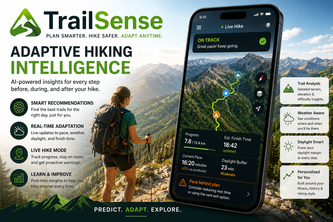
What it appears to be: A hiking trail prediction tool that uses environmental and personal data to recommend trails and adapt recommendations in real time.
What changed: The project was submitted to the OpenAI 2026 hackathon, suggesting a focus on AI-powered solutions for outdoor activities.
Single most important open question: What is the actual user base or adoption rate of this tool?
Note: This analysis is based exclusively on the self-reported description provided by the author. No external verification or historical data are available.
What The Product Actually Is
The description states that Trail_Intel "predicts how your hike will unfold using terrain, weather, daylight, fatigue, and adaptive recommendations to help you choose the best trail and adapt as conditions change."
- Claimed functionality: Predictive analytics for hiking trails based on environmental and personal factors.
- Technology stack: The author lists several technologies including Cloudflare, Mapbox, OpenAI JavaScript SDK, React, Next.js, and TypeScript.
- Inference: It appears to be a web-based or mobile application that integrates with mapping and weather APIs.
Not evidenced: No details on how the predictions are made, whether it's a mobile app, web app, or API, or if there is any user interface beyond the tech stack.
Positioning & Claim Evolution
The author positions Trail_Intel as a tool that helps hikers make informed decisions by using predictive data.
- Tagline: "Trail_Intel predicts how your hike will unfold using terrain, weather, daylight, fatigue, and adaptive recommendations to help you choose the best trail and adapt as conditions change."
- Claim evolution: The product is described as a decision-support tool for hikers that integrates AI and environmental data.
Not evidenced: No evidence of prior versions or claims, no indication of how this differs from existing hiking apps or tools.
Target Customer & ICP
The description does not specify the target customer segment or ideal customer profile (ICP).
- Inference: Likely hikers or outdoor enthusiasts who use technology to plan and adapt their trails.
- Not evidenced: No indication of demographics, user behavior, or specific market targeting.
Business Model & Pricing Evidence
There is no evidence in the description regarding a business model or pricing structure.
- Claim: The product may be offered as a free app or paid service, but this is not stated.
- Not evidenced: No mention of monetization, subscriptions, or revenue streams.
Technical & Delivery Signals
The author lists several technologies used in building the tool:
- Cloudflare
- Drizzle
- Mapbox
- Next.js
- Node.js
- Open-Meteo
- OpenAI JavaScript SDK
- React
- Tailwind
- TypeScript
- Inference: The product is likely a web application built with modern frontend and backend stacks, possibly using AI for predictive modeling.
- Not evidenced: No information on deployment, scalability, or delivery mechanism beyond the tech stack.
Traction & Maturity Signals
There is no evidence of traction or maturity in the description.
- Not evidenced: No mention of users, downloads, revenue, or product usage metrics.
- Inference: The project was submitted to a hackathon, suggesting early-stage development.
Competitive Context
The author does not provide any information on competitive landscape or existing solutions.
- Not evidenced: No mention of competitors or differentiation from existing hiking tools.
- Inference: Likely in a crowded space of outdoor and trail planning apps, but no evidence to support this.
Open Questions & Risks
Several key risks and open questions are present due to lack of evidence:
- Risk: No evidence of product-market fit or user adoption.
- Open question: The project is described as a hackathon submission — not a commercial product.
- Open question: No indication of monetization, scalability, or long-term viability.
Questions the description leaves open
- What is the actual use case for Trail_Intel? Is it for casual hikers or professionals?
- How does the tool collect and process data on terrain, weather, fatigue, etc.?
- Has there been any user testing or feedback so far?
- Are there plans to monetize this product, and how?
- What are the key assumptions behind the predictive models?
Overall Assessment
Not evidenced: No information is provided on whether this project is suitable for investment or partnership.
- Confidence level: Low — based solely on a hackathon submission with no commercial traction or evidence of product-market fit.
- Inference: If the tool progresses beyond prototype stage, it may have potential in the outdoor tech space, but current evidence does not support any conclusion about its viability or scalability.
User Stories BotA demo video on every pull request
Get a demo video on every new feature
GitHub App that watches your pull requests and records a narrated, captioned demo.
Save time on demo prep and make informed decisions faster with a video walkthrough of every new feature.
Source
Submitted to the OpenAI 2026 hackathon on Devpost. Project home on Devpost. Back to the full gallery on Devpost.
This competitive analysis was produced by top-founders.com (opens in a new tab)
Generated by a language model from this project's public Devpost page — its tagline and any built-with tags listed there, since the author published no write-up — as captured in August 2026. Short quotations are the author's words. It is an opinion on the idea as a business, not on the people behind it, and it reflects the description as published then. If the project has moved on, request a correction below. The analysis is not independent research and contains no verified traction, revenue or customer data.
An independent guide by KFG International LLC — not affiliated with, endorsed by, or connected to Devpost or OpenAI.