

Archive position — measured, not model output
0 likes on Devpost
2,263 of the 7,850 archived projects have more likes, and 5,587 share exactly 0 — so this project's #3,440 place in the like-ranked listing is a tie-break inside that group, not a ranking.
Projects (log scale)
Likes on Devpost. ▲ marks this project's group.
Show the figures
| Likes | Projects | Share of archive |
|---|---|---|
| 0 | 5,587 | 71.2% |
| 1 | 1,758 | 22.4% |
| 2 | 284 | 3.6% |
| 3–4 | 132 | 1.7% |
| 5–9 | 75 | 1.0% |
| 10+ | 14 | 0.2% |
 User Stories BotA demo video on every pull request
Get a demo video on every new feature
GitHub App that watches your pull requests and records a narrated, captioned demo.
Save time on demo prep and make informed decisions faster with a video walkthrough of every new feature.
Executive Summary
Company: CoinRadar
Self-reported basis: The description is entirely self-reported and unverified, based on a Devpost submission for the OpenAI 2026 hackathon. No independent evidence of revenue, customers, or traction exists.
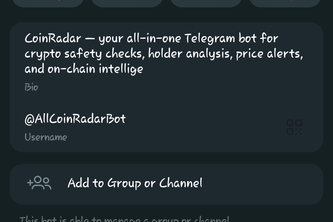
What it appears to be: A crypto monitoring tool that uses bots to detect patterns and connections in token deployments and trading behavior, aiming to surface insights that humans might miss. It is positioned as a "signalcraft" tool that goes beyond standard safety checks.
What changed: The project evolved from a simple bot merge into a broader philosophy of detecting invisible signals in crypto markets — moving from "check this token" to "here's a connection you didn't know existed."
Most important open question: Is there a real market need for such a tool, and does the author have the technical and commercial capability to build it at scale?
What The Product Actually Is
The description states that CoinRadar is a bot-based system designed to monitor crypto tokens and detect patterns or connections that are not immediately obvious. It builds on the idea of "signalcraft" — identifying insights from noise, rather than just performing standard checks like liquidity or mint authority.
It was built using json, node.js, and postgresql, and is intended for deployment on Telegram, where it delivers intelligence directly to users.
Inference: The tool appears to be a prototype or early-stage product, likely built as part of a hackathon. It is not described as having any production-ready features or commercial use cases beyond the author’s own experimentation.
Positioning & Claim Evolution
The description states that CoinRadar was born from frustration with existing crypto tools — which tell users what a token is doing but not why it matters. The tool aims to go deeper, asking questions like:
- Has this deployer burned people before?
- Is this whale backing other tokens too?
This reflects a shift in positioning: from standard safety checks to pattern detection and insight generation.
The name “CoinRadar” is said to reflect the philosophy of “crafting signal out of noise,” suggesting an emphasis on detecting hidden or overlooked signals rather than just reporting data.
Inference: The author sees CoinRadar as part of a broader "Signalcraft" approach — not just automating tasks, but surfacing previously invisible connections. However, no evidence is provided that this approach has been validated in practice or adopted by users.
Target Customer & ICP
The description states that the tool is built for crypto traders and analysts who are looking for deeper insights than what standard tools offer. It is positioned to deliver intelligence where users already spend time — Telegram, which has 900M+ users.
It targets those who manually investigate tokens, one tab at a time, and want to automate or enhance that process with pattern recognition.
Inference: The ICP (Ideal Customer Profile) appears to be experienced crypto traders or analysts who are already using Telegram for communication and want more advanced monitoring capabilities. However, no evidence of actual users or customer feedback is provided.
Business Model & Pricing Evidence
No business model or pricing information is provided in the description.
Inference: The project is described as a prototype or hackathon submission, with no indication of monetization strategy, pricing tiers, or revenue streams. It is unclear whether it will be offered as a freemium service, subscription, or one-time tool.
Technical & Delivery Signals
The project was built using:
- json
- node.js
- postgresql
It is intended for deployment on Telegram, suggesting integration with Telegram’s API and possibly bot architecture.
Inference: The technical stack suggests a lightweight, early-stage prototype. No evidence of scalability, performance metrics, or enterprise-grade infrastructure is provided. The delivery mechanism (Telegram) implies a focus on user accessibility rather than traditional SaaS platforms.
Traction & Maturity Signals
The description states that the project was submitted to the OpenAI 2026 hackathon, indicating it is likely in an early stage of development.
It was built by a single team member, Geoffry Yohanna.
There is no evidence of:
- Revenue
- Customers
- User adoption
- Product-market fit
- Any traction beyond the author’s own use case
Inference: The project is at a very early stage — likely a prototype or proof-of-concept. No signs of product maturity, user engagement, or commercial viability are evident.
Competitive Context
The description states that existing crypto tools focus on what a token is doing but not why it matters. It also mentions that safety bots check basic boxes (liquidity, mint authority) but stop before deeper insights begin.
It does not name specific competitors, nor does it describe how CoinRadar differentiates from them in terms of features or execution.
Inference: The author sees a gap in the market for tools that go beyond standard checks. However, no competitive analysis or differentiation strategy is provided. It’s unclear whether similar tools already exist or if this is a novel idea.
Open Questions & Risks
- No evidence of traction or revenue: The project is described as a hackathon submission with no commercial use.
- Single founder: The team size is listed as 1, which may limit execution capability.
- Unproven market need: No customer feedback, user data, or adoption metrics are provided.
- Early-stage prototype: No indication of scalability, performance, or long-term viability.
- No pricing or monetization strategy: Unclear how the tool will be monetized or whether it will ever reach a paid model.
Questions the description leaves open
- What specific problems are you solving for users, and how do you know they exist?
- Have you tested this idea with any real traders or analysts? If so, what feedback did you get?
- How do you plan to scale beyond a single developer and a hackathon prototype?
- What is your roadmap for monetization and product development?
- Are there existing tools in the market that already solve similar problems?
Overall Assessment
Not evidenced: The description provides no evidence of commercial traction, revenue, or customer adoption. It is unclear whether CoinRadar has any real market potential or if it’s merely an idea or prototype.
The project appears to be a conceptual or early-stage prototype, likely built as part of a hackathon. No signs of product-market fit, scalability, or monetization are evident.
Confidence level: Very low — this is a self-reported, unverified account with no external validation or evidence of real-world use.
User Stories BotA demo video on every pull request
Get a demo video on every new feature
GitHub App that watches your pull requests and records a narrated, captioned demo.
Save time on demo prep and make informed decisions faster with a video walkthrough of every new feature.
Source
Submitted to the OpenAI 2026 hackathon on Devpost. Project home on Devpost. Back to the full gallery on Devpost.
This competitive analysis was produced by top-founders.com (opens in a new tab)
Generated by a language model from this project's public Devpost page — its tagline, the author's own write-up and any built-with tags listed there — as captured in August 2026. Short quotations are the author's words. It is an opinion on the idea as a business, not on the people behind it, and it reflects the description as published then. If the project has moved on, request a correction below. The analysis is not independent research and contains no verified traction, revenue or customer data.
An independent guide by KFG International LLC — not affiliated with, endorsed by, or connected to Devpost or OpenAI.