

Archive position — measured, not model output
0 likes on Devpost
2,263 of the 7,850 archived projects have more likes, and 5,587 share exactly 0 — so this project's #3,442 place in the like-ranked listing is a tie-break inside that group, not a ranking.
Projects (log scale)
Likes on Devpost. ▲ marks this project's group.
Show the figures
| Likes | Projects | Share of archive |
|---|---|---|
| 0 | 5,587 | 71.2% |
| 1 | 1,758 | 22.4% |
| 2 | 284 | 3.6% |
| 3–4 | 132 | 1.7% |
| 5–9 | 75 | 1.0% |
| 10+ | 14 | 0.2% |
 User Stories BotA demo video on every pull request
Get a demo video on every new feature
GitHub App that watches your pull requests and records a narrated, captioned demo.
Save time on demo prep and make informed decisions faster with a video walkthrough of every new feature.
Executive Summary
Company: COLD AISLE: Data Center Tycoon
Self-reported basis: The description is entirely from the project author’s own submission to the OpenAI 2026 hackathon on Devpost. No external verification or historical data is available.
Commercial due-diligence read: This appears to be a prototype game built during a hackathon, combining elements of a tycoon simulator with first-person infrastructure management in a data center setting. It is not evidenced to have any commercial traction, revenue, or customer base. The author states the project was built using AI tools like Codex and GPT-5.6, but there is no evidence of monetization, user adoption, or business model validation.
Key open question: Is this a prototype with potential for further development into a commercial product, or a one-off hackathon experiment?
What The Product Actually Is
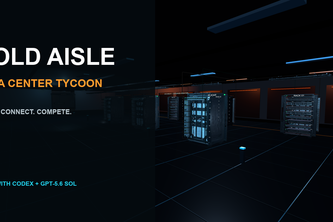
The description states that COLD AISLE: Data Center Tycoon is a data center management simulation game. Players purchase and place hardware (racks, servers, GPUs, power distribution, networking, cooling), manage contracts, and operate a data center business over time.
It includes:
- Realistic physical interactions (e.g., placing equipment, routing cables)
- Multi-day contract execution
- Capacity reservations and operational tradeoffs
- A guided tutorial and large walkable facility
Inference: The game is built in Unity 2022.3 LTS and uses AI tools like Codex and GPT-5.6 for development.
Positioning & Claim Evolution
The author positions the product as a management simulation game that places players inside the business they are building, rather than hiding infrastructure behind menus.
Claims:
- Combines clarity of a tycoon game with physical satisfaction of a first-person simulator.
- Players carry hardware, see connections, and understand capacity loss.
- The demo includes features like dynamic cable routing, multi-language UI, and encrypted saves.
Inference: This is a game prototype, not a commercial product. It was built during a hackathon and is described as a “guided first shift” with a large walkable facility.
Target Customer & ICP
The description does not state who the target customer or ideal customer profile (ICP) is. The author describes the game as a simulation, but no evidence of a defined user base, player persona, or market segment is provided.
Not evidenced: No information on who plays this, what their needs are, or how they would engage with it commercially.
Business Model & Pricing Evidence
The description does not include any information about pricing, monetization, or business model. The author states that the demo includes a guided tutorial and large facility, but no details on how users pay, if there is a subscription, or whether it’s free-to-play or paid.
Not evidenced: No revenue model, pricing structure, or monetization strategy is described.
Technical & Delivery Signals
The project was built using:
- Unity 2022.3 LTS
- C#
- Codex with GPT-5.6
- Visual assets and music from licensed sources
- Generated FBX assets
- Dynamic cable routing
- Localization in six languages
- Resolution-aware UI (1080p to 4K)
- Automated smoke tests
Inference: The development process involved a close human-AI collaboration, with Codex used for code implementation and refactoring, while the human developer tested and iterated on results.
Traction & Maturity Signals
The description states that this is a prototype built during a hackathon, and that it was extended during the Build Week challenge window. The demo includes:
- A guided first shift
- A large walkable facility
- Dynamic cable routing
- Multi-language support
- Automated validation
Not evidenced: No user engagement, downloads, or adoption data is provided. The project is described as a prototype with future roadmap items, but no evidence of traction.
Competitive Context
The description does not mention any direct competitors or the broader market context for data center management games or simulation games.
Not evidenced: No competitive analysis or positioning in a larger market is provided.
Open Questions & Risks
- Prototype only: The project is described as a hackathon prototype, with no evidence of commercial viability.
- No monetization strategy: There is no indication of how the product would generate revenue.
- Unproven market demand: No evidence of target users or user feedback.
- AI dependency: Heavy reliance on AI tools like Codex and GPT-5.6 may not be scalable or sustainable without human oversight.
Questions the description leaves open
- What is the intended commercial path for this product?
- Have you tested it with real users or players beyond the prototype stage?
- How do you plan to monetize this game, if at all?
- What are the key assumptions about user behavior and engagement that drive your development roadmap?
- Is there any evidence of interest from publishers, investors, or players in a full version?
Overall Assessment
Not evidenced: There is no evidence of commercial traction, revenue, or customer base to support an investment or partnership decision.
This project appears to be a hackathon prototype, not a product with demonstrated market demand or business viability. The author describes a strong development process involving AI tools, but there is no indication that the game has moved beyond the experimental stage or has any commercial potential at this time.
Confidence: Low — based entirely on self-reported description with no external validation or evidence of traction.
User Stories BotA demo video on every pull request
Get a demo video on every new feature
GitHub App that watches your pull requests and records a narrated, captioned demo.
Save time on demo prep and make informed decisions faster with a video walkthrough of every new feature.
Source
Submitted to the OpenAI 2026 hackathon on Devpost. Project home on Devpost. Back to the full gallery on Devpost.
This competitive analysis was produced by top-founders.com (opens in a new tab)
Generated by a language model from this project's public Devpost page — its tagline, the author's own write-up and any built-with tags listed there — as captured in August 2026. Short quotations are the author's words. It is an opinion on the idea as a business, not on the people behind it, and it reflects the description as published then. If the project has moved on, request a correction below. The analysis is not independent research and contains no verified traction, revenue or customer data.
An independent guide by KFG International LLC — not affiliated with, endorsed by, or connected to Devpost or OpenAI.