

Archive position — measured, not model output
0 likes on Devpost
2,263 of the 7,850 archived projects have more likes, and 5,587 share exactly 0 — so this project's #3,441 place in the like-ranked listing is a tie-break inside that group, not a ranking.
Projects (log scale)
Likes on Devpost. ▲ marks this project's group.
Show the figures
| Likes | Projects | Share of archive |
|---|---|---|
| 0 | 5,587 | 71.2% |
| 1 | 1,758 | 22.4% |
| 2 | 284 | 3.6% |
| 3–4 | 132 | 1.7% |
| 5–9 | 75 | 1.0% |
| 10+ | 14 | 0.2% |
 User Stories BotA demo video on every pull request
Get a demo video on every new feature
GitHub App that watches your pull requests and records a narrated, captioned demo.
Save time on demo prep and make informed decisions faster with a video walkthrough of every new feature.
Executive Summary
What the company appears to be
CoLabourHood is a self-reported neighbourhood collaboration platform built as a lightweight web app with a map-first interface. The author states it helps residents in defined neighbourhoods see local issues, propose projects, offer help, raise concerns, and work together to improve their local area.
What changed
The project was submitted to the OpenAI 2026 hackathon on Devpost. It is described as a prototype or beta-stage tool, with no evidence of revenue, customers, or traction beyond its own self-description.
Single most important open question
Is there sufficient evidence that residents in the pilot area (Ballinacurra Gardens, Oakview Drive, Greenfields, and Roundwood Estate in Limerick, Ireland) are actively using or engaging with CoLabourHood?
Note
This analysis is based entirely on the self-reported description provided by the author. No independent verification, archived data, or third-party sources were used. All claims are treated as stated by the author, not proven.
What The Product Actually Is
The description states that CoLabourHood is a map-based platform designed to help residents in a defined neighbourhood collaborate on local issues and projects. It allows users to:
- See proposed local projects on a map;
- Open dedicated pages for each project;
- Support a project;
- Offer time, skills, tools, materials, or funding pledges;
- Upload project photos;
- Suggest changes to the action plan;
- Raise constructive concerns;
- Post updates;
- Keep a transparent record of local action.
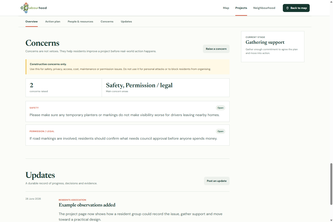
It is built as a lightweight web app, using technologies like Leaflet.js, OpenStreetMap, Supabase, Vercel, and GitHub. Each project has its own page showing details such as description, location, action plan, needs, supporters, funding pledges, concerns, and updates.
Inference The platform appears to be a prototype or early-stage tool, not yet a full-fledged product with established user engagement or monetization.
Positioning & Claim Evolution
The author states that CoLabourHood was inspired by the frustration of residents knowing what needs improving in their neighbourhood but lacking an easy way to organize with others. It positions itself as a solution to this problem, aiming to move from complaints to coordinated action.
It is described as:
- A tool for ordinary residents;
- Structured enough to coordinate real-world work;
- Open enough to avoid gatekeeping;
- Safe enough to handle concerns, privacy, and moderation.
The platform’s goal is to help neighbours stop waiting, start organising, and improve the places they live.
Claim vs Fact
The positioning is self-reported and claims a specific user need and solution. No evidence of actual adoption or impact is provided.
Target Customer & ICP
The author states that CoLabourHood targets residents in a defined neighbourhood, specifically those who know what needs improving but lack an easy way to organize with others.
The first pilot area includes:
- Ballinacurra Gardens
- Oakview Drive
- Greenfields
- Roundwood Estate
in Limerick, Ireland
Inference The target customer is a local resident in a specific geographic area. No evidence of broader market targeting or segmentation beyond this pilot.
Business Model & Pricing Evidence
The description does not contain any information about pricing, monetization, or business model. It is unclear whether CoLabourHood intends to charge users, seek funding, or operate as a non-profit platform.
Not evidenced No claims or evidence of revenue streams, pricing models, or commercial strategy.
Technical & Delivery Signals
The platform was built using the following technologies:
- Frontend: Leaflet.js, OpenStreetMap
- Backend: Supabase (authentication, database storage, profiles, projects, support, concerns, media, updates)
- Deployment: Vercel
- Version control: GitHub
- Design: Custom visual identity and logo
The author notes that the first user experience is kept simple, with core actions being:
- Support it
- Shape the plan
- Offer help
- Take action
Advanced features are available in context without overwhelming the initial interface.
Inference The platform appears to be a minimal viable product (MVP) built with modern web tools and designed for ease of use. No evidence of scalability or infrastructure beyond this MVP stage.
Traction & Maturity Signals
The project is described as a first-neighbourhood beta, with no evidence of:
- Active users
- Revenue
- Customer base
- Adoption metrics
- Product maturity beyond prototype stage
The author states that the next step is to test whether residents can use CoLabourHood to move from scattered local complaints to practical shared action.
Not evidenced No data on usage, engagement, or adoption. The platform is described as a beta, not a live product with traction.
Competitive Context
No information is provided about competitors or the broader market landscape. The description does not mention any similar tools or platforms that address local neighbourhood collaboration or civic engagement.
Not evidenced No competitive analysis or awareness of existing solutions in this space.
Open Questions & Risks
- Lack of traction and adoption: The platform is described as a beta, with no evidence of real-world usage.
- Unclear business model: No indication of how the platform will generate revenue or sustain itself.
- Verification challenges: The author acknowledges that verification of residence is difficult to balance with user experience and privacy concerns.
- No third-party validation: All claims are self-reported; there is no independent evidence of success, impact, or scalability.
Inference Without real-world usage or feedback, the platform’s viability remains unproven. Risks include low adoption, unclear monetization, and potential user trust issues around verification.
Questions the description leaves open
- What is the actual level of engagement from residents in the pilot neighbourhood?
- How are you planning to scale beyond the first neighbourhood?
- What is your long-term vision for monetization or sustainability?
- How do you plan to handle concerns and moderation without creating friction?
- Are there any partnerships or support from local government or community organizations?
- What metrics are you using to evaluate success, if any?
- How are you addressing the challenge of verifying residence while maintaining usability?
Overall Assessment
Not evidenced No information is provided about financials, traction, or commercial viability.
Assessment Based on the self-reported description alone, CoLabourHood appears to be an early-stage prototype or beta product. It has not demonstrated any measurable traction, revenue, or customer engagement. The platform’s positioning and features are described clearly, but there is no evidence of real-world impact or scalability. Any investment or partnership decision would require further validation of user adoption, business model clarity, and market demand.
User Stories BotA demo video on every pull request
Get a demo video on every new feature
GitHub App that watches your pull requests and records a narrated, captioned demo.
Save time on demo prep and make informed decisions faster with a video walkthrough of every new feature.
Source
Submitted to the OpenAI 2026 hackathon on Devpost. Project home on Devpost. Back to the full gallery on Devpost.
This competitive analysis was produced by top-founders.com (opens in a new tab)
Generated by a language model from this project's public Devpost page — its tagline, the author's own write-up and any built-with tags listed there — as captured in August 2026. Short quotations are the author's words. It is an opinion on the idea as a business, not on the people behind it, and it reflects the description as published then. If the project has moved on, request a correction below. The analysis is not independent research and contains no verified traction, revenue or customer data.
An independent guide by KFG International LLC — not affiliated with, endorsed by, or connected to Devpost or OpenAI.