

Archive position — measured, not model output
0 likes on Devpost
2,263 of the 7,850 archived projects have more likes, and 5,587 share exactly 0 — so this project's #7,365 place in the like-ranked listing is a tie-break inside that group, not a ranking.
Projects (log scale)
Likes on Devpost. ▲ marks this project's group.
Show the figures
| Likes | Projects | Share of archive |
|---|---|---|
| 0 | 5,587 | 71.2% |
| 1 | 1,758 | 22.4% |
| 2 | 284 | 3.6% |
| 3–4 | 132 | 1.7% |
| 5–9 | 75 | 1.0% |
| 10+ | 14 | 0.2% |
 User Stories BotA demo video on every pull request
Get a demo video on every new feature
GitHub App that watches your pull requests and records a narrated, captioned demo.
Save time on demo prep and make informed decisions faster with a video walkthrough of every new feature.
Executive Summary
What the company appears to be
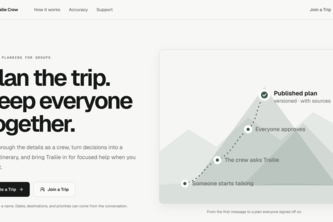
Trailie Crew is a self-reported collaborative AI trip-planning tool designed for groups to chat, decide, verify, map, and publish shared itineraries. It is positioned as part of a larger ecosystem called TrailVerse, which focuses on national parks and outdoor travel discovery and planning.
What changed
The project evolved from an earlier effort, TrailVerse, which began with park discovery and expanded into trip planning features including AI-assisted itinerary creation. Trailie Crew was introduced as the collaborative layer within that ecosystem to address group decision-making challenges in travel planning.
The single most important open question
Is there any evidence of user adoption or traction beyond the author’s own development and submission to a hackathon?
What The Product Actually Is
- The description states that Trailie Crew is a collaborative AI trip planner where groups can chat, decide, verify, map, and publish one shared itinerary.
- It allows users to create or join shared trips, discuss destinations, ask questions of an integrated AI (Trailie), pull live travel information from official sources, generate structured itineraries, view verified locations on maps, and share final versions with guests.
- The tool integrates with various APIs such as OpenWeather, Mapbox, Recreation.gov, RIDB, and others to provide real-time data.
- It supports version control, privacy controls, guest comment collection, and access revocation.
- Built using technologies like Next.js, React, Supabase, PostgreSQL, Vercel, Cloudflare, and OpenAI.
Not evidenced No information on actual usage, revenue, customer base, or product performance beyond the author’s own account.
Positioning & Claim Evolution
- The description states that Trailie Crew grew out of TrailVerse, a broader national parks and outdoor travel-planning ecosystem.
- TrailVerse started with helping people discover parks and understand current conditions, but evolved to include trip planning, alerts, weather, reservations, events, crowd insights, maps, and AI-assisted itinerary creation.
- The author claims that most group trips are currently fragmented across multiple tools (chats, notes, maps, browser tabs, booking sites, documents), creating confusion.
- Trailie Crew was created as the collaborative planning layer of the TrailVerse ecosystem to solve this fragmentation.
- The goal is to make Trailie feel less like a chatbot and more like a planning teammate inside TrailVerse.
Inference The evolution from discovery-focused tools to group collaboration suggests an attempt to capture value in both individual and collective decision-making phases of travel planning.
Not evidenced No evidence of how this positioning has been tested or validated by users, nor whether it aligns with market demand beyond the author’s perspective.
Target Customer & ICP
- The description implies that Trailie Crew targets groups planning trips together — partners, friends, families.
- These users are described as needing to align preferences, dates, budgets, routes, and ideas while navigating changing plans.
- It is positioned for people who engage in outdoor travel and national park exploration, based on the integration with Recreation.gov and RIDB.
Not evidenced No explicit identification of personas, segmentation criteria, or user research data. No evidence of target customer acquisition strategy or market validation.
Business Model & Pricing Evidence
- The description does not provide any information about pricing models, monetization strategies, or business model assumptions.
- There is no mention of subscriptions, freemium tiers, transaction fees, or other revenue streams.
- The project appears to be a hackathon submission and lacks evidence of commercial viability or financial structure.
Not evidenced No indication of how the product will generate revenue or sustain itself beyond its initial development phase.
Technical & Delivery Signals
- Built with Next.js, React, TypeScript, Supabase, PostgreSQL, Vercel, Cloudflare, OpenAI, Mapbox, OpenWeather, and others.
- Integrates with APIs from Recreation.gov, RIDB, and other travel-related services.
- Supports features like map visualization, live data pulling, version control, sharing, and comment collection.
- Uses AI agents for processing group conversations and generating summaries or itineraries.
Inference The tech stack suggests a modern web application built around real-time collaboration and AI integration.
Not evidenced No evidence of scalability, infrastructure robustness, or delivery mechanisms beyond the author’s own development efforts.
Traction & Maturity Signals
- The project is described as part of a larger ecosystem (TrailVerse) that has been under development.
- It was submitted to the OpenAI 2026 hackathon on Devpost.
- No evidence of user adoption, active customers, or revenue generation.
- No mention of product iterations, feedback loops, or growth metrics.
Not evidenced No data on traction, retention, or product maturity beyond the author’s own claims and submission to a hackathon.
Competitive Context
- The description does not include any competitive analysis or references to existing solutions in the group travel planning space.
- It assumes that current tools are fragmented and inefficient, but does not name competitors or describe how Trailie Crew differentiates itself from them.
Not evidenced No information on existing players, competitive advantages, or market positioning relative to alternatives.
Open Questions & Risks
- The entire project is self-reported and unverified; there is no independent validation of its functionality or traction.
- Submitted to a hackathon — implies early-stage development with limited real-world testing.
- No evidence of commercial viability, pricing strategy, or monetization model.
- The author is a single individual (team size: 1), raising questions about scalability and long-term maintenance.
- No indication of user feedback, product-market fit, or market demand beyond the author’s own perception.
Inference The lack of traction, revenue, or customer data raises significant concerns about whether this represents a viable business opportunity.
Questions the description leaves open
- What specific problems do you observe in group travel planning that your solution addresses?
- Have you conducted any user research or testing with actual travelers?
- How do you plan to monetize the platform once it reaches scale?
- What is the timeline for moving beyond the hackathon prototype into a production-ready product?
- Are there any existing partnerships or integrations that support your vision?
- Can you describe how you intend to build and maintain community engagement around the platform?
Overall Assessment
- The description presents Trailie Crew as a conceptual, early-stage idea built by one person for a hackathon.
- There is no evidence of traction, revenue, or customer adoption.
- The project lacks commercial due-diligence signals such as pricing models, user feedback, or market validation.
- While the concept may be relevant to group travel planning and AI integration, its current status is that of an unproven prototype.
Assessment Not ready for investment or partnership consideration without further evidence of traction, product-market fit, or business model development.
User Stories BotA demo video on every pull request
Get a demo video on every new feature
GitHub App that watches your pull requests and records a narrated, captioned demo.
Save time on demo prep and make informed decisions faster with a video walkthrough of every new feature.
Source
Submitted to the OpenAI 2026 hackathon on Devpost. Project home on Devpost. Back to the full gallery on Devpost.
This competitive analysis was produced by top-founders.com (opens in a new tab)
Generated by a language model from this project's public Devpost page — its tagline, the author's own write-up and any built-with tags listed there — as captured in August 2026. Short quotations are the author's words. It is an opinion on the idea as a business, not on the people behind it, and it reflects the description as published then. If the project has moved on, request a correction below. The analysis is not independent research and contains no verified traction, revenue or customer data.
An independent guide by KFG International LLC — not affiliated with, endorsed by, or connected to Devpost or OpenAI.