

Archive position — measured, not model output
0 likes on Devpost
2,263 of the 7,850 archived projects have more likes, and 5,587 share exactly 0 — so this project's #7,357 place in the like-ranked listing is a tie-break inside that group, not a ranking.
Projects (log scale)
Likes on Devpost. ▲ marks this project's group.
Show the figures
| Likes | Projects | Share of archive |
|---|---|---|
| 0 | 5,587 | 71.2% |
| 1 | 1,758 | 22.4% |
| 2 | 284 | 3.6% |
| 3–4 | 132 | 1.7% |
| 5–9 | 75 | 1.0% |
| 10+ | 14 | 0.2% |
 User Stories BotA demo video on every pull request
Get a demo video on every new feature
GitHub App that watches your pull requests and records a narrated, captioned demo.
Save time on demo prep and make informed decisions faster with a video walkthrough of every new feature.
Executive Summary
What the company appears to be
TradeParity Lab is a self-reported platform for beginner-friendly quantitative research in algorithmic trading, built as a single-person project during an OpenAI hackathon. It uses GPT-5.6 and Codex to convert natural-language strategy ideas into Python code, with strong emphasis on safety, reproducibility, and deterministic verification.
What changed
The author transformed an early prototype into TradeParity Studio, which now supports strategy generation, backtesting, AI/ML research, and reliability verification across multiple execution paths. It is described as a "beginner-friendly" platform that avoids broker connections and real-money risk.
The single most important open question
Is there any evidence of traction, revenue, or customer adoption beyond the author's own development work?
Note
This analysis is based entirely on the self-reported project description provided by the author. No independent verification or external data has been used. All claims are stated by the author and not confirmed.
What The Product Actually Is
The description states that TradeParity Lab is a "GPT-5.6 and Codex-powered reliability toolkit" that verifies algorithmic trading behavior across backtests, replays, simulated live runs, and broker execution.
It builds on an early prototype developed during Build Week and evolved into TradeParity Studio, which converts natural-language strategy ideas into constrained Strategy Blueprints and reviewable Python code.
Key technical components include:
- A standalone Python package with plugin contracts for strategy engines and trade managers
- A graphical Judge Console implemented in HTML/CSS/JS, served only locally
- Judge Mode that runs completely offline using synthetic fixtures
- Optional OpenAI integration via the Responses API with structured output
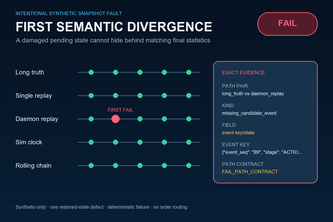
- Configurable backtesting workflows and deterministic verification through five independent execution paths
Inference The product appears to be a research tool for algorithmic trading strategies, focused on safety, reproducibility, and beginner accessibility.
Positioning & Claim Evolution
The author positions TradeParity Lab as a safer path for beginners in quantitative research. It aims to allow users to describe ideas in natural language and have Codex help generate professional, testable workflows without connecting to brokers or risking real money.
Key claims:
- The platform enables "natural-language strategy design and audited code generation"
- It enforces long-only behavior, blocks network access, and prevents automatic execution
- AI output is advisory only and cannot override deterministic gates
- The system runs completely offline with no account or API key required
Inference The positioning has evolved from a prototype to a full platform focused on safety, reproducibility, and accessibility for newcomers in algorithmic trading.
Target Customer & ICP
The author describes the target as "beginners" in quantitative research who may not yet understand strategy code, backtesting, data leakage, transaction costs, or risk controls.
It is positioned as a tool that allows users to "describe an idea in natural language" and get a professional, testable workflow without real financial risk.
Inference The primary customer segment appears to be novice quantitative researchers or developers learning algorithmic trading, with no evidence of enterprise or institutional adoption.
Business Model & Pricing Evidence
There is no evidence provided about pricing models, monetization strategies, or business model details. The description does not mention any revenue streams, subscriptions, or paid features.
Finding
Not evidenced.
Technical & Delivery Signals
The platform includes:
- A standalone Python package with plugin contracts
- Local-only graphical interface (Judge Console)
- Judge Mode that runs offline using versioned synthetic fixtures
- Optional OpenAI integration via structured API calls
- Configurable backtesting and deterministic verification through five execution paths
- 79 automated tests, GitHub Actions validation, and security auditing
Inference The technical stack suggests a research-focused, isolated development environment with strong emphasis on reproducibility and safety.
Traction & Maturity Signals
The project is described as a single-person effort developed during a hackathon. It includes:
- 79 automated tests
- GitHub Actions validation
- Package security auditing
- A complete offline "Judge Mode"
There is no evidence of customers, revenue, or usage metrics beyond the author's own development.
Finding
Not evidenced.
Competitive Context
No mention of competitors or market positioning in relation to existing platforms for algorithmic trading or quantitative research. The description does not reference similar tools or products in the space.
Finding
Not evidenced.
Open Questions & Risks
- The platform is described as a single-person project, with no team or external contributors
- It operates entirely offline and without real broker integration — this may limit its utility for actual trading
- The use of GPT-5.6 is optional and advisory only, but the core system relies on deterministic code
- No evidence of traction, revenue, or customer adoption
Inference Risk of limited scalability or commercial viability due to lack of team, real-world usage, and monetization strategy.
Questions the description leaves open
- What specific problems in quantitative research did you observe that led to building this?
- How do you plan to scale beyond a single-person development effort?
- Are there any early users or pilot partners who have tested the platform?
- What is your roadmap for monetization and commercial adoption?
- How do you intend to validate the reliability claims in real-world scenarios?
Overall Assessment
The project is described as a single-person hackathon effort with no evidence of traction, revenue, or customer base. It focuses on safety, reproducibility, and accessibility for beginners in quantitative research.
Assessment Not evidenced. No commercial due-diligence signal can be drawn from this self-reported description alone. The project lacks any demonstrated market validation or business momentum.
User Stories BotA demo video on every pull request
Get a demo video on every new feature
GitHub App that watches your pull requests and records a narrated, captioned demo.
Save time on demo prep and make informed decisions faster with a video walkthrough of every new feature.
Source
Submitted to the OpenAI 2026 hackathon on Devpost. Project home on Devpost. Back to the full gallery on Devpost.
This competitive analysis was produced by top-founders.com (opens in a new tab)
Generated by a language model from this project's public Devpost page — its tagline, the author's own write-up and any built-with tags listed there — as captured in August 2026. Short quotations are the author's words. It is an opinion on the idea as a business, not on the people behind it, and it reflects the description as published then. If the project has moved on, request a correction below. The analysis is not independent research and contains no verified traction, revenue or customer data.
An independent guide by KFG International LLC — not affiliated with, endorsed by, or connected to Devpost or OpenAI.