

Archive position — measured, not model output
1 like on Devpost
505 of the 7,850 archived projects have more likes, and 1,758 share exactly 1 — so this project's #1,470 place in the like-ranked listing is a tie-break inside that group, not a ranking.
Projects (log scale)
Likes on Devpost. ▲ marks this project's group.
Show the figures
| Likes | Projects | Share of archive |
|---|---|---|
| 0 | 5,587 | 71.2% |
| 1 | 1,758 | 22.4% |
| 2 | 284 | 3.6% |
| 3–4 | 132 | 1.7% |
| 5–9 | 75 | 1.0% |
| 10+ | 14 | 0.2% |
 User Stories BotA demo video on every pull request
Get a demo video on every new feature
GitHub App that watches your pull requests and records a narrated, captioned demo.
Save time on demo prep and make informed decisions faster with a video walkthrough of every new feature.
Executive Summary
What the company appears to be
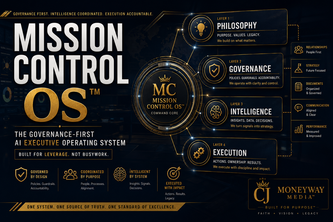
Mission Control OS™ is a self-described AI-powered executive command center designed for founders and small organizations. The author states it aims to unify strategy, operations, relationships, and growth through an AI system that operates under governance-first principles. It is described as a prototype built during a hackathon, with no verified revenue, customers or traction.
What changed
The project was submitted as part of the OpenAI 2026 hackathon. The author describes it as a "Build Week" prototype, not yet a production platform. It includes a four-layer architecture (philosophy, governance, intelligence, execution) and is intended to help leaders route work, preserve context, and prepare human teams for execution.
Single most important open question
Is there evidence that the described system can be scaled beyond a single-person prototype into an enterprise-grade solution with real organizational impact?
What The Product Actually Is
The description states that Mission Control OS™ is:
- An AI-powered executive command center
- Designed to transform conversations, meetings, documents, and organizational knowledge into coordinated enterprise intelligence
- Built for leverage—not busywork
- Organizes work through specialized executive and departmental roles rather than relying on one general-purpose assistant
- A governance-first system that begins with organizational principles before developing agents
It is described as a prototype built using:
- ChatGPT for intelligence and governance development
- Codex for formalizing intelligence into technical structures
- OpenAI API for classification and specialist execution
- Python for runtime
- JSONL for structured audit and execution records
The system is said to process directives or conversations (e.g., podcast content) and produce outputs such as:
- CEO Executive Summaries
- Leadership insights
- Content-repurposing opportunities
- Relationship intelligence
- Operational action plans
- Department-specific work products
- Searchable organizational knowledge
- Decision and execution records
It is not evidenced to be a commercial product or platform with live users or integrations.
Positioning & Claim Evolution
The author states that Mission Control OS™:
- Aims to answer the question: “What if AI could prepare an organization for its people instead of replacing them?”
- Is built around a governance-first operating model, not agents first
- Focuses on helping leadership route work, preserve context, identify tradeoffs, and prepare teams for execution
- Operates under the philosophy: “AI prepares. People lead. Organizations grow.”
It positions itself as:
- A system that helps organizations think better, lead better, and grow together
- An alternative to isolated AI assistants or chatbots
- A tool that strengthens people rather than replaces them
The claim evolution appears to move from a hackathon prototype to a vision of an enterprise-grade executive operating system. The author emphasizes the importance of shared principles, clear responsibilities, evidence standards, and human accountability in multi-agent systems.
Target Customer & ICP
The description states:
- Mission Control OS™ is built for founders, creators, media companies, nonprofits, ministries, and growing businesses
- It targets small organizations that move between strategy, operations, marketing, research, relationships, publishing, and execution
- The system is designed to help leaders make decisions by routing work appropriately and preserving institutional knowledge
It does not state specific customer segments beyond these broad categories. No evidence of actual customers or use cases outside the prototype exists.
Business Model & Pricing Evidence
There is no evidence of:
- Revenue streams
- Pricing models
- Customer acquisition strategies
- Monetization plans
The description only states that it is a prototype and that future development includes deeper workflow automation, CRM integration, and collaboration tools. The business model remains undefined.
Technical & Delivery Signals
The system is described as built using:
- ChatGPT for intelligence and governance development
- Codex for formalizing intelligence into technical structures
- OpenAI API for classification and specialist execution
- Python for runtime
- JSONL for structured audit and execution records
It uses a four-layer architecture:
- Philosophy — Mission, values, identity, fixed organizational principles
- Governance — Decision filters, escalation rules, reporting requirements, brand alignment, executive review
- Intelligence — Directive classification, departmental routing, specialist execution, review, and executive summarization
- Execution — Articles, reports, recommendations, follow-ups, logs, and other organizational work products
Features are categorized as:
- Demonstrated capabilities (e.g., podcast-to-enterprise workflow)
- Validation-required (e.g., expanded governance review)
- Roadmap items (e.g., automated revision handling)
No evidence of production-grade delivery, scalability, or integration with existing tools is provided.
Traction & Maturity Signals
The description states:
- Mission Control OS™ is a Build Week prototype
- It was submitted to the OpenAI 2026 hackathon
- No verified revenue, customers, or adoption data are available
- Some proposed capabilities require additional development and validation
There is no evidence of traction, user feedback, or market testing beyond the author’s own account.
Competitive Context
The description does not mention any direct competitors. It positions itself as an alternative to isolated AI assistants or chatbots, but there is no evidence of:
- Competitor analysis
- Market positioning against existing tools (e.g., CRM platforms, workflow automation tools, executive intelligence systems)
- Differentiation from similar concepts in the market
Open Questions & Risks
Key risks and open questions include:
- The system is described as a prototype, not a production platform
- No evidence of revenue, customers, or traction
- Lack of independent verification or third-party validation
- Heavy reliance on self-reported claims without external corroboration
- Unclear path to scalability or enterprise adoption
- No pricing, monetization, or go-to-market strategy
- The author is a single individual (1-person team), which raises questions about execution capability
Questions the description leaves open
- What specific organizational challenges does Mission Control OS™ solve that current tools do not?
- How will the system scale beyond a single-person prototype to support larger teams or organizations?
- What evidence exists of user feedback or testing with actual founders or executives?
- Are there any existing partnerships, pilot programs, or early adopters?
- What are the key assumptions in the governance-first model, and how are they validated?
- How does the system handle data privacy, security, and compliance in enterprise settings?
- What is the timeline for moving from prototype to a production-ready platform?
Overall Assessment
Mission Control OS™ is currently a single-person hackathon prototype with no verified traction, revenue, or customer base. The author's description outlines an ambitious vision of a governance-first AI operating system for executives and growing organizations.
While the concept shows potential in aligning AI with organizational principles and leadership decision-making, there is insufficient evidence to assess its commercial viability or scalability.
Confidence: Low
The project is positioned as a conceptual framework rather than a product. The lack of verified execution, customer data, or market validation makes it difficult to evaluate whether this represents a viable investment or partnership opportunity at this stage.
User Stories BotA demo video on every pull request
Get a demo video on every new feature
GitHub App that watches your pull requests and records a narrated, captioned demo.
Save time on demo prep and make informed decisions faster with a video walkthrough of every new feature.
Source
Submitted to the OpenAI 2026 hackathon on Devpost. Project home on Devpost. Back to the full gallery on Devpost.
This competitive analysis was produced by top-founders.com (opens in a new tab)
Generated by a language model from this project's public Devpost page — its tagline, the author's own write-up and any built-with tags listed there — as captured in August 2026. Short quotations are the author's words. It is an opinion on the idea as a business, not on the people behind it, and it reflects the description as published then. If the project has moved on, request a correction below. The analysis is not independent research and contains no verified traction, revenue or customer data.
An independent guide by KFG International LLC — not affiliated with, endorsed by, or connected to Devpost or OpenAI.