

Archive position — measured, not model output
1 like on Devpost
505 of the 7,850 archived projects have more likes, and 1,758 share exactly 1 — so this project's #1,472 place in the like-ranked listing is a tie-break inside that group, not a ranking.
Projects (log scale)
Likes on Devpost. ▲ marks this project's group.
Show the figures
| Likes | Projects | Share of archive |
|---|---|---|
| 0 | 5,587 | 71.2% |
| 1 | 1,758 | 22.4% |
| 2 | 284 | 3.6% |
| 3–4 | 132 | 1.7% |
| 5–9 | 75 | 1.0% |
| 10+ | 14 | 0.2% |
 User Stories BotA demo video on every pull request
Get a demo video on every new feature
GitHub App that watches your pull requests and records a narrated, captioned demo.
Save time on demo prep and make informed decisions faster with a video walkthrough of every new feature.
Executive Summary
What the company appears to be
MittiGuard is a self-reported proof-of-concept application designed to prevent premature agri-input sales by ensuring that sufficient evidence is gathered before an invoice can be approved. It uses AI to draft evidence briefs but does not make product recommendations or approve sales; instead, it enforces a policy engine that pauses transactions if critical information is missing or if prior unresolved issues exist.
What changed
The project was built as part of the OpenAI 2026 hackathon and is described as a synthetic jury demo, not a production system. It includes a server-side policy engine, mobile field capture links, and an audit trail, but lacks real-world deployment or user data.
Single most important open question
Is there any evidence that this concept has traction with actual agri-input dealers or extension teams, or that the described workflow would be adopted in practice?
What The Product Actually Is
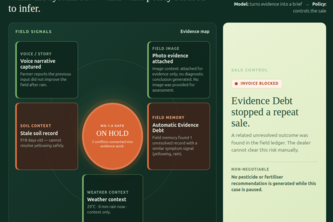
The description states that MittiGuard is a system that turns uncertain farm-input requests into evidence work. It records field details, crop stage, farmer’s story, previous input outcomes, soil reports, optional images, and weather context.
It uses Amazon Nova Pro through Amazon Bedrock to generate an editable evidence draft but does not recommend products or doses. If critical data is missing, the invoice is paused and tasks are created for human review.
The system includes:
- A server-side policy engine
- Field Memory
- Audit trail
- Mobile Field Capture links
- Evidence Debt detection (to block repeat sales)
- A Safety Bench for replaying controls
It is built with Node.js, JavaScript, HTML, CSS, and deployed on AWS Lightsail.
Not evidenced No actual product, revenue, or customer data. The system is described as a demo, not a live tool.
Positioning & Claim Evolution
The author states that the inspiration was to avoid building a disease-diagnosis app that gives confident answers — which they felt would be wrong in cases of incomplete information.
Instead, MittiGuard is positioned around the idea of “not selling blind,” where evidence must be sufficient before any sale can proceed.
It claims to separate AI’s role in organizing information from its role in making decisions. The system is designed so that:
- AI helps draft evidence
- Policy engine controls sales
- No single model response leads to a sale
Inference The positioning implies a shift from reactive, data-driven decision-making to a more cautious, evidence-based workflow — but this is not validated by real-world adoption or feedback.
Target Customer & ICP
The description states that MittiGuard targets agri-input dealers who face pressure to give quick answers when farmers present unclear crop issues.
It also mentions that the next step would involve testing with “real dealers, field workers, and extension teams.”
Not evidenced No actual customer list, user roles, or market segmentation. The target is inferred from the use case described.
Business Model & Pricing Evidence
The description does not state any pricing model or business model beyond the idea of preventing premature sales.
It mentions that the system would need to be integrated into real dealer workflows and that it would require proper user roles, secure authentication, and durable databases for production deployment.
Not evidenced No revenue streams, pricing tiers, or monetization strategy are described. The project is presented as a demo with no commercial implementation.
Technical & Delivery Signals
The system is built using:
- Node.js
- JavaScript
- HTML/CSS
- AWS Lightsail
- Amazon Bedrock (Nova Pro)
- Codex and GPT-5.6 for development
- Docker, Caddy, JSON, HMAC-SHA256
It includes:
- Server-side policy engine
- Mobile Field Capture links with bounded observation storage
- Evidence Debt detection
- Audit trail
- Safety Bench for replaying controls
Inference The use of AWS and AI tools suggests a modern tech stack, but no production-grade infrastructure or scalability data is provided.
Traction & Maturity Signals
The project is described as a “synthetic jury demo,” not a production system. It includes:
- A public live demo
- Bypass-proof UI and server-side validation
- A 45-check Safety Bench
It has no real-world users, customers, or adoption data.
Not evidenced No traction, revenue, or user feedback is reported. The project is self-reported as a hackathon submission with no evidence of real-world usage.
Competitive Context
The description does not mention any competitors or existing solutions in the agri-input or agricultural diagnostics space.
It implies that current tools may be too confident in their outputs, leading to ineffective or unsafe recommendations — but this is not substantiated by market data or competitive analysis.
Not evidenced No competitive landscape or differentiation strategy is provided.
Open Questions & Risks
- The project is described as a demo, not a production system.
- No evidence of real-world adoption or user feedback.
- The system relies on a single developer and lacks team structure or scalability.
- It uses AI tools like GPT-5.6 and Codex for development — which may not reflect long-term technical strategy.
- There is no mention of data privacy, consent, or regulatory compliance in the described workflow.
Inference The lack of real-world testing and user feedback raises questions about whether the workflow would be practical or accepted by dealers or extension teams.
Questions the description leaves open
- What specific feedback have you received from agri-input dealers or extension teams during the demo phase?
- How does the system handle edge cases, such as when a dealer intentionally bypasses a required task?
- Are there any plans to integrate with existing dealer management systems or agricultural platforms?
- What is the expected cost of deploying this system at scale?
- How do you plan to onboard and train dealers on using the system?
- Have you considered how to handle data retention, consent, and privacy for field observations?
Overall Assessment
Not evidenced.
The project is described as a hackathon demo with no revenue, customers, or traction. It presents an idea that could be valuable in agricultural sales workflows but lacks evidence of real-world application or commercial viability.
There is no indication of a scalable business model or team structure beyond one developer. The concept may have potential, but the current state is unproven and self-reported only.
Confidence level Low. The description provides no verifiable data to support any claims about traction, adoption, or scalability.
User Stories BotA demo video on every pull request
Get a demo video on every new feature
GitHub App that watches your pull requests and records a narrated, captioned demo.
Save time on demo prep and make informed decisions faster with a video walkthrough of every new feature.
Source
Submitted to the OpenAI 2026 hackathon on Devpost. Project home on Devpost. Back to the full gallery on Devpost.
This competitive analysis was produced by top-founders.com (opens in a new tab)
Generated by a language model from this project's public Devpost page — its tagline, the author's own write-up and any built-with tags listed there — as captured in August 2026. Short quotations are the author's words. It is an opinion on the idea as a business, not on the people behind it, and it reflects the description as published then. If the project has moved on, request a correction below. The analysis is not independent research and contains no verified traction, revenue or customer data.
An independent guide by KFG International LLC — not affiliated with, endorsed by, or connected to Devpost or OpenAI.