

Archive position — measured, not model output
0 likes on Devpost
2,263 of the 7,850 archived projects have more likes, and 5,587 share exactly 0 — so this project's #7,341 place in the like-ranked listing is a tie-break inside that group, not a ranking.
Projects (log scale)
Likes on Devpost. ▲ marks this project's group.
Show the figures
| Likes | Projects | Share of archive |
|---|---|---|
| 0 | 5,587 | 71.2% |
| 1 | 1,758 | 22.4% |
| 2 | 284 | 3.6% |
| 3–4 | 132 | 1.7% |
| 5–9 | 75 | 1.0% |
| 10+ | 14 | 0.2% |
 User Stories BotA demo video on every pull request
Get a demo video on every new feature
GitHub App that watches your pull requests and records a narrated, captioned demo.
Save time on demo prep and make informed decisions faster with a video walkthrough of every new feature.
Executive Summary
What the company appears to be
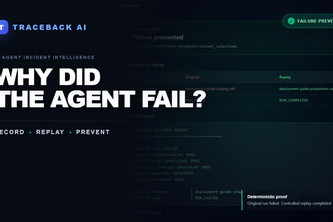
Traceback AI is a self-reported tool designed to record, reconstruct, and replay incidents involving autonomous AI agents. It claims to offer causal observability for agent-based systems by capturing observable execution trails and generating preventive controls.
What changed
The project was submitted as part of an OpenAI 2026 hackathon. The author describes a minimal viable product (MVP) demonstrating core functionality in a simulated deployment scenario, using deterministic logic to ensure reproducibility.
Single most important open question
Is there evidence that Traceback AI has moved beyond the MVP stage or demonstrated real-world applicability with actual autonomous agents?
What The Product Actually Is
The description states that Traceback AI is a flight recorder for autonomous agents, capturing observable execution events such as:
- RUN_STARTED
- CONTEXT_RETRIEVED
- PLAN_CREATED
- TOOL_COMPLETED
- VALIDATION_FAILED
- RUN_COMPLETED
It includes:
- A Python recorder SDK
- A FastAPI backend
- A React/TypeScript console
- Simulated deployment agent
- Preventive control engine
- Checkpoint replay services
- Deterministic causal-reconstruction rules
The system records 12 core event types and reconstructs failures from observable evidence, including selected context, tool inputs, validation events, and outcomes.
Inference The product is described as a lightweight monorepo with nine layers, built for local execution without cloud credentials. It uses Codex and GPT-5.6 in development but does not depend on them at runtime.
Positioning & Claim Evolution
The author positions Traceback AI as:
“The flight recorder for autonomous agents—recording observable decisions, reconstructing failures, replaying incidents, and proving preventive controls work.”
It is framed as a solution to the gap between traditional logs and understanding why an agent made a decision. The system avoids exposing hidden chain-of-thought by relying only on observable execution data.
Key claims:
- It records the full execution trail of autonomous agents.
- It reconstructs causal paths behind failures.
- It generates preventive controls.
- It replays incidents from checkpoints.
- It proves whether controls would have prevented the original failure.
Inference The positioning emphasizes causality and reproducibility over interpretability or model introspection. It is not presented as a general-purpose observability platform but rather a specialized tool for autonomous agent reliability.
Target Customer & ICP
The description does not name specific customers or personas. However, it implies:
- Organizations using autonomous AI agents in production environments.
- Teams responsible for agent reliability, incident response, and system governance.
- Developers working with LLM-based tools, frameworks like LangGraph or AutoGen, or agent orchestration platforms.
The MVP focuses on a single simulated deployment incident. The long-term vision includes adapters for various agent SDKs (e.g., OpenAI Agents SDK, LangGraph), suggesting broader applicability across agent ecosystems.
Inference The ICP likely centers around enterprise users who operate autonomous agents and need to debug, audit, or prevent failures in those systems.
Business Model & Pricing Evidence
No business model or pricing information is provided. The project is described as a hackathon submission with no mention of monetization, licensing, or commercial use cases.
Inference There is no evidence of any revenue-generating mechanism or pricing structure at this time.
Technical & Delivery Signals
The system is built using:
- Python (SDK, FastAPI)
- React/TypeScript (console)
- Docker
- Ollama for local models
- GPT-5.6 for development assistance
- Pydantic, SQLAlchemy, SQLite
- Tailwind CSS, Vite
It supports:
- Deterministic execution to enable replayability.
- Model-independent adapter architecture.
- Local deployment without cloud credentials.
The MVP demonstrates:
- 73 project files across nine layers.
- A recorder SDK with 12 event types.
- Evidence classification (observed, derived, inferred, assumed, unverified).
- Replay from context-selection checkpoint.
- Machine-readable proof report generation.
Inference The architecture is modular and designed for extensibility. It uses deterministic logic to ensure reproducibility, which may be critical for debugging or compliance use cases.
Traction & Maturity Signals
The project is described as a hackathon MVP, submitted to the OpenAI 2026 hackathon on Devpost. The author notes:
- All 22 Build Week acceptance checks passed.
- Demo runs locally without cloud credentials.
- No external customers, revenue, or adoption data are mentioned.
Inference There is no evidence of traction beyond the MVP stage. No production usage, customer feedback, or performance metrics are reported.
Competitive Context
The description does not reference direct competitors. However, it implies alignment with:
- Agent reliability and observability tools
- Incident management platforms for AI systems
- Causal reasoning frameworks for autonomous agents
It distinguishes itself from traditional logging by focusing on:
- Observable execution
- Preventive controls
- Replayable incidents
Inference The space is nascent, with limited known players. Traceback AI appears to be positioned at the intersection of agent observability and incident prevention.
Open Questions & Risks
- No real-world validation: The entire system is described as a hackathon MVP.
- Limited scope: Only one simulated incident was demonstrated; no multi-agent or cross-system integration.
- Dependency on deterministic logic: While helpful for reproducibility, it may limit scalability or applicability in complex, non-deterministic environments.
- Self-reported maturity: No third-party verification of claims or performance.
- No commercialization path: No evidence of a business model, pricing, or go-to-market strategy.
Inference The project is early-stage and lacks any demonstrated traction or commercial viability.
Questions the description leaves open
- What are the key assumptions made in the deterministic approach? How would it scale to more complex agent workflows?
- Has the system been tested with real autonomous agents beyond the MVP?
- Are there plans for integrating with existing observability or incident-response platforms?
- What is the roadmap for moving from MVP to a production-ready version?
- How does Traceback AI handle edge cases where observable data is insufficient to reconstruct causality?
Overall Assessment
Not evidenced.
The project is described as a hackathon submission with no evidence of:
- Revenue
- Customers
- Traction
- Product-market fit
- Commercial viability
Inference At this stage, there is insufficient evidence to support an investment or partnership decision. The concept shows promise in addressing a niche but growing need for agent reliability and observability, but the current offering remains experimental.
User Stories BotA demo video on every pull request
Get a demo video on every new feature
GitHub App that watches your pull requests and records a narrated, captioned demo.
Save time on demo prep and make informed decisions faster with a video walkthrough of every new feature.
Source
Submitted to the OpenAI 2026 hackathon on Devpost. Project home on Devpost. Back to the full gallery on Devpost.
This competitive analysis was produced by top-founders.com (opens in a new tab)
Generated by a language model from this project's public Devpost page — its tagline, the author's own write-up and any built-with tags listed there — as captured in August 2026. Short quotations are the author's words. It is an opinion on the idea as a business, not on the people behind it, and it reflects the description as published then. If the project has moved on, request a correction below. The analysis is not independent research and contains no verified traction, revenue or customer data.
An independent guide by KFG International LLC — not affiliated with, endorsed by, or connected to Devpost or OpenAI.