

Archive position — measured, not model output
1 like on Devpost
505 of the 7,850 archived projects have more likes, and 1,758 share exactly 1 — so this project's #1,454 place in the like-ranked listing is a tie-break inside that group, not a ranking.
Projects (log scale)
Likes on Devpost. ▲ marks this project's group.
Show the figures
| Likes | Projects | Share of archive |
|---|---|---|
| 0 | 5,587 | 71.2% |
| 1 | 1,758 | 22.4% |
| 2 | 284 | 3.6% |
| 3–4 | 132 | 1.7% |
| 5–9 | 75 | 1.0% |
| 10+ | 14 | 0.2% |
 User Stories BotA demo video on every pull request
Get a demo video on every new feature
GitHub App that watches your pull requests and records a narrated, captioned demo.
Save time on demo prep and make informed decisions faster with a video walkthrough of every new feature.
Executive Summary
Project: Messenger Across a Thousand Years
Self-reported basis: The description is entirely from the author’s own submission to the OpenAI 2026 hackathon on Devpost. No external verification or historical data is available.
Confidence level: Low — based on a single, unverified self-description and no evidence of traction, revenue, customers or product-market fit.
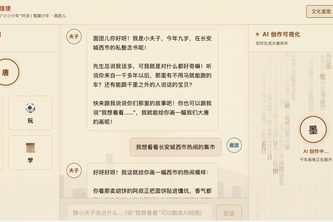
This project describes an AI-driven psychological companion that allows users to write letters to historical figures (e.g., Su Shi, Seneca) and receive therapeutic responses grounded in psychology and historical persona. The author states the goal is to use ancient wisdom to address modern anxieties. It was built as a hackathon submission using Next.js, React, Tailwind CSS, and AI tools like Coze and Doubao LLM.
The project is positioned as a healing tool, not a commercial product. No pricing, revenue or customer data are provided. The author claims to have created a warm experience rather than a robotic one, but there is no evidence of user adoption or feedback.
Single most important open question: Is this a prototype for a scalable psychological wellness product, or a creative experiment with limited commercial potential?
What The Product Actually Is
The description states:
- Messenger Across a Thousand Years is an AI-driven psychological companion.
- Users write letters to historical sages (e.g., Su Shi, Seneca) about their anxieties.
- The AI replies with empathetic, therapeutic guidance based on psychology.
Inferred from the write-up:
- It uses an AI engine built with Coze and Doubao LLM for dialog and image generation.
- Frontend is built with Next.js, React, Tailwind CSS, and Canvas animations.
Not evidenced:
- Whether the AI actually delivers personalized or therapeutic responses.
- Whether it includes voice synthesis or other interactive features beyond text.
- The extent to which historical personas are accurately portrayed.
- If the system supports multiple languages or cultural contexts.
Positioning & Claim Evolution
The author states:
- “Modern life is full of stress.”
- “We wanted to use ancient wisdom to heal modern minds.”
- “Messenger Across a Thousand Years is an AI psychological companion.”
- “Users write letters to historical sages... and the AI replies with empathetic, therapeutic guidance.”
Inferred from the write-up:
- The product is positioned as a healing tool that blends psychology and history.
- It aims to offer emotional support through the lens of timeless wisdom.
Not evidenced:
- Whether this is a new category or an evolution of existing wellness apps.
- If there are any competitors or prior art in this space.
- How the positioning differs from other AI therapy tools or historical persona bots.
Target Customer & ICP
The description states:
- Users write letters to historical sages about their anxieties.
- The product is aimed at people seeking emotional support and healing.
Inferred from the write-up:
- Likely users are individuals interested in mindfulness, self-reflection, or therapy.
- Possibly those who resonate with historical philosophy or cultural wisdom.
Not evidenced:
- Specific user segments (e.g., age, gender, income, mental health status).
- Whether there is a defined buyer persona or market research.
- If the product targets specific anxiety types or psychological conditions.
Business Model & Pricing Evidence
The description states:
- No mention of pricing, monetization, or business model.
Inferred from the write-up:
- The project was submitted as a hackathon entry; no commercial intent is evident.
- There is no indication of subscription plans, freemium models, or paid features.
Not evidenced:
- Revenue streams.
- Pricing tiers or monetization strategy.
- Any evidence of customer willingness to pay.
Technical & Delivery Signals
The description states:
- Built with Next.js, React, Tailwind CSS, and Canvas animations.
- AI engine built with Coze and Doubao LLM for dialog and image generation.
Inferred from the write-up:
- The frontend is web-based and uses modern frameworks.
- The AI component integrates with third-party LLMs.
- The system includes visual elements (Canvas animations) to enhance user experience.
Not evidenced:
- Technical architecture or scalability.
- Whether the AI responses are generated in real time or pre-recorded.
- If there are any data privacy or security measures in place.
- How the system handles user data or feedback loops.
Traction & Maturity Signals
The description states:
- This is a hackathon submission to the OpenAI 2026 hackathon.
- No mention of users, customers, or adoption metrics.
Inferred from the write-up:
- The project is in early development (a prototype).
- It has not been released to the public or tested with real users.
Not evidenced:
- Any user base or engagement data.
- Product usage statistics or retention rates.
- Feedback from early adopters or beta testers.
- Plans for product release or commercialization.
Competitive Context
The description states:
- No mention of competitors or similar products.
Inferred from the write-up:
- The project appears to be a novel concept combining AI, psychology, and historical figures.
- It may overlap with AI therapy tools or historical persona bots, but no direct comparison is made.
Not evidenced:
- Existing players in the AI psychological wellness space.
- Whether similar products already exist or have been tested.
- Competitive advantages or differentiators.
Open Questions & Risks
The description states:
- The project was built as a hackathon submission.
- No evidence of commercial viability or scalability.
Inferred from the write-up:
- Risk of being a one-off creative experiment with no path to product-market fit.
- Lack of user feedback or real-world testing.
- Potential for ethical concerns around AI-generated historical personas.
- Dependency on third-party LLMs (Coze, Doubao) may create technical or commercial risks.
Not evidenced:
- Any market validation or customer demand.
- Financial sustainability or funding plans.
- Regulatory or compliance issues in mental health tech.
Questions the description leaves open
- What is the intended user journey and how does it differ from existing AI therapy tools?
- How do you plan to validate the therapeutic value of responses from historical figures?
- Are there any ethical concerns with portraying historical figures as psychological companions?
- What are your plans for monetization or product release beyond the hackathon?
- How will you scale beyond a prototype if the idea gains traction?
Overall Assessment
The description states:
- This is a hackathon project submitted to the OpenAI 2026 hackathon.
- No evidence of commercial readiness, traction or funding.
Inferred from the write-up:
- The project is in early conceptual and prototyping stages.
- It has no demonstrated product-market fit or revenue model.
- It may be a creative idea with potential but lacks commercial viability at this stage.
Not evidenced:
- Any investment-ready metrics or milestones.
- Evidence of a scalable business model.
- Founders’ prior experience or track record in the space.
Assessment: Not investment-ready. This is an early-stage idea with no evidence of traction, revenue, or customer validation. It may be a promising concept for future development but is not yet a viable commercial product or partnership opportunity.
User Stories BotA demo video on every pull request
Get a demo video on every new feature
GitHub App that watches your pull requests and records a narrated, captioned demo.
Save time on demo prep and make informed decisions faster with a video walkthrough of every new feature.
Source
Submitted to the OpenAI 2026 hackathon on Devpost. Project home on Devpost. Back to the full gallery on Devpost.
This competitive analysis was produced by top-founders.com (opens in a new tab)
Generated by a language model from this project's public Devpost page — its tagline, the author's own write-up and any built-with tags listed there — as captured in August 2026. Short quotations are the author's words. It is an opinion on the idea as a business, not on the people behind it, and it reflects the description as published then. If the project has moved on, request a correction below. The analysis is not independent research and contains no verified traction, revenue or customer data.
An independent guide by KFG International LLC — not affiliated with, endorsed by, or connected to Devpost or OpenAI.