

Archive position — measured, not model output
0 likes on Devpost
2,263 of the 7,850 archived projects have more likes, and 5,587 share exactly 0 — so this project's #7,315 place in the like-ranked listing is a tie-break inside that group, not a ranking.
Projects (log scale)
Likes on Devpost. ▲ marks this project's group.
Show the figures
| Likes | Projects | Share of archive |
|---|---|---|
| 0 | 5,587 | 71.2% |
| 1 | 1,758 | 22.4% |
| 2 | 284 | 3.6% |
| 3–4 | 132 | 1.7% |
| 5–9 | 75 | 1.0% |
| 10+ | 14 | 0.2% |
 User Stories BotA demo video on every pull request
Get a demo video on every new feature
GitHub App that watches your pull requests and records a narrated, captioned demo.
Save time on demo prep and make informed decisions faster with a video walkthrough of every new feature.
Executive Summary
What the company appears to be
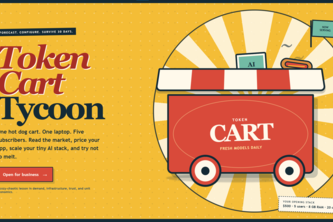
Token Cart Tycoon is a self-reported educational strategy game about managing an AI startup during its first 30 days. The author states it simulates core operational and economic decisions such as infrastructure planning, pricing, model quality, trust, and founder sanity.
What changed
The project description indicates the author iterated from an early prototype that was “cute and responsive” but lacked strategic depth. The final version includes interconnected systems like compute capacity, caching, monitoring, and dynamic events to reflect real-world trade-offs in AI product management.
Single most important open question
Is there any evidence of traction, revenue, or user adoption beyond the author’s own playtesting and development?
What The Product Actually Is
The description states that Token Cart Tycoon is a dependency-free, one-page browser game built with HTML, CSS, JavaScript, and Sol (presumably OpenAI's Codex). It simulates the first 30 days of an AI startup using:
- Forecast-driven demand
- Persistent RAM and GPU infrastructure
- Multiple model tiers with varying quality, cost, and throughput
- Subscription pricing and revenue tracking
- Caching, monitoring, and burst-compute systems
- Founder sanity and competing attention costs
- Conditional outages, trust incidents, and market events
The game is described as static, meaning no backend or external APIs are used. It was built using GPT 5.6 Sol Medium via Codex in the ChatGPT Desktop app.
Inference The product appears to be a browser-based simulation tool, not a commercial SaaS offering or marketplace. The author’s own description makes clear that this is an educational prototype, not a production-ready product.
Positioning & Claim Evolution
The author states:
- The game aims to explain what operating an AI product involves without requiring prior knowledge.
- It draws inspiration from classic management games like Hot Dog Stand but applies the structure to modern AI startups.
- The goal is to make learning fun and immersive through gameplay.
Inference This is positioned as a pedagogical tool, not a commercial product. The author emphasizes that it's about teaching, not selling.
Target Customer & ICP
The description states:
- The game targets people who want to understand AI startup operations.
- It is designed for those unfamiliar with the lingo or dynamics of AI product management.
- The author notes that the game should be accessible without prior technical or business knowledge.
Inference The target audience likely includes students, educators, aspiring founders, and early-career professionals interested in learning about AI operations through simulation.
Business Model & Pricing Evidence
Not evidenced.
There is no mention of pricing, monetization, or any commercial model in the description.
Technical & Delivery Signals
The author states:
- The game is built with semantic HTML, modern CSS, and vanilla JavaScript modules.
- It uses GPT 5.6 Sol Medium via Codex for development.
- The simulation state is separated from the interface to allow independent testing.
- All systems are data-driven and designed to be repeatable and testable.
- No paid APIs or third-party services were used.
- Visual identity was created with original CSS artwork, typography, and shapes.
Inference The technical approach is lightweight and self-contained, using only browser technologies. The use of AI tools (Codex) suggests a developer-centric development process, not a product-market fit focus.
Traction & Maturity Signals
Not evidenced.
There is no mention of users, downloads, engagement metrics, or any form of traction beyond the author’s own playtesting and iteration.
Competitive Context
The description states:
- The game draws inspiration from classic management games like Hot Dog Stand.
- It is a hackathon submission to the OpenAI 2026 hackathon.
Inference It exists within a niche of educational or gamified learning tools, but there is no evidence of direct competitors or market positioning beyond its own self-description.
Open Questions & Risks
- The project is described as a single-person hackathon effort, with no indication of team size or ongoing development.
- It is not a commercial product and lacks any revenue, customer, or adoption data.
- The author’s own description indicates that the game was intended for educational use only, not for monetization or market entry.
- No evidence of scalability, long-term vision, or business sustainability.
Questions the description leaves open
- What is the intended audience for this game beyond personal learning?
- Is there any plan to expand beyond a one-page browser simulation?
- Has the author considered how to validate that the educational outcomes are effective?
- Are there plans to monetize or commercialize this tool?
- How does the author intend to measure success or impact of the game?
Overall Assessment
Not evidenced.
There is no evidence of any investment, funding, or partnership activity beyond the author’s own development effort. The project is described as a personal hackathon submission, not a venture-ready business.
Confidence Level Low This analysis is based entirely on self-reported information with no external validation or traction data. The product is clearly an educational prototype, not a commercial entity.
User Stories BotA demo video on every pull request
Get a demo video on every new feature
GitHub App that watches your pull requests and records a narrated, captioned demo.
Save time on demo prep and make informed decisions faster with a video walkthrough of every new feature.
Source
Submitted to the OpenAI 2026 hackathon on Devpost. Project home on Devpost. Back to the full gallery on Devpost.
This competitive analysis was produced by top-founders.com (opens in a new tab)
Generated by a language model from this project's public Devpost page — its tagline, the author's own write-up and any built-with tags listed there — as captured in August 2026. Short quotations are the author's words. It is an opinion on the idea as a business, not on the people behind it, and it reflects the description as published then. If the project has moved on, request a correction below. The analysis is not independent research and contains no verified traction, revenue or customer data.
An independent guide by KFG International LLC — not affiliated with, endorsed by, or connected to Devpost or OpenAI.