

Archive position — measured, not model output
0 likes on Devpost
2,263 of the 7,850 archived projects have more likes, and 5,587 share exactly 0 — so this project's #3,391 place in the like-ranked listing is a tie-break inside that group, not a ranking.
Projects (log scale)
Likes on Devpost. ▲ marks this project's group.
Show the figures
| Likes | Projects | Share of archive |
|---|---|---|
| 0 | 5,587 | 71.2% |
| 1 | 1,758 | 22.4% |
| 2 | 284 | 3.6% |
| 3–4 | 132 | 1.7% |
| 5–9 | 75 | 1.0% |
| 10+ | 14 | 0.2% |
 User Stories BotA demo video on every pull request
Get a demo video on every new feature
GitHub App that watches your pull requests and records a narrated, captioned demo.
Save time on demo prep and make informed decisions faster with a video walkthrough of every new feature.
Executive Summary
What the company appears to be
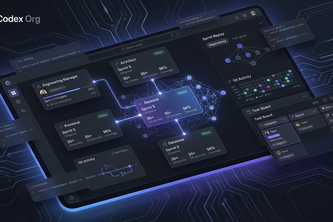
Codex Org is a self-reported project that simulates an autonomous software engineering organization using AI agents. The description states it builds a system where multiple specialized Codex agents function in roles like Engineering Manager, Architect, Frontend/Backend engineers, QA, and Security, coordinating through structured communication, Git commits, and shared state.
What changed
The author reports that the project emerged from an observation that most agentic coding demos only show one AI generating code. The goal was to explore whether real organizational structure (planning, delegation, ownership boundaries, review, retrospectives) produces better outcomes than a single agent working alone — and to test this empirically.
Single most important open question
Is there evidence of traction, revenue, or customer adoption beyond the author’s own development effort? The description does not state any such data.
What The Product Actually Is
The description states that Codex Org simulates a complete autonomous software company using AI agents. Each sprint begins with an Engineering Manager planning work, followed by roles like Architect defining technical contracts, and specialized engineers (Frontend, Backend, Database) implementing features in parallel while respecting dependency graphs.
QA validates functionality, and Security performs vulnerability reviews. Engineers own files, communicate through structured messages, produce Git commits, and update a shared project state.
A dashboard visualizes the organization in real time, showing:
- Active engineers
- Sprint progress
- Dependency graph
- Task board
- Replay timeline
- Engineering activity feed
- Git history
- Blockers
- Ownership
- Retrospectives
Each completed sprint becomes part of a permanent engineering history that can be replayed later.
The system also maintains:
- Sprint history
- Architecture decisions
- Dependency graphs
- Usage metrics
- Engineering retrospectives
- Git activity
- Replay timelines
Evidence
- The author describes the system as an "autonomous software company" with defined roles and workflows.
- It uses structured prompts, Git commits, shared state, and real-time dashboards.
- The system supports replaying engineering activity over time.
Inference The system appears to be a simulation or prototype built for demonstration purposes, not a production-ready platform.
Positioning & Claim Evolution
The author states that the inspiration came from observing how large software projects become difficult to manage with a single AI conversation. They argue that while many demos show one model writing code fast, the more interesting question is whether real organizational structure produces better outcomes than one agent working alone.
They claim to have built an autonomous engineering organization rather than a single AI coding assistant — one that coordinates specialized agents through planning, communication, ownership, and retrospectives.
Evidence
- The project was submitted to the OpenAI 2026 hackathon.
- The author explicitly contrasts their approach with “one agent grinding alone” or “theater.”
- They emphasize empirical testing of organizational workflows over code generation.
Inference The positioning is that Codex Org explores a new paradigm for AI-driven software development — one focused on structure and process, not just automation.
Target Customer & ICP
Not evidenced.
The description does not identify specific target customers or personas. It only describes the internal structure of an autonomous organization simulated by AI agents.
Evidence
- No mention of end users, clients, or customer segments.
- The focus is on demonstrating a system for autonomous software development, not selling to a market.
Business Model & Pricing Evidence
Not evidenced.
There is no indication in the description of how Codex Org would generate revenue or what pricing model it might use. It is described as a prototype or hackathon submission.
Evidence
- No mention of monetization strategies.
- No pricing information, subscriptions, or commercial offerings.
Technical & Delivery Signals
The system is built almost entirely with Python and vanilla JavaScript. The orchestrator coordinates specialized Codex agents that receive structured prompts, complete engineering work, exchange messages, update shared project state, and create Git commits.
A lightweight dashboard continuously visualizes the organization by reading the shared state and replaying engineering activity over time.
Key technical components include:
- Sprint history
- Architecture decisions
- Dependency graphs
- Usage metrics
- Engineering retrospectives
- Git activity
- Replay timelines
Evidence
- Built with Python, JavaScript, Git, SQLite, OpenAI APIs.
- Uses structured prompts and message exchange between agents.
- Maintains shared state and Git history.
Inference The system is a proof-of-concept prototype, likely built for demonstration or experimentation rather than production use.
Traction & Maturity Signals
Not evidenced.
There is no evidence of revenue, customers, user adoption, or product-market fit beyond the author’s own development effort. The project was submitted to a hackathon and described as a simulation.
Evidence
- Submitted to OpenAI 2026 hackathon.
- No mention of users, customers, or commercial traction.
- Described as a prototype with future enhancements planned.
Competitive Context
Not evidenced.
The description does not reference existing competitive products or platforms in the space of AI-driven software development or autonomous engineering organizations.
Evidence
- No mention of competitors or similar tools.
- No indication of how Codex Org fits into the broader ecosystem of AI coding tools or DevOps platforms.
Open Questions & Risks
- No commercial traction or revenue evidence: The project is described as a hackathon submission with no signs of monetization or customer adoption.
- Unproven scalability: The system simulates an organization but does not demonstrate real-world performance or handling of complex, large-scale projects.
- Limited technical depth: While it mentions structured prompts and Git integration, there is little detail on how the agents actually coordinate or resolve conflicts.
- Self-reported only: All claims are unverified; no third-party validation or data exists to support assertions about effectiveness or performance.
Evidence
- No revenue, customers, or usage metrics.
- No demonstration of real-world application beyond simulation.
- No mention of scalability or robustness in handling complex workflows.
Questions the description leaves open
- What specific problems are you trying to solve with this system? How do you plan to validate its effectiveness?
- Have you tested the system on actual software projects, or is it purely a simulation?
- Is there any data showing how this approach compares to traditional development or single-agent AI coding?
- What are your plans for transitioning from prototype to a scalable product?
- How do you intend to monetize or commercialize this platform?
Overall Assessment
Not evidenced.
There is no evidence of financials, funding rounds, or investment interest in Codex Org beyond the author’s own description and hackathon submission. No indication exists that the project has attracted investors or partners.
Evidence
- Submitted to a hackathon.
- No mention of funding, investors, or partnerships.
- No commercial traction or revenue data provided.
Inference At this stage, Codex Org appears to be an experimental prototype with no clear path to commercialization or investment readiness.
User Stories BotA demo video on every pull request
Get a demo video on every new feature
GitHub App that watches your pull requests and records a narrated, captioned demo.
Save time on demo prep and make informed decisions faster with a video walkthrough of every new feature.
Source
Submitted to the OpenAI 2026 hackathon on Devpost. Project home on Devpost. Back to the full gallery on Devpost.
This competitive analysis was produced by top-founders.com (opens in a new tab)
Generated by a language model from this project's public Devpost page — its tagline, the author's own write-up and any built-with tags listed there — as captured in August 2026. Short quotations are the author's words. It is an opinion on the idea as a business, not on the people behind it, and it reflects the description as published then. If the project has moved on, request a correction below. The analysis is not independent research and contains no verified traction, revenue or customer data.
An independent guide by KFG International LLC — not affiliated with, endorsed by, or connected to Devpost or OpenAI.