

Archive position — measured, not model output
0 likes on Devpost
2,263 of the 7,850 archived projects have more likes, and 5,587 share exactly 0 — so this project's #3,393 place in the like-ranked listing is a tie-break inside that group, not a ranking.
Projects (log scale)
Likes on Devpost. ▲ marks this project's group.
Show the figures
| Likes | Projects | Share of archive |
|---|---|---|
| 0 | 5,587 | 71.2% |
| 1 | 1,758 | 22.4% |
| 2 | 284 | 3.6% |
| 3–4 | 132 | 1.7% |
| 5–9 | 75 | 1.0% |
| 10+ | 14 | 0.2% |
 User Stories BotA demo video on every pull request
Get a demo video on every new feature
GitHub App that watches your pull requests and records a narrated, captioned demo.
Save time on demo prep and make informed decisions faster with a video walkthrough of every new feature.
Executive Summary
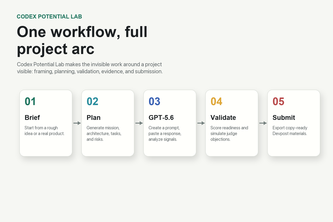
What the company appears to be: Codex Potential Lab is a self-reported tool that claims to help builders turn ideas or existing products into structured build plans, GPT-5.6 evidence traces, demo stories, readiness scores, and submission packages. It is presented as an end-to-end workflow for product development and submission, using GPT-5.6 for analysis and structuring.
What changed: The project evolved from a basic idea generator to a validation cockpit after receiving critique from GPT-5.6. This led to the addition of features like Submission Readiness Score, Build Gap Finder, and Judge Simulation.
The single most important open question: Is there evidence that Codex Potential Lab has been used beyond this hackathon submission to generate real product development workflows or validate actual products?
What The Product Actually Is
The description states that Codex Potential Lab is a tool that helps builders go from an idea to a "credible submission pack". It generates:
- Mission
- Architecture map
- Execution board
- Risks
- Checklist
- GPT-5.6 prompt
- Response analysis
- Markdown export
It includes Magic List as a case study, which existed before the project and is used to demonstrate how the tool can analyze an existing product.
The tool was built with HTML, CSS, JavaScript, and integrates with GPT-5.6 Studio for structured prompts and response analysis.
Evidence: The author states that it generates a mission, architecture map, execution board, risks, checklist, GPT-5.6 prompt, response analysis, and Markdown export. It uses GPT-5.6 Studio to analyze responses and includes Magic List as a case study.
Inference: The tool appears to be a local application designed for rapid prototyping or hackathon use, with no indication of cloud infrastructure or SaaS delivery.
Positioning & Claim Evolution
The project is positioned as a tool that helps shape the full arc of a project: product framing, implementation, quality, documentation, demo narrative, and final submission.
It started as a basic idea generator but evolved after feedback from GPT-5.6 to become a "validation cockpit" focused on readiness scoring, gap detection, and judge simulation.
Evidence: The author states that the tool was built to make end-to-end workflows visible and that it evolved after receiving critique from GPT-5.6 to include Submission Readiness Score, Build Gap Finder, and Judge Simulation.
Inference: The positioning shifted from a generative tool to one focused on validation and readiness — suggesting an evolution in intent or capability.
Target Customer & ICP
The description does not explicitly state the target customer or ideal customer profile (ICP). It implies that the tool is for "builders" who are working on ideas or products, particularly those submitting to hackathons or competitions.
Evidence: The author refers to builders going from idea to submission pack and mentions a hackathon context. No specific customer segment or persona is defined.
Inference: Likely targets include developers, product managers, or startup teams working in fast-paced environments like hackathons or early-stage product development.
Business Model & Pricing Evidence
There is no evidence of pricing, revenue model, or monetization strategy in the description. The tool appears to be a local application built for a hackathon and published on GitHub.
Evidence: The project is described as a local app built with HTML/CSS/JS and published on GitHub. No mention of pricing, subscriptions, or commercial use.
Inference: It seems to be a prototype or proof-of-concept tool, not a commercial product.
Technical & Delivery Signals
The tool was built using:
- HTML
- CSS
- JavaScript
- GPT-5.6 Studio workflow
- Local generation logic
- Image generation via Codex
It integrates with GPT-5.6 for structured prompts and response analysis, and includes a Magic List case study.
Evidence: The author states it was built with HTML/CSS/JS and uses GPT-5.6 Studio for workflows. It includes a Magic List case study and integrates image generation.
Inference: The tool is designed to be lightweight and local, suggesting minimal infrastructure or cloud dependencies.
Traction & Maturity Signals
There is no evidence of traction, customers, or adoption beyond the hackathon submission. The project was published on GitHub and submitted to a hackathon, but there are no metrics or usage data.
Evidence: The project was submitted to the OpenAI 2026 hackathon and published on GitHub. No mention of users, revenue, or product adoption.
Inference: It is a prototype or proof-of-concept with no demonstrated market traction.
Competitive Context
The description does not provide any information about competitors or how Codex Potential Lab compares to existing tools in the space. It is unclear whether similar tools exist for idea-to-submission workflows or product validation.
Evidence: No mention of competitors, market positioning, or comparison to other tools.
Inference: The tool may be unique in its approach, but there is no evidence to support this claim.
Open Questions & Risks
- Unverified claims: All features and functionality are self-reported without independent verification.
- No traction or adoption: No evidence of real-world use beyond a hackathon submission.
- Unclear commercial viability: The tool appears to be a prototype, not a scalable product.
- Over-reliance on GPT-5.6: The tool’s value is tied to a specific AI model that may not be available or stable.
Evidence: No revenue, customers, or adoption data; the tool is described as a hackathon submission with no commercial use case.
Questions the description leaves open
- What real-world use cases have you seen for this tool beyond the hackathon?
- How does Codex Potential Lab differ from existing tools in product development or idea structuring?
- Have you tested the tool with actual teams or users outside of the hackathon context?
- Is there a plan to monetize or scale this tool beyond its current prototype form?
- What are the limitations of GPT-5.6 integration, and how do you handle model instability?
Overall Assessment
Not evidenced: There is no evidence of revenue, customers, traction, or commercial viability to support an investment or partnership decision.
The project is described as a hackathon submission with no indication of market demand, product-market fit, or scalability. It appears to be a prototype or proof-of-concept, not a commercial product.
Confidence: Low — based on self-reported information only, with no external validation or evidence of traction.
User Stories BotA demo video on every pull request
Get a demo video on every new feature
GitHub App that watches your pull requests and records a narrated, captioned demo.
Save time on demo prep and make informed decisions faster with a video walkthrough of every new feature.
Source
Submitted to the OpenAI 2026 hackathon on Devpost. Project home on Devpost. Back to the full gallery on Devpost.
This competitive analysis was produced by top-founders.com (opens in a new tab)
Generated by a language model from this project's public Devpost page — its tagline, the author's own write-up and any built-with tags listed there — as captured in August 2026. Short quotations are the author's words. It is an opinion on the idea as a business, not on the people behind it, and it reflects the description as published then. If the project has moved on, request a correction below. The analysis is not independent research and contains no verified traction, revenue or customer data.
An independent guide by KFG International LLC — not affiliated with, endorsed by, or connected to Devpost or OpenAI.