

Archive position — measured, not model output
0 likes on Devpost
2,263 of the 7,850 archived projects have more likes, and 5,587 share exactly 0 — so this project's #3,394 place in the like-ranked listing is a tie-break inside that group, not a ranking.
Projects (log scale)
Likes on Devpost. ▲ marks this project's group.
Show the figures
| Likes | Projects | Share of archive |
|---|---|---|
| 0 | 5,587 | 71.2% |
| 1 | 1,758 | 22.4% |
| 2 | 284 | 3.6% |
| 3–4 | 132 | 1.7% |
| 5–9 | 75 | 1.0% |
| 10+ | 14 | 0.2% |
 User Stories BotA demo video on every pull request
Get a demo video on every new feature
GitHub App that watches your pull requests and records a narrated, captioned demo.
Save time on demo prep and make informed decisions faster with a video walkthrough of every new feature.
Executive Summary
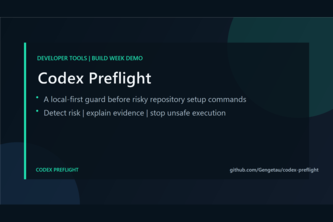
The company appears to be a solo project named Codex Preflight Guardian, submitted by 綾波 長門 for the OpenAI 2026 hackathon. The author describes it as a local-first tool that detects risky repository commands, binds repairs to approval, and verifies safety before execution — operating without external credentials or cloud backends.
What changed: This is a self-reported project submitted to a hackathon; there is no evidence of prior development, traction, or commercial activity beyond the author’s own description. It is not known whether this was ever built, tested, or deployed in any real environment.
The single most important open question: Is this a working prototype or a conceptual idea? The lack of any external validation, testing data, or product-market fit evidence makes it impossible to assess its viability or commercial potential.
What The Product Actually Is
The description states that Codex Preflight Guardian is a local-first tool designed to detect risky repository commands and verify safety before execution. It integrates with the Codex platform via a marketplace installation process using codex/v0.4.0-build-week-guardian and supports specific paths like .agents/plugins and plugins/codex-preflight.
It uses:
- Codex as its core integration platform
- FastMCP, GitHub Actions, GPT-5.6, JSON Schema, Node.js, PyInstaller, and Python
- It is built to run on Windows x64 and Linux x64 platforms
The tool is described as:
- Operating without credentials, API keys, cloud backends, or local web servers
- Using a read-only path if live probes fail
- Supporting a synthetic fixture and conformance evidence for testing
Inference: The product appears to be a security or safety guard that operates locally in a Codex environment. It is not evident whether it has been tested beyond the author’s own claims.
Positioning & Claim Evolution
The project is positioned as:
- A local-first Codex guard
- That detects risky repository commands
- That binds repairs to exact approval
- That verifies safety before execution
It is described as a "guardian" — implying it acts as a safeguard or gatekeeper in the development workflow.
The author states this was submitted for the OpenAI 2026 hackathon, suggesting that:
- It may be a prototype or proof-of-concept
- It is not yet a commercial product
Claim: The tool is designed to prevent unsafe operations in repository environments.
Inference: It targets developers or teams using Codex for local development and wants to reduce risk through pre-execution checks.
Target Customer & ICP
The description does not identify specific customer segments or personas.
It implies:
- Users of the Codex platform
- Developers working in local repository environments
- Teams seeking pre-execution safety verification
Inference: The target is likely developers or DevOps engineers using Codex, but there is no evidence of actual users, customer interviews, or market research.
Business Model & Pricing Evidence
There is no evidence of a business model or pricing structure in the description.
The author states:
- No cloud backend or API keys are required
- The tool is self-contained and local-only
- It integrates with Codex via marketplace installation
Inference: If this were to become a product, it might be offered as a local plugin, possibly free or bundled with Codex. However, no pricing or monetization strategy is described.
Technical & Delivery Signals
The project:
- Is built using Python, Node.js, JSON Schema, and PyInstaller
- Supports Windows x64 and Linux x64
- Uses Codex marketplace integration
- Does not require credentials, API keys, or cloud services
- Includes a BUILD_WEEK.md file with installation steps and synthetic fixtures
It is described as:
- A standalone workflow
- Supporting read-only paths if live probes fail
- Using mcp definitions, hook definitions, and skill definitions
Inference: The tool appears to be a local plugin or extension that integrates with Codex. It is not clear whether it has been deployed or tested in real-world environments.
Traction & Maturity Signals
There is no evidence of traction, adoption, or usage beyond the author’s own description.
The project:
- Was submitted to a hackathon
- Has no revenue data
- Has no customer base
- Has no product-market fit indicators
- Has no prior versions or releases mentioned
Inference: This is likely a conceptual or prototype-level effort, not a mature product with real-world usage.
Competitive Context
The description does not mention any competitors or direct market context.
It is implied that:
- The tool operates within the Codex ecosystem
- It may compete with or complement other local development safety tools
Inference: There is no known competitive landscape for this specific product, and no evidence of similar tools in the market.
Open Questions & Risks
- No external validation: No third-party testing, user feedback, or real-world deployment
- Solo team: Only one member listed; no indication of team capacity or scalability
- Hackathon submission: Likely a prototype or proof-of-concept, not a product
- No revenue or traction data: No evidence of monetization or adoption
- Unverified claims: All statements are self-reported and unverified
Questions the description leaves open
- Is this project a working prototype or a conceptual idea?
- Has it been tested in real-world development environments?
- What is the intended user journey from installation to execution?
- How does it handle false positives or edge cases?
- Are there any plans for commercialization or product development beyond the hackathon?
- What are the technical limitations of the local-only approach?
Overall Assessment
Not evidenced: There is no evidence of a viable business, traction, or commercial readiness.
The project appears to be a self-reported hackathon submission, with no indication of product-market fit, revenue, or adoption. It is not clear whether it has been built, tested, or deployed beyond the author’s own claims.
Confidence level: Very low. This is an unverified idea submitted for a competition, not a commercial product.
User Stories BotA demo video on every pull request
Get a demo video on every new feature
GitHub App that watches your pull requests and records a narrated, captioned demo.
Save time on demo prep and make informed decisions faster with a video walkthrough of every new feature.
Source
Submitted to the OpenAI 2026 hackathon on Devpost. Project home on Devpost. Back to the full gallery on Devpost.
This competitive analysis was produced by top-founders.com (opens in a new tab)
Generated by a language model from this project's public Devpost page — its tagline, the author's own write-up and any built-with tags listed there — as captured in August 2026. Short quotations are the author's words. It is an opinion on the idea as a business, not on the people behind it, and it reflects the description as published then. If the project has moved on, request a correction below. The analysis is not independent research and contains no verified traction, revenue or customer data.
An independent guide by KFG International LLC — not affiliated with, endorsed by, or connected to Devpost or OpenAI.