

Archive position — measured, not model output
0 likes on Devpost
2,263 of the 7,850 archived projects have more likes, and 5,587 share exactly 0 — so this project's #7,312 place in the like-ranked listing is a tie-break inside that group, not a ranking.
Projects (log scale)
Likes on Devpost. ▲ marks this project's group.
Show the figures
| Likes | Projects | Share of archive |
|---|---|---|
| 0 | 5,587 | 71.2% |
| 1 | 1,758 | 22.4% |
| 2 | 284 | 3.6% |
| 3–4 | 132 | 1.7% |
| 5–9 | 75 | 1.0% |
| 10+ | 14 | 0.2% |
 User Stories BotA demo video on every pull request
Get a demo video on every new feature
GitHub App that watches your pull requests and records a narrated, captioned demo.
Save time on demo prep and make informed decisions faster with a video walkthrough of every new feature.
Executive Summary
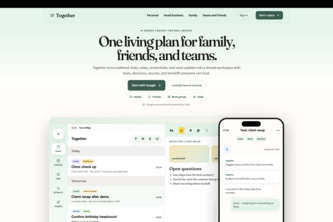
The description states that Together is a group coordination tool built around "spaces" — isolated environments for family, friends, or teams. The product allows users to create invite-only rooms with their own data and tasks, and supports natural language commands ("Tell Together") to convert plain English into structured events or tasks in the correct space. It uses a Next.js stack with Clerk authentication, Neon Postgres + Prisma, and optionally LLMs for intent parsing.
The author describes it as a "calm place where a group’s plans become owned work", aiming to reduce coordination noise by making ownership clear and context tied to tasks. The product is presented as a single-person project built during an OpenAI hackathon, with no evidence of revenue, customers or traction beyond the self-reported write-up.
The single most important open question
Is there any evidence that users actually adopt or engage with the product beyond its initial development? The description does not state whether Together has been used by real groups, nor if it has achieved any level of retention or usage beyond the hackathon context.
What The Product Actually Is
The description states that Together is a group coordination tool built around "spaces" — isolated rooms for family, friends, or teams. Each space is invite-only and fully separate from others (like Slack-style isolation). It includes:
- Spaces: Color-coded, invite-only rooms with their own people and data.
- Home: A task board with owners, due times, tags, and status pulses.
- Tell Together: Plain English commands like “Tennis at 4pm on 25th July” that land as the right event/task in the right space, in the user’s timezone.
- Calendar: Month/week/year view for shared events.
- Chat & Notes: Space chat, per-task threads, and notes so context stays with the work.
- Invites & Assignment: Share a link; assign owners so responsibility is visible.
It is built using Next.js 14 App Router, TypeScript, React, Clerk for auth, Neon Postgres + Prisma for multi-tenant space data, and Vercel for hosting. The "Tell Together" feature uses local timezone-aware intent parsing, optionally enhanced with free-tier LLMs (Groq / Gemini) when keys are present.
Inference: The product is a task-and-event management tool designed to reduce coordination friction in group settings by centralizing ownership and context.
Positioning & Claim Evolution
The description states that Together was inspired by the problem of scattered group communication: “Can you pick this up Friday?”, “Did anyone book the court?”, “Who owns the deck?” The author claims the tool aims to turn such queries into clear tasks, events, and ownership in plain English.
It positions itself as a "calm place where a group’s plans become owned work", without drowning people in another heavy productivity suite. It is described as a multi-tenant product with space isolation, and built for use by families, friends, teams, or clubs.
Inference: The positioning evolved from addressing fragmented group communication to offering a lightweight, task-centric alternative to existing tools like Slack or Notion, with an emphasis on clarity of ownership and context.
Target Customer & ICP
The description states that Together is built for groups — family, friends, teams, or clubs. Each group can create its own "space" within the product, which is fully isolated from others.
It is described as a tool for people who want to coordinate plans and tasks in a shared environment without the complexity of full productivity suites.
Inference: The ICP appears to be small groups (families, friends, work crews) that need simple coordination tools but don’t want to use heavy or fragmented platforms. No explicit customer segmentation beyond group size is described.
Business Model & Pricing Evidence
The description does not state anything about pricing, monetization, or a business model. It mentions the product was built with assistance from GPT-5.6 for the OpenAI Hackathon and that it uses free-tier services (Clerk, Neon, Vercel, optional LLMs), but no commercial structure is described.
Inference: There is no evidence of a monetization strategy or pricing model in the description.
Technical & Delivery Signals
The product is built with:
- Stack: Next.js 14 App Router, TypeScript, React
- Auth: Clerk
- Database: Neon Postgres + Prisma
- Hosting: Vercel
- LLMs: Optionally Groq / Gemini (free-tier)
- Frontend: CSS, Lucide icons, PWA support
The "Tell Together" feature uses a local timezone-aware intent parser, with optional LLM upgrades. It includes a three-pane workspace: space rail, home/calendar/chat/notes, and detail/digest pane.
Inference: The technical stack is modern and lightweight, designed for rapid development and deployment on free-tier services. The product appears to be a single-person hackathon project with no evidence of enterprise-grade infrastructure or scalability planning.
Traction & Maturity Signals
The description states that this was a project submitted to the OpenAI 2026 Hackathon and built by one developer, Saksham Ojha. It does not mention any users, customers, revenue, or adoption beyond the author’s own account.
Inference: There is no evidence of traction or product-market fit beyond its initial development phase. No data on usage, retention, or user engagement is provided.
Competitive Context
The description does not mention competitors directly. However, it positions Together as a tool for group coordination that avoids the complexity of existing tools like Slack, Notion, or Trello.
Inference: The competitive landscape likely includes tools like Slack, Notion, Google Calendar, and Trello — but no explicit comparison or differentiation from these is stated in the description.
Open Questions & Risks
- No traction or adoption evidence: The product was built for a hackathon and has no reported users or engagement.
- Single-person development: No team or external contributors are mentioned, raising questions about scalability or long-term maintenance.
- Free-tier dependency: Reliance on free-tier services (Clerk, Neon, Vercel) may not be sustainable as the product scales.
- No pricing or monetization model: The lack of a business model is a significant gap for any commercial product.
- Unproven user need: No evidence that users actually want or use this solution beyond the author’s own experience.
Questions the description leaves open
- What real-world groups are currently using Together?
- How many active users does the product have, if any?
- Are there any plans for monetization or pricing?
- What is the long-term roadmap beyond the hackathon version?
- How does Together plan to scale beyond free-tier infrastructure?
- Has the author tested the product with actual users outside of the development team?
Overall Assessment
The description states that Together was built as a hackathon project by one developer, and no evidence of traction, revenue, or commercial viability is provided.
Inference: The product has not yet demonstrated product-market fit or commercial potential. It is in an early stage with no verified users or monetization strategy.
Assessment: Not evidenced as a viable investment or partnership opportunity at this time. A follow-up evaluation would require evidence of user engagement, adoption, or revenue.
User Stories BotA demo video on every pull request
Get a demo video on every new feature
GitHub App that watches your pull requests and records a narrated, captioned demo.
Save time on demo prep and make informed decisions faster with a video walkthrough of every new feature.
Source
Submitted to the OpenAI 2026 hackathon on Devpost. Project home on Devpost. Back to the full gallery on Devpost.
This competitive analysis was produced by top-founders.com (opens in a new tab)
Generated by a language model from this project's public Devpost page — its tagline, the author's own write-up and any built-with tags listed there — as captured in August 2026. Short quotations are the author's words. It is an opinion on the idea as a business, not on the people behind it, and it reflects the description as published then. If the project has moved on, request a correction below. The analysis is not independent research and contains no verified traction, revenue or customer data.
An independent guide by KFG International LLC — not affiliated with, endorsed by, or connected to Devpost or OpenAI.