

Archive position — measured, not model output
0 likes on Devpost
2,263 of the 7,850 archived projects have more likes, and 5,587 share exactly 0 — so this project's #7,310 place in the like-ranked listing is a tie-break inside that group, not a ranking.
Projects (log scale)
Likes on Devpost. ▲ marks this project's group.
Show the figures
| Likes | Projects | Share of archive |
|---|---|---|
| 0 | 5,587 | 71.2% |
| 1 | 1,758 | 22.4% |
| 2 | 284 | 3.6% |
| 3–4 | 132 | 1.7% |
| 5–9 | 75 | 1.0% |
| 10+ | 14 | 0.2% |
 User Stories BotA demo video on every pull request
Get a demo video on every new feature
GitHub App that watches your pull requests and records a narrated, captioned demo.
Save time on demo prep and make informed decisions faster with a video walkthrough of every new feature.
Executive Summary
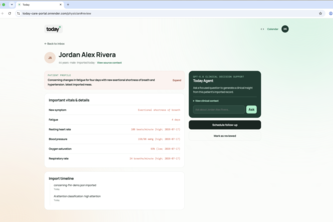
The description states that "Today" is a lightweight Node.js web application designed to help primary care clinicians process fragmented health data by offering a focused patient review experience with AI-powered insights and calendar integration. The author claims it supports Apple Health XML, FHIR JSON, and PDF imports, uses GPT-5.6 for clinical decision support, and includes a rolling calendar for scheduling follow-ups.
The project appears to be a self-contained prototype built during a hackathon, with no evidence of revenue, customers or traction beyond the author's own account. The single-person team has not yet deployed persistent storage or authentication features, which are listed as future goals.
The most important open question is whether the described AI clinical insights and triage logic can be reliably implemented at scale without compromising safety or clinical utility — particularly given the challenges noted around data structuring and AI certainty.
What The Product Actually Is
The description states that "Today" is a web application built with Node.js, featuring:
- A patient upload portal supporting Apple Health XML, FHIR JSON, and PDF clinical records.
- A physician portal with prioritized patient inbox based on concerning metrics.
- AI-powered insights generated using GPT-5.6 to evaluate imported data and suggest next steps.
- Integration with Google Calendar and Apple Calendar for scheduling follow-ups.
- A synthetic FHIR demo patient with multi-day wearable and lab data.
The author describes it as a "lightweight Node.js web application with a clean, animated frontend and a small API layer" that serves separate routes for patients and physicians. It parses structured formats like XML and JSON, creates AI-generated patient profiles, and preserves clinical context for the AI agent to reference.
Positioning & Claim Evolution
The description states that "Today" was built around the question: "who needs attention today, and why?" The author positions it as an alternative to "another dashboard full of charts", aiming instead for a "calmer, more actionable workspace that turns fragmented health data into a concise clinical starting point."
The claim evolution shows a shift from a general problem (too much data) to a specific solution (focused inbox + AI triage), with emphasis on reducing cognitive load and improving workflow efficiency. The author notes they intentionally chose an inbox experience over graph-heavy dashboards.
Target Customer & ICP
The description states that "Today" targets primary care clinicians who must make sense of large volumes of data including wearables, lab results, patient-uploaded records, and incomplete clinical context — while still protecting time for patients in front of them.
The implied ideal customer profile is a physician or clinician working in primary care settings where they need to quickly assess patient health status from multiple data sources and prioritize follow-ups.
Business Model & Pricing Evidence
Not evidenced. The description does not mention any pricing model, monetization strategy, or business model details beyond the author's own development efforts.
Technical & Delivery Signals
The description states that "Today" was built as a lightweight Node.js web application with:
- A clean, animated frontend
- Small API layer
- Separate patient and physician routes
- Parsing of Apple Health XML, FHIR JSON, and PDF-derived text
- Use of GPT-5.6 for intake classification and clinical decision support
- Deployment from GitHub to Render
- Collaboration with Codex for rapid iteration
The author notes that the application includes a synthetic FHIR demo patient with multi-day wearable and lab data for end-to-end demonstration.
Traction & Maturity Signals
Not evidenced. The description does not contain any information about revenue, customers, user adoption, or product maturity beyond the single-person development effort and hackathon submission.
Competitive Context
Not evidenced. The description does not mention existing competitors, market positioning relative to other health data platforms, or competitive landscape details.
Open Questions & Risks
- The author states that GPT-5.6 was used for clinical decision support, but notes early AI responses exposed issues with certainty and reliability when source data lacked structure.
- The application currently lacks secure persistent storage, authentication, role-based access, and longitudinal patient histories — all of which are listed as future goals.
- The project is described as a prototype built during a hackathon with no evidence of commercial traction or customer validation.
- The author's own write-up indicates that the AI output quality depends heavily on data representation, suggesting potential scalability issues if raw data sources remain unstructured.
Questions the description leaves open
- What specific clinical workflows does "Today" aim to improve, and how do you plan to validate those improvements?
- How will you ensure the reliability and safety of AI-generated insights when working with unstructured or incomplete source data?
- What are your plans for secure data storage, authentication, and compliance with healthcare regulations like HIPAA?
- Can you demonstrate a working prototype that shows how the AI triage and clinical decision support function in practice?
- How do you plan to scale beyond the current single-person development model?
Overall Assessment
Not evidenced. The description provides no information about funding rounds, valuations, or investment interest — only the author's own account of a hackathon project. No commercial due-diligence signals are present to support an investment or partnership assessment.
User Stories BotA demo video on every pull request
Get a demo video on every new feature
GitHub App that watches your pull requests and records a narrated, captioned demo.
Save time on demo prep and make informed decisions faster with a video walkthrough of every new feature.
Source
Submitted to the OpenAI 2026 hackathon on Devpost. Project home on Devpost. Back to the full gallery on Devpost.
This competitive analysis was produced by top-founders.com (opens in a new tab)
Generated by a language model from this project's public Devpost page — its tagline, the author's own write-up and any built-with tags listed there — as captured in August 2026. Short quotations are the author's words. It is an opinion on the idea as a business, not on the people behind it, and it reflects the description as published then. If the project has moved on, request a correction below. The analysis is not independent research and contains no verified traction, revenue or customer data.
An independent guide by KFG International LLC — not affiliated with, endorsed by, or connected to Devpost or OpenAI.