

Archive position — measured, not model output
1 like on Devpost
505 of the 7,850 archived projects have more likes, and 1,758 share exactly 1 — so this project's #1,423 place in the like-ranked listing is a tie-break inside that group, not a ranking.
Projects (log scale)
Likes on Devpost. ▲ marks this project's group.
Show the figures
| Likes | Projects | Share of archive |
|---|---|---|
| 0 | 5,587 | 71.2% |
| 1 | 1,758 | 22.4% |
| 2 | 284 | 3.6% |
| 3–4 | 132 | 1.7% |
| 5–9 | 75 | 1.0% |
| 10+ | 14 | 0.2% |
 User Stories BotA demo video on every pull request
Get a demo video on every new feature
GitHub App that watches your pull requests and records a narrated, captioned demo.
Save time on demo prep and make informed decisions faster with a video walkthrough of every new feature.
Executive Summary
What the company appears to be
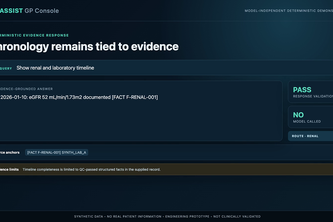
MD_ASSIST is a solo-developed project that claims to transform scattered patient records into concise, clinician-ready summaries using AI. It is positioned as a tool for preparing clinicians before visits, not for diagnosing or prescribing.
What changed
The project emerged from one developer’s personal frustration with inefficient clinical data retrieval during specialist visits. It was built rapidly as a prototype using AI tools like Codex and GPT-5.6, with no evidence of prior traction, revenue, or customer adoption.
Single most important open question
Is there sufficient evidence that clinicians will adopt this tool in real-world settings, or is it still an unvalidated concept?
What The Product Actually Is
The description states:
- MD_ASSIST is designed to turn scattered patient-provided health information into a concise, clinician-ready brief.
- It supports preparation and communication; it does not replace a clinician, diagnose disease, or prescribe treatment.
- The system uses synthetic medical records for development and demonstration.
Inference It appears to be an AI-powered summarization tool aimed at improving clinical workflow efficiency by pre-processing patient data.
Not evidenced No actual product functionality, user interface, or real-world usage details are provided beyond the prototype stage.
Positioning & Claim Evolution
The description states:
- The inspiration came from a frustrating experience where physicians spent 20–30 minutes reconstructing medical history.
- MD_ASSIST aims to reduce time spent on information gathering so clinicians can focus on care.
- It emphasizes that better clinical encounters don’t require more data, but the right information at the right time.
Inference The positioning evolved from a personal pain point into a solution for improving clinical efficiency through AI-assisted summarization.
Not evidenced There is no evidence of prior market research, competitive positioning, or feedback loops with actual clinicians.
Target Customer & ICP
The description states:
- The target users are clinicians (e.g., specialists) who need to prepare for patient visits.
- It supports preparation and communication, not diagnosis or treatment.
Inference The primary customer is a healthcare professional preparing for a clinical encounter.
Not evidenced No specific ICP defined, no segmentation of types of clinicians, or evidence of how the tool would be integrated into existing workflows.
Business Model & Pricing Evidence
The description states:
- No mention of pricing, licensing, or monetization strategy.
- The project is described as a prototype built by one person.
Inference There is no business model evident at this stage.
Not evidenced No revenue streams, customer acquisition plans, or pricing models are mentioned.
Technical & Delivery Signals
The description states:
- Built with Codex, GPT-5.6, Next.js, React, Tailwind CSS, TypeScript, Vite, and Cloudflare.
- Used synthetic patients and records for privacy during development.
- Created documented evaluations to test system behavior and usefulness.
- The developer used Codex for rapid iteration across workflow, implementation, testing, and documentation.
Inference The technical stack suggests a modern web-based AI application with emphasis on rapid prototyping.
Not evidenced No information about scalability, infrastructure, or production deployment readiness.
Traction & Maturity Signals
The description states:
- Built a working end-to-end prototype as a solo developer.
- Produced a complete demonstration video.
- Used synthetic records and patients throughout the demo workflow.
- Created documented evaluations for repeatable testing.
- Established a clear boundary between information preparation and clinical decision-making.
Inference The project is at an early stage, likely a hackathon prototype with no real-world deployment or adoption.
Not evidenced No evidence of user feedback, product usage metrics, or customer validation beyond internal testing.
Competitive Context
The description states:
- No mention of existing tools or competitors in the space.
Inference It is unclear whether similar tools already exist or how this project differentiates from them.
Not evidenced No competitive analysis, market positioning, or differentiation strategy is provided.
Open Questions & Risks
The description states:
- Privacy and safety were treated as product requirements from the start.
- Challenges included balancing compression with clinical usefulness and avoiding presenting generated text as medical judgment.
Inference There are inherent risks in AI-assisted clinical tools, particularly around accuracy, trustworthiness, and regulatory compliance.
Open questions
- No evidence of regulatory review or clinical validation.
- The tool is described as a prototype with no real-world testing.
- One-person team implies limited capacity for scaling or iteration.
Questions the description leaves open
- What specific clinical workflows does MD_ASSIST aim to improve, and how will it integrate into current systems?
- How do you plan to validate the accuracy of generated summaries with real clinicians?
- Are there any regulatory or compliance considerations that have been addressed in the prototype?
- What is your roadmap for moving from a prototype to a production-ready product?
- Have you considered how to handle edge cases where patient data may be incomplete or ambiguous?
Overall Assessment
The description states:
- The project was submitted to an OpenAI hackathon and is described as a solo effort.
- No evidence of revenue, customers, or traction beyond the prototype stage.
Inference This is a very early-stage idea with no commercial viability demonstrated.
Not evidenced No financials, customer base, or strategic partnerships are evident. The project lacks any signs of product-market fit or scalability potential at this point.
User Stories BotA demo video on every pull request
Get a demo video on every new feature
GitHub App that watches your pull requests and records a narrated, captioned demo.
Save time on demo prep and make informed decisions faster with a video walkthrough of every new feature.
Source
Submitted to the OpenAI 2026 hackathon on Devpost. Project home on Devpost. Back to the full gallery on Devpost.
This competitive analysis was produced by top-founders.com (opens in a new tab)
Generated by a language model from this project's public Devpost page — its tagline, the author's own write-up and any built-with tags listed there — as captured in August 2026. Short quotations are the author's words. It is an opinion on the idea as a business, not on the people behind it, and it reflects the description as published then. If the project has moved on, request a correction below. The analysis is not independent research and contains no verified traction, revenue or customer data.
An independent guide by KFG International LLC — not affiliated with, endorsed by, or connected to Devpost or OpenAI.