

Archive position — measured, not model output
0 likes on Devpost
2,263 of the 7,850 archived projects have more likes, and 5,587 share exactly 0 — so this project's #7,287 place in the like-ranked listing is a tie-break inside that group, not a ranking.
Projects (log scale)
Likes on Devpost. ▲ marks this project's group.
Show the figures
| Likes | Projects | Share of archive |
|---|---|---|
| 0 | 5,587 | 71.2% |
| 1 | 1,758 | 22.4% |
| 2 | 284 | 3.6% |
| 3–4 | 132 | 1.7% |
| 5–9 | 75 | 1.0% |
| 10+ | 14 | 0.2% |
 User Stories BotA demo video on every pull request
Get a demo video on every new feature
GitHub App that watches your pull requests and records a narrated, captioned demo.
Save time on demo prep and make informed decisions faster with a video walkthrough of every new feature.
Executive Summary
What the company appears to be
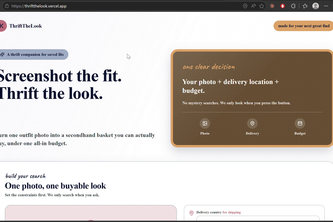
ThriftTheLook is a self-reported project that claims to turn an outfit photo into complete, delivery-aware secondhand look options using eBay inventory. It is described as a tool for users to upload an outfit image, set a budget and delivery location, and receive curated matches under the budget.
What changed
This is a hackathon submission (submitted to OpenAI 2026). No prior version or product history is evidenced. The project is described as a proof-of-concept with no commercial traction, revenue, or customer data.
The single most important open question
Is there evidence of any real-world usage, user feedback, or monetization model beyond the self-reported hackathon submission?
What The Product Actually Is
The description states that ThriftTheLook:
- Turns one outfit photo into complete, delivery-aware secondhand look options.
- Identifies visible pieces in an outfit image.
- Searches official eBay inventory for matches.
- Assembles complete look options under a user-defined budget.
- Shows item price and shipping for each listing.
- Allows switching between look options, inspecting match reasoning, and clicking through to eBay listings.
The app is built using:
- Frontend: Next.js 15, TypeScript, Tailwind CSS
- Backend: FastAPI
- Vision pipeline: Uses structured outputs to decompose outfits into garment slots and assess matches.
- Solver logic: A deterministic Python solver (not an LLM) that chooses baskets based on delivered prices.
- Streaming: Server-Sent Events for progress updates.
Inference The product is described as a visual search tool, not a marketplace or e-commerce platform. It aggregates secondhand items from eBay and presents them in a curated way.
Positioning & Claim Evolution
The author states:
- The project started with the question: “What if an outfit screenshot could become a secondhand basket you can actually buy—not a loose collection of similar items?”
- It is positioned as solving the problem of recreating outfits secondhand, which usually involves tab-switching and budget overruns.
- The app is described as using official eBay APIs rather than scraping.
- It emphasizes delivery-aware totals, complete look options, and explainable decisions.
Inference The positioning appears to be a niche solution for fashion enthusiasts or thrift shoppers who want to recreate looks from images. It is not described as a general visual search tool or marketplace aggregator.
Target Customer & ICP
The description does not state:
- Who the target customer is.
- Whether the app is aimed at individual users, retailers, or fashion influencers.
- Any segmentation or persona details.
Not evidenced No explicit customer profile or ideal customer profile (ICP) is described.
Business Model & Pricing Evidence
The description states:
- The app uses official eBay APIs.
- It shows delivery totals and shipping costs for each item.
- Users can set a budget and receive options under that budget.
- No pricing model, monetization strategy, or revenue streams are mentioned.
Inference There is no evidence of a business model beyond the hackathon submission. The app appears to be a prototype with no stated monetization path.
Technical & Delivery Signals
The description states:
- Built with Next.js 15 and TypeScript.
- Backend built on FastAPI.
- Uses eBay Browse API with OAuth, retries, and cached queries.
- Vision pipeline uses structured outputs for garment decomposition.
- A deterministic Python solver chooses baskets based on delivered prices.
- Streaming via Server-Sent Events.
- Client-side image optimization to handle serverless upload limits.
- Offline demo mode available.
Inference The technical stack is modern and well-suited for a web-based visual search tool. The use of official APIs, structured outputs, and deterministic logic suggests an attempt at reliability and explainability.
Traction & Maturity Signals
The description states:
- This is a hackathon submission (OpenAI 2026).
- No revenue, customers, or adoption data are provided.
- The app includes an offline demo mode.
- It was built by one person (Marwan AbdElhameed).
Not evidenced No evidence of user traction, customer feedback, or product maturity beyond the hackathon prototype.
Competitive Context
The description does not state:
- Who the competitors are.
- Whether similar tools exist in the market.
- How this differs from existing visual search or secondhand platforms.
Not evidenced No competitive analysis or positioning relative to other tools is provided.
Open Questions & Risks
- Unproven commercial viability: The project is a hackathon submission with no evidence of traction, revenue, or user adoption.
- Limited team size: Only one developer is mentioned, which may limit scalability and product development speed.
- No monetization model: No indication of how the product would generate revenue.
- Dependency on eBay API: Reliance on a single marketplace API limits flexibility and introduces risk if access changes.
- Unverified claims: All descriptions are self-reported and unverified.
Questions the description leaves open
- What is the intended user base, and how did you identify them?
- How do you plan to monetize this product beyond the hackathon prototype?
- Have you validated the matching quality with real users or licensed outfit photos?
- What are your plans for scaling beyond a single developer?
- Are there any legal or compliance concerns around using eBay APIs or visual search of outfits?
Overall Assessment
Not evidenced There is no evidence of commercial traction, revenue, or customer data to assess viability for investment or partnership.
The project is described as a hackathon submission with no prior version or product history. The author states that it is a proof-of-concept and not yet monetized or deployed in production.
Confidence level Low This analysis is based entirely on self-reported, unverified information. No third-party data, revenue figures, or user feedback are available to support any commercial assessment.
User Stories BotA demo video on every pull request
Get a demo video on every new feature
GitHub App that watches your pull requests and records a narrated, captioned demo.
Save time on demo prep and make informed decisions faster with a video walkthrough of every new feature.
Source
Submitted to the OpenAI 2026 hackathon on Devpost. Project home on Devpost. Back to the full gallery on Devpost.
This competitive analysis was produced by top-founders.com (opens in a new tab)
Generated by a language model from this project's public Devpost page — its tagline, the author's own write-up and any built-with tags listed there — as captured in August 2026. Short quotations are the author's words. It is an opinion on the idea as a business, not on the people behind it, and it reflects the description as published then. If the project has moved on, request a correction below. The analysis is not independent research and contains no verified traction, revenue or customer data.
An independent guide by KFG International LLC — not affiliated with, endorsed by, or connected to Devpost or OpenAI.