

Archive position — measured, not model output
1 like on Devpost
505 of the 7,850 archived projects have more likes, and 1,758 share exactly 1 — so this project's #1,400 place in the like-ranked listing is a tie-break inside that group, not a ranking.
Projects (log scale)
Likes on Devpost. ▲ marks this project's group.
Show the figures
| Likes | Projects | Share of archive |
|---|---|---|
| 0 | 5,587 | 71.2% |
| 1 | 1,758 | 22.4% |
| 2 | 284 | 3.6% |
| 3–4 | 132 | 1.7% |
| 5–9 | 75 | 1.0% |
| 10+ | 14 | 0.2% |
 User Stories BotA demo video on every pull request
Get a demo video on every new feature
GitHub App that watches your pull requests and records a narrated, captioned demo.
Save time on demo prep and make informed decisions faster with a video walkthrough of every new feature.
Executive Summary
What the company appears to be
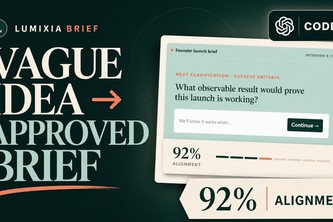
Lumixia Brief is a self-reported SaaS product that uses AI (specifically GPT-5.6) to guide users through an adaptive interview process to turn vague project ideas into structured, versioned briefs. The tool integrates with Notion and is built as a web application using React, Express.js, Supabase, and OpenAI APIs.
What changed
The author states this was built for the OpenAI 2026 hackathon, suggesting it's an early-stage prototype or proof-of-concept rather than a commercial product. There is no evidence of prior versions, funding, or market traction.
Single most important open question
Is there any evidence that Lumixia Brief has been used beyond the hackathon context, or whether it will evolve into a commercial offering?
Note
This analysis is based solely on the self-reported project description provided by the author. No independent verification, revenue data, customer names, or traction metrics are available.
What The Product Actually Is
The description states that Lumixia Brief:
- Turns vague project ideas into structured, versioned briefs.
- Uses an adaptive interview process with 5–12 questions.
- Provides a confidence score across eight dimensions: Problem, Audience, Outcome, Scope, Constraints, Timeline, Risks, and Success criteria.
- Syncs approved briefs to Notion.
- Is built using React, Express.js, Supabase, OpenAI GPT-5.6, and other technologies.
Inference The product appears to be a guided AI-assisted tool for generating project briefs, not a general-purpose AI assistant or document generator.
Claim
The author claims the tool uses GPT-5.6 with structured outputs.
Evidence Yes — stated in the "How we built it" section.
Positioning & Claim Evolution
The description states:
- The product is positioned as an alternative to “generate first, ask questions never.”
- It believes that a good brief isn’t written, it’s interviewed into existence.
- It emphasizes explainability and testability over black-box AI decision-making.
Inference The positioning is focused on improving clarity and alignment in early-stage project definition, especially for teams dealing with vague or ambiguous ideas.
Claim
Lumixia Brief aims to reduce ambiguity in idea-to-brief conversion.
Evidence Yes — stated in the “Inspiration” section.
Target Customer & ICP
The description states:
- The target audience includes founders, product managers (PMs), and agency teams.
- It addresses a common problem: when someone drops a one-line idea into a document, downstream teams must guess what it means.
Inference The primary customer segment is internal or external stakeholders who need to define and align on project scope early in the process.
Claim
The product targets PMs, founders, and agency teams.
Evidence Yes — stated in the “Inspiration” section.
Business Model & Pricing Evidence
The description does not provide any information about:
- Revenue model
- Pricing structure
- Monetization strategy
- Customer acquisition or retention plans
Inference No evidence of a business model or pricing is available beyond the fact that this was built for a hackathon.
Claim
There is no stated business model or pricing.
Evidence Not evidenced — the description does not mention any commercial aspects.
Technical & Delivery Signals
The description states:
- Built with React 19 + Vite, Express.js, Supabase, Docker, GitHub Actions, Sentry, Playwright, Zod, and more.
- Uses GPT-5.6 via OpenAI API with structured outputs.
- Implements a Codex MCP integration for local development without API costs.
- Includes full test coverage (unit, E2E, RLS) and audit trails (Build Ledger, ADRs).
- Supports multi-language (EN/TH) and mobile/desktop support.
Inference The technical stack suggests a modern, secure, and testable web application with strong developer practices.
Claim
The product is built using modern full-stack technologies.
Evidence Yes — detailed in the “How we built it” section.
Traction & Maturity Signals
The description states:
- The app can go from a vague one-line idea to an approved, Notion-synced brief in under three minutes.
- It includes a production-ready Codex integration that avoids API costs.
- It has 85%+ line/function coverage on the server and stricter security gates.
Inference The product is mature enough for a hackathon submission but lacks evidence of real-world usage or adoption.
Claim
The app is fast, secure, and tested.
Evidence Yes — stated in “Accomplishments that we're proud of.”
Competitive Context
The description does not mention:
- Competitors
- Market positioning relative to existing tools
- Differentiation from similar AI-based brief or planning tools
Inference No competitive context is provided.
Claim
No competitive analysis or market differentiation is evident.
Evidence Not evidenced — the description does not reference competitors or markets.
Open Questions & Risks
The description states:
- The team size is one person (Aitthikorn Khammee).
- It was built for a hackathon, suggesting limited time and resources.
- No paid OpenAI credits during development; workaround involved Codex MCP.
- Auth migration mid-build due to deadline pressure.
Inference Key risks include:
- Lack of team scale or support for long-term development.
- Dependency on a single developer.
- Potential instability from rapid changes or untested integrations.
- Unclear path to commercial viability or scalability.
Claim
The product is a solo-developer hackathon project with no clear roadmap.
Evidence Yes — stated in the “What we learned” and “Challenges we ran into” sections.
Questions the description leaves open
- What is your plan for scaling beyond this hackathon prototype?
- Are you planning to monetize this tool, and if so, how?
- How do you intend to acquire users or customers post-hackathon?
- What are the key assumptions in your value proposition that you’re testing?
- Do you have any early adopters or feedback from potential users?
- How do you plan to handle data privacy and compliance (especially with Supabase + Notion integrations)?
- What is the timeline for moving from prototype to product-market fit?
Note
These questions are based on the lack of evidence around traction, business model, and commercial strategy.
Overall Assessment
The description states that this was built as a hackathon submission and does not indicate any funding, revenue, or customer adoption. There is no evidence of:
- Commercial traction
- Revenue streams
- Market validation
- Product-market fit beyond the prototype stage
Inference This appears to be an early-stage idea or prototype with no demonstrated commercial viability or market readiness.
Claim
No investment or partnership opportunity is evident at this time.
Evidence Not evidenced — the description does not suggest any commercial development or traction.
User Stories BotA demo video on every pull request
Get a demo video on every new feature
GitHub App that watches your pull requests and records a narrated, captioned demo.
Save time on demo prep and make informed decisions faster with a video walkthrough of every new feature.
Source
Submitted to the OpenAI 2026 hackathon on Devpost. Project home on Devpost. Back to the full gallery on Devpost.
This competitive analysis was produced by top-founders.com (opens in a new tab)
Generated by a language model from this project's public Devpost page — its tagline, the author's own write-up and any built-with tags listed there — as captured in August 2026. Short quotations are the author's words. It is an opinion on the idea as a business, not on the people behind it, and it reflects the description as published then. If the project has moved on, request a correction below. The analysis is not independent research and contains no verified traction, revenue or customer data.
An independent guide by KFG International LLC — not affiliated with, endorsed by, or connected to Devpost or OpenAI.