

Archive position — measured, not model output
0 likes on Devpost
2,263 of the 7,850 archived projects have more likes, and 5,587 share exactly 0 — so this project's #7,271 place in the like-ranked listing is a tie-break inside that group, not a ranking.
Projects (log scale)
Likes on Devpost. ▲ marks this project's group.
Show the figures
| Likes | Projects | Share of archive |
|---|---|---|
| 0 | 5,587 | 71.2% |
| 1 | 1,758 | 22.4% |
| 2 | 284 | 3.6% |
| 3–4 | 132 | 1.7% |
| 5–9 | 75 | 1.0% |
| 10+ | 14 | 0.2% |
 User Stories BotA demo video on every pull request
Get a demo video on every new feature
GitHub App that watches your pull requests and records a narrated, captioned demo.
Save time on demo prep and make informed decisions faster with a video walkthrough of every new feature.
Executive Summary
ThisOne is a self-reported single-page web app designed to help shoppers compare fresh grocery options by analyzing photos of food items. The author states it uses structured demo data and local logic for initial functionality, with optional GPT-5.6 integration for photo analysis. It supports four food categories (Fruit, Veg, Seafood, Meat) and surfaces category-specific visible cues. The app allows users to compare options and receive recommendations based on timing, preferences, and dietary needs.
The project appears to be a hackathon submission with no demonstrated traction or commercial use. The author describes it as a proof-of-concept tool built during OpenAI Build Week, using HTML, CSS, JavaScript, and OpenAI Codex. It is not evidenced to have any revenue, customers, or live deployment beyond demo mode.
The single most important open question is: What is the actual commercial viability of this product, and how does it differ from existing grocery comparison tools or AI-powered shopping assistants?
What The Product Actually Is
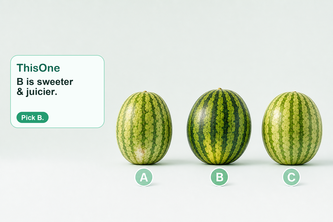
The description states ThisOne is a responsive single-page web app that helps shoppers compare fresh-food options by analyzing photos. It supports four food categories (Fruit, Veg, Seafood, Meat) and surfaces category-specific visible cues such as variety, ripeness, freshness, texture, and best use.
The author describes two modes of operation:
- Demo mode: Uses structured demo data and local recommendation logic without API key
- Live mode: Integrates with GPT-5.6 vision when deployed with an OpenAI API key
The app allows users to upload shelf or package photos, review comparison cards showing visible cues, and optionally receive recommendations based on timing, preferences, and dietary needs.
Positioning & Claim Evolution
The author states ThisOne was designed for "the real supermarket moment: standing in front of a shelf and wondering, 'Which pack should I actually buy?'" It positions itself as a solution to the problem of broad grocery labels that don't convey meaningful differences between products.
The product claims to help shoppers make better choices by comparing up to four options across four food categories. It surfaces category-specific visible cues and allows users to either stop at comparison or request recommendations based on preferences such as low sugar, high protein, or kid-friendly eating.
Target Customer & ICP
The description states ThisOne targets shoppers who are "standing in front of a shelf and wondering, 'Which pack should I actually buy?'" It appears designed for everyday grocery shoppers looking to make informed decisions about fresh food purchases.
The author does not specify any细分 customer segments beyond general consumers. The product is positioned as a consumer-facing tool rather than a B2B solution.
Business Model & Pricing Evidence
Not evidenced. The description does not contain information about pricing, monetization strategy, or business model.
Technical & Delivery Signals
The author states ThisOne is built with HTML, CSS, JavaScript and uses structured demo data for initial functionality. It includes server-side GPT-5.6 vision integration that can be enabled with an OpenAI API key.
Key technical elements mentioned:
- Responsive single-page web app
- Structured demo data and local recommendation logic
- Server-side GPT-5.6 vision integration
- Photo compression and processing
- Category-specific comparison logic
- UI that turns structured results into comparison cards
The public demo is intentionally available in demo mode with no account or API key required.
Traction & Maturity Signals
Not evidenced. The description does not contain any information about revenue, customers, user adoption, or product maturity beyond its status as a hackathon submission.
Competitive Context
Not evidenced. The description does not mention any existing competitive products or market positioning relative to competitors.
Open Questions & Risks
- The project is described as a hackathon submission with no demonstrated traction
- No revenue, customer, or adoption data provided
- The demo mode uses structured demo data rather than live photo analysis
- The author states that photos cannot prove food safety or fully identify every cut or variety
- The product appears to be in early development stage without clear path to commercialization
Questions the description leaves open
- What is the actual commercial viability of this product, and how does it differ from existing grocery comparison tools?
- How does ThisOne plan to monetize its service if it becomes a viable product?
- What are the technical limitations of the current demo mode that would need to be addressed for production use?
- Has there been any user testing or feedback on the accuracy of the visible-cue estimates?
- What is the roadmap for moving from demo mode to full functionality with real API integrations?
Overall Assessment
Not evidenced. The description does not contain information about funding rounds, valuation, or investment interest. The project appears to be a hackathon submission with no demonstrated traction or commercial viability beyond its status as a proof-of-concept tool.
User Stories BotA demo video on every pull request
Get a demo video on every new feature
GitHub App that watches your pull requests and records a narrated, captioned demo.
Save time on demo prep and make informed decisions faster with a video walkthrough of every new feature.
Source
Submitted to the OpenAI 2026 hackathon on Devpost. Project home on Devpost. Back to the full gallery on Devpost.
This competitive analysis was produced by top-founders.com (opens in a new tab)
Generated by a language model from this project's public Devpost page — its tagline, the author's own write-up and any built-with tags listed there — as captured in August 2026. Short quotations are the author's words. It is an opinion on the idea as a business, not on the people behind it, and it reflects the description as published then. If the project has moved on, request a correction below. The analysis is not independent research and contains no verified traction, revenue or customer data.
An independent guide by KFG International LLC — not affiliated with, endorsed by, or connected to Devpost or OpenAI.