

Archive position — measured, not model output
1 like on Devpost
505 of the 7,850 archived projects have more likes, and 1,758 share exactly 1 — so this project's #1,384 place in the like-ranked listing is a tie-break inside that group, not a ranking.
Projects (log scale)
Likes on Devpost. ▲ marks this project's group.
Show the figures
| Likes | Projects | Share of archive |
|---|---|---|
| 0 | 5,587 | 71.2% |
| 1 | 1,758 | 22.4% |
| 2 | 284 | 3.6% |
| 3–4 | 132 | 1.7% |
| 5–9 | 75 | 1.0% |
| 10+ | 14 | 0.2% |
 User Stories BotA demo video on every pull request
Get a demo video on every new feature
GitHub App that watches your pull requests and records a narrated, captioned demo.
Save time on demo prep and make informed decisions faster with a video walkthrough of every new feature.
Executive Summary
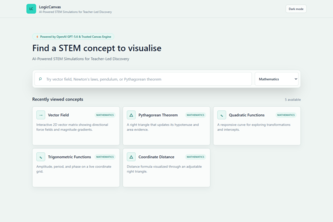
The company appears to be a single-person project named LogicCanvas, self-described as a tool that converts STEM prompts into interactive visual lessons using GPT-5.6, Codex, Zod, and other technologies. The author states it is designed for teachers to create classroom-ready materials with dynamic simulations, guided explanations, and student challenges.
What changed: This is a hackathon submission describing an early-stage concept. It does not indicate any prior traction, revenue, or customer adoption.
Single most important open question: Is there evidence of actual teacher engagement or usage beyond the author’s own demonstration?
What The Product Actually Is
The description states that LogicCanvas is a system that:
- Converts teacher STEM prompts into interactive visual lessons.
- Provides live visual models with meaningful controls, equations, and guided explanations.
- Includes student challenges and classroom-ready materials.
- Uses GPT-5.6 for scientific reasoning, Zod for validation, and Codex for rendering.
It is described as a teacher-led learning workflow, not just a simulation gallery.
Inference: The system appears to be a prototype or proof-of-concept built around AI-generated educational content, with an emphasis on safety through structured outputs and sandboxed execution.
Positioning & Claim Evolution
The author states:
- LogicCanvas helps teachers turn difficult STEM concepts into interactive visual lessons.
- It aims to reduce the need for separate tools for simulations, lesson planning, assessment, and handouts.
- It supports both student investigation and teacher preparation workflows.
- The tool is positioned as a teacher-led learning workflow rather than a generic simulation platform.
Inference: The positioning reflects an attempt to solve fragmentation in STEM education tools by integrating multiple functions into one interface. However, the claim of being “teacher-led” is not substantiated with evidence of actual teacher use or feedback.
Target Customer & ICP
The description states:
- The primary user is a teacher.
- Teachers are expected to prepare concepts for class and generate lesson materials.
- Students interact through live controls and visual feedback.
Inference: The target customer segment is educators working in STEM disciplines, likely at the high school or college level. No evidence of specific grade levels, school types, or geographic focus is provided.
Business Model & Pricing Evidence
The description does not contain any information about:
- Revenue model
- Pricing structure
- Monetization strategy
- Customer acquisition plans
Not evidenced
Technical & Delivery Signals
The author describes the following technical components:
- Uses GPT-5.6 as a reasoning engine.
- Employs Zod for validation of AI outputs.
- Leverages Codex to compile structured specifications into visualizations.
- Visualizations are rendered using HTML5 Canvas, sandboxed iframes, and React.
- The system uses OpenAI API and JavaScript SDK.
- Includes optional GPT-5.6 structured-output endpoint for live integrations.
Inference: There is a clear separation between AI reasoning (GPT), validation (Zod), and rendering (Codex). This suggests an architecture designed for safety, reusability, and scalability — though no production deployment or performance data is shared.
Traction & Maturity Signals
The description states:
- The project was submitted to the OpenAI 2026 hackathon.
- It includes curated lesson fixtures (mock data) for demonstration purposes.
- The UI currently uses mock data, not live integrations.
- No mention of real users, customers, or adoption metrics.
Not evidenced
Competitive Context
The description does not reference:
- Competitors
- Market size
- Existing solutions in the STEM education space
- Differentiation from similar tools
Not evidenced
Open Questions & Risks
- No traction or revenue: The project is a hackathon submission with no evidence of real-world usage.
- Unproven market fit: No indication that teachers actually want or need this tool.
- Single-founder model: Only one team member listed, which may limit execution capacity.
- Unclear monetization path: No business model or pricing strategy described.
- Dependency on proprietary tech: Heavy reliance on GPT-5.6 and OpenAI APIs introduces risk of dependency and cost.
Questions the description leaves open
- What specific STEM concepts have you tested with teachers?
- Have you conducted any user research or interviews with educators?
- How do you plan to validate the educational accuracy of GPT-5.6 outputs at scale?
- Are there any existing partnerships with schools, districts, or edtech platforms?
- What is your roadmap for moving from mock data to live integration?
- How do you intend to monetize this tool in the long term?
Overall Assessment
The project is a self-reported hackathon submission with no evidence of traction, revenue, or customer adoption.
It is not evident whether LogicCanvas has moved beyond concept stage or demonstrated real utility to its intended users.
Confidence level: Low
This is a preliminary idea, not a product in the market. Any investment or partnership decision should be contingent on further validation and evidence of user engagement, product-market fit, and scalability.
User Stories BotA demo video on every pull request
Get a demo video on every new feature
GitHub App that watches your pull requests and records a narrated, captioned demo.
Save time on demo prep and make informed decisions faster with a video walkthrough of every new feature.
Source
Submitted to the OpenAI 2026 hackathon on Devpost. Project home on Devpost. Back to the full gallery on Devpost.
This competitive analysis was produced by top-founders.com (opens in a new tab)
Generated by a language model from this project's public Devpost page — its tagline, the author's own write-up and any built-with tags listed there — as captured in August 2026. Short quotations are the author's words. It is an opinion on the idea as a business, not on the people behind it, and it reflects the description as published then. If the project has moved on, request a correction below. The analysis is not independent research and contains no verified traction, revenue or customer data.
An independent guide by KFG International LLC — not affiliated with, endorsed by, or connected to Devpost or OpenAI.