

Archive position — measured, not model output
0 likes on Devpost
2,263 of the 7,850 archived projects have more likes, and 5,587 share exactly 0 — so this project's #7,269 place in the like-ranked listing is a tie-break inside that group, not a ranking.
Projects (log scale)
Likes on Devpost. ▲ marks this project's group.
Show the figures
| Likes | Projects | Share of archive |
|---|---|---|
| 0 | 5,587 | 71.2% |
| 1 | 1,758 | 22.4% |
| 2 | 284 | 3.6% |
| 3–4 | 132 | 1.7% |
| 5–9 | 75 | 1.0% |
| 10+ | 14 | 0.2% |
 User Stories BotA demo video on every pull request
Get a demo video on every new feature
GitHub App that watches your pull requests and records a narrated, captioned demo.
Save time on demo prep and make informed decisions faster with a video walkthrough of every new feature.
Executive Summary
What the company appears to be
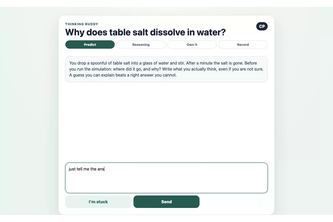
Thinking Buddy is a Socratic tutoring tool built with GPT-5.6 that refuses to give direct answers to students. The product enforces a rule: "attempt before delegation" — meaning students must first state their reasoning, even if incorrect, before receiving help. It includes an ownership test where student responses are blurred and unselectable after submission, requiring them to restate concepts in their own words without AI assistance. Teachers receive a "Reasoning Record" that tracks the student's path through the problem-solving process.
What changed
The author describes a shift from traditional AI tutoring tools (which provide answers) to a model that enforces reasoning and ownership. This change is framed as a response to findings that unrestricted AI use leads to poor retention, while guarded tutoring can reverse this harm.
The single most important open question
Does the described approach actually improve learning outcomes or simply create a more complex interface for students? The author states no evidence of traction, revenue, or adoption beyond the hackathon submission — so there is no way to assess whether the model’s design works in practice.
What The Product Actually Is
The description states that Thinking Buddy is a Socratic tutor built using Codex and GPT-5.6. It enforces a rule: "attempt before delegation." Students must state their reasoning first, even if incorrect, before receiving help. The system uses hidden model tags to flag student behavior (e.g., cleared the bar, stalling, off task) and integrates safety features such as mandated reporting for threats or disclosures.
The interface is a single-page frontend with a small Node.js backend so that API keys never touch the browser. It includes an ownership test where tutor messages are permanently blurred and unselectable when the student clicks “I think I’ve got it.” The student must then restate the concept in their own words, with no access to previous AI output.
The teacher gets a "Reasoning Record" that documents the student’s journey — including starting point, gaps, reasoning moves, and whether they truly understood. The system also includes safety layers for detecting harmful content or signs of distress.
Inference The product is described as a classroom-based tool designed to prevent students from using AI to get answers without understanding the process.
Positioning & Claim Evolution
The author positions Thinking Buddy as a solution to a specific problem in education: that current AI tools give students correct answers without requiring them to think through the steps. This leads to poor retention, according to the author’s claim based on a randomized controlled trial of 1,000 high school students.
The product is positioned not just as an AI tutor but as a guardian of learning integrity — one that refuses to answer questions directly and instead pushes students toward deeper thinking. It is framed as a response to the "wound" AI has opened in classrooms, where students appear to succeed on reports but lack true understanding.
The claim evolution shows a shift from general AI tutoring to a Socratic method applied via AI, with an emphasis on student ownership and accountability, rather than just correctness or speed of delivery.
Inference The positioning is rooted in the author’s personal teaching experience and a belief that AI should not be used to bypass thinking, but to guide it.
Target Customer & ICP
The description states that Thinking Buddy is built for high school chemistry students, with levels such as CP, Honors, and AP. Each level has a written bar — a set of criteria the student must meet to demonstrate understanding.
The primary user is a student in a high school classroom who interacts with the tool under teacher supervision. The teacher receives the Reasoning Record and uses it to assess learning progress.
There is no mention of other educational levels (e.g., elementary, college), nor any indication that the system targets parents or institutions beyond schools.
Inference The ICP is a high school chemistry teacher using the tool with students in a structured classroom environment. No evidence suggests broader market targeting.
Business Model & Pricing Evidence
The description does not contain any information about pricing, monetization, or business model. There are no mentions of subscriptions, licensing fees, institutional contracts, or revenue streams.
Not evidenced.
Technical & Delivery Signals
The system is built using:
- Codex
- GPT-5.6
- Node.js backend
- Playwright for demo automation
- Frontend in HTML/CSS/JS
It runs entirely on the OpenAI API and uses a single-page interface with no external dependencies.
Model behavior is controlled through explicit rules:
- Never name the answer to the question just asked.
- Never credit a student with reasoning you supplied.
- If a student says “I don’t know” three times, go down a level.
- Vocabulary words can be given once, then must be used by the student.
The system tags every reply with a hidden signal that flags student behavior (e.g., cleared bar, stalling, off task). These signals are read by the interface to raise appropriate flags.
Inference The technical architecture is minimal and focused on enforcing behavioral rules via AI prompts. There is no evidence of scalability or integration into existing platforms.
Traction & Maturity Signals
The description states that this was a hackathon submission (OpenAI 2026) and does not include any data about:
- Revenue
- Customers
- Users
- Adoption
- Product usage metrics
There is no mention of deployment, testing in real classrooms, or feedback from educators.
Not evidenced.
Competitive Context
The description does not reference any competitors or existing tools in the edtech space. It only contrasts Thinking Buddy with "every tutor on the market" that is built to finish the task — implying a lack of alternatives that enforce reasoning before answering.
There is no discussion of similar Socratic tutoring systems, AI-powered homework helpers, or educational platforms like Khan Academy, Duolingo, or Chegg.
Not evidenced.
Open Questions & Risks
- No real-world testing or validation: The product exists only as a hackathon submission with no evidence of use in classrooms.
- Unproven pedagogical effectiveness: While the author claims that guarded tutoring improves retention, there is no data to support this assertion beyond one trial cited.
- Potential for user frustration: The refusal to answer may confuse or frustrate students who expect immediate help.
- Safety implementation risks: The system relies on AI to distinguish between provocation and disclosure — a potentially dangerous misclassification could lead to harm.
- Limited scope: Only chemistry is mentioned as a subject area, with no indication of how easily the model can be adapted to other subjects.
Inference Without real-world usage or performance data, the risk of failure is high. The design may not translate into better learning outcomes.
Questions the description leaves open
- What specific learning outcomes have been observed in pilot testing (if any)?
- How does the system handle cases where a student genuinely cannot begin an attempt?
- Is there a plan for validating the pedagogical approach through controlled studies or expert feedback?
- How is the model trained to detect subtle indicators of understanding vs. guessing?
- What are the technical limitations in scaling this to multiple classrooms or subjects?
- Are there any plans to integrate with existing LMS platforms or school systems?
Overall Assessment
The author describes Thinking Buddy as a conceptual and technical innovation aimed at addressing a real issue in education — that AI tutoring often bypasses thinking rather than promoting it.
However, the product is currently a hackathon prototype with no traction, revenue, or user data. It has not been validated in real classrooms or shown to improve learning outcomes.
Given the lack of evidence for impact, adoption, or scalability, and the high risk associated with untested pedagogical assumptions, there is insufficient basis to recommend investment or partnership at this time.
Inference The idea shows promise but lacks validation. It would require significant further development, testing, and proof-of-concept before it could be considered viable for commercial use or investment.
User Stories BotA demo video on every pull request
Get a demo video on every new feature
GitHub App that watches your pull requests and records a narrated, captioned demo.
Save time on demo prep and make informed decisions faster with a video walkthrough of every new feature.
Source
Submitted to the OpenAI 2026 hackathon on Devpost. Project home on Devpost. Back to the full gallery on Devpost.
This competitive analysis was produced by top-founders.com (opens in a new tab)
Generated by a language model from this project's public Devpost page — its tagline, the author's own write-up and any built-with tags listed there — as captured in August 2026. Short quotations are the author's words. It is an opinion on the idea as a business, not on the people behind it, and it reflects the description as published then. If the project has moved on, request a correction below. The analysis is not independent research and contains no verified traction, revenue or customer data.
An independent guide by KFG International LLC — not affiliated with, endorsed by, or connected to Devpost or OpenAI.