

Archive position — measured, not model output
0 likes on Devpost
2,263 of the 7,850 archived projects have more likes, and 5,587 share exactly 0 — so this project's #3,345 place in the like-ranked listing is a tie-break inside that group, not a ranking.
Projects (log scale)
Likes on Devpost. ▲ marks this project's group.
Show the figures
| Likes | Projects | Share of archive |
|---|---|---|
| 0 | 5,587 | 71.2% |
| 1 | 1,758 | 22.4% |
| 2 | 284 | 3.6% |
| 3–4 | 132 | 1.7% |
| 5–9 | 75 | 1.0% |
| 10+ | 14 | 0.2% |
 User Stories BotA demo video on every pull request
Get a demo video on every new feature
GitHub App that watches your pull requests and records a narrated, captioned demo.
Save time on demo prep and make informed decisions faster with a video walkthrough of every new feature.
Executive Summary
What the company appears to be
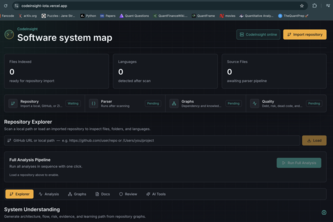
CodeInsight is a self-reported code intelligence platform that imports software repositories, parses source code across 8 languages, builds knowledge graphs, and provides AI-powered Q&A, bug impact prediction, documentation generation, and code review capabilities. It positions itself as "Google Maps for Software Systems" — enabling engineers to navigate large codebases like a city map.
What changed
The project description is a self-reported submission to the OpenAI 2026 hackathon. It describes an early-stage prototype built in a short timeframe, with no evidence of revenue, customers, or product-market fit beyond its own claims.
Single most important open question
Is there any evidence that CodeInsight has been used by engineers outside of the development team, or that it solves a real problem at scale?
What The Product Actually Is
The description states that CodeInsight is a full-stack codebase intelligence platform. It imports repositories via GitHub URLs, local paths, or ZIP uploads and parses source code in 8 languages (Python, JavaScript, TypeScript, C, C++, Java, Go, Rust) using Tree-sitter with regex fallback.
It builds architectural knowledge graphs using Neo4j, NetworkX, and SQLite. It supports hybrid retrieval combining semantic search, keyword matching, and graph traversal to provide grounded answers to questions about the codebase.
Key features include:
- Repository Q&A with streaming responses
- Technical debt detection (cyclomatic complexity, god objects, etc.)
- Bug impact prediction using stack traces
- Documentation generation (READMEs, Mermaid diagrams, onboarding guides)
- Code review engines for PRs, architecture, and security
The platform is built as a monorepo with six modules:
- Frontend (Next.js, React, TypeScript, Tailwind CSS, React Flow)
- Backend (FastAPI, Pydantic, SQLite)
- Parser (Tree-sitter, Python)
- Graph engine (Neo4j, NetworkX, SQLite)
- Shared utilities
- Workers (Python)
The processing pipeline includes: Import → Clone → Scan → Parse → Extract Symbols → Build Graphs → Chunk → Embed → Store → Ready.
Evidence Self-reported. No independent verification of functionality or usage.
Positioning & Claim Evolution
The author states that CodeInsight was built to address the frustration engineers feel when joining new codebases — where documentation is outdated and architecture is implicit, making it hard to understand how systems work.
It positions itself as a "dark-first code intelligence platform" that maps software systems, visualizes code graphs, answers repo questions, predicts bug impact, reviews code, and creates docs.
The tagline: "It is a dark-first code intelligence platform that maps software systems, analyses repositories, visualises code graphs, answers repo questions, predicts bug impact, reviews code, and creates docs." — reflects this positioning.
Inference The product appears to be a developer tool aimed at improving onboarding, debugging, and architecture understanding in large codebases. It is not a commercial product yet but a prototype submitted for a hackathon.
Target Customer & ICP
The description states that CodeInsight targets engineers working with large, complex codebases, especially those who struggle with onboarding into new systems or understanding system behavior across files and modules.
It is positioned to help users navigate code like a city map — zooming out to see architecture and zooming in to see symbols.
Inference The primary ICP appears to be software engineers, developers, and tech leads, particularly those working in large monorepos or legacy systems where understanding architecture is difficult.
Evidence Self-reported. No data on actual users or customer segments.
Business Model & Pricing Evidence
The description does not mention any pricing model, revenue streams, or monetization strategy.
It states that the tool supports local demos with zero configuration, and works with or without an OpenAI key (using Ollama as a fallback).
Inference The business model is unclear. It may be intended for open-source use or early-stage adoption before commercialization.
Evidence Not evidenced.
Technical & Delivery Signals
The platform uses:
- Frontend: Next.js, React, TypeScript, Tailwind CSS, React Flow
- Backend: FastAPI, Pydantic, SQLite
- Parser: Tree-sitter with regex fallback
- Graph Engine: Neo4j, NetworkX, SQLite
- AI Tools: OpenAI, Ollama
- Deployment: Docker Compose, Vercel, Railway
It supports:
- Zero-config local demo
- Streaming Q&A responses
- 177 tests with 90%+ coverage gate
- Production-ready architecture (health checks, structured logging, error recovery)
- Hybrid retrieval for grounded answers
Inference The engineering team has built a functional prototype with attention to quality gates and scalability considerations.
Evidence Self-reported. No evidence of production usage or performance data.
Traction & Maturity Signals
The description states that the project was submitted to the OpenAI 2026 hackathon, indicating it is in an early-stage prototype phase.
It includes:
- 25+ backend services
- 23+ frontend panels
- Zero-config local demo
- Real answers grounded in code (citing files, functions, lines)
- Docker Compose deployment
However, there is no evidence of:
- Revenue
- Customers
- Product-market fit
- Adoption metrics
- User feedback or usage data
Inference The project is a hackathon submission with no demonstrated traction.
Competitive Context
The description does not mention any direct competitors. However, it implies that existing tools like GitHub Copilot, CodeGeeX, or code intelligence platforms are insufficient for answering system-level questions — such as how authentication works across the entire application.
It positions itself as a tool that bridges the gap between local context (e.g., Copilot) and system understanding.
Inference CodeInsight competes with AI-assisted code navigation tools, but there is no evidence of market positioning or competitive analysis in the description.
Open Questions & Risks
- No traction or revenue: The project is a hackathon submission with no evidence of adoption.
- Unverified claims: All features are self-reported; no independent validation.
- Early-stage prototype: No indication of production use, scalability testing, or user feedback.
- Limited team size (2 members): May limit execution speed and depth of development.
- No commercialization path: No pricing, monetization, or go-to-market strategy is described.
Inference The project lacks commercial viability without further evidence of traction or product-market fit.
Questions the description leaves open
- What specific problems are engineers solving with CodeInsight today?
- Have you tested the platform with real teams or organizations?
- How do you plan to monetize this tool?
- What is your roadmap for moving from prototype to product?
- Are there any existing users or pilot programs?
- How does CodeInsight compare to existing tools like GitHub Copilot or SonarQube in terms of functionality and adoption?
Overall Assessment
Not evidenced.
The project is a self-reported hackathon submission with no evidence of revenue, customers, or product-market fit.
It is an early-stage prototype that demonstrates technical capability but lacks any commercial due-diligence signals.
Confidence Level Very low — based entirely on the author's own description, which is unverified and self-promotional.
User Stories BotA demo video on every pull request
Get a demo video on every new feature
GitHub App that watches your pull requests and records a narrated, captioned demo.
Save time on demo prep and make informed decisions faster with a video walkthrough of every new feature.
Source
Submitted to the OpenAI 2026 hackathon on Devpost. Project home on Devpost. Back to the full gallery on Devpost.
This competitive analysis was produced by top-founders.com (opens in a new tab)
Generated by a language model from this project's public Devpost page — its tagline, the author's own write-up and any built-with tags listed there — as captured in August 2026. Short quotations are the author's words. It is an opinion on the idea as a business, not on the people behind it, and it reflects the description as published then. If the project has moved on, request a correction below. The analysis is not independent research and contains no verified traction, revenue or customer data.
An independent guide by KFG International LLC — not affiliated with, endorsed by, or connected to Devpost or OpenAI.