

Archive position — measured, not model output
0 likes on Devpost
2,263 of the 7,850 archived projects have more likes, and 5,587 share exactly 0 — so this project's #7,257 place in the like-ranked listing is a tie-break inside that group, not a ranking.
Projects (log scale)
Likes on Devpost. ▲ marks this project's group.
Show the figures
| Likes | Projects | Share of archive |
|---|---|---|
| 0 | 5,587 | 71.2% |
| 1 | 1,758 | 22.4% |
| 2 | 284 | 3.6% |
| 3–4 | 132 | 1.7% |
| 5–9 | 75 | 1.0% |
| 10+ | 14 | 0.2% |
 User Stories BotA demo video on every pull request
Get a demo video on every new feature
GitHub App that watches your pull requests and records a narrated, captioned demo.
Save time on demo prep and make informed decisions faster with a video walkthrough of every new feature.
Executive Summary
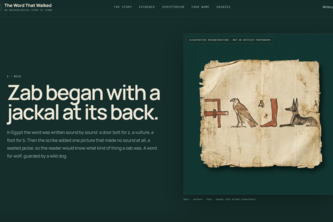
The Word That Walked is an interactive educational experience that traces the historical journey of a single Hebrew word — "zab," meaning wolf — from ancient Egyptian hieroglyphics through Proto-Sinaitic script to modern digital formats. The project uses AI (GPT-5.6) and structured outputs to present historical claims with source citations, while also allowing users to type their names in Latin letters and see them rendered in ancient Proto-Sinaitic script.
The author states that this is a personal project built during an OpenAI hackathon, with no evidence of revenue, customers or traction beyond the self-reported narrative. The product appears to be a museum-style web experience with educational goals, not a commercial offering.
Key open question
Is there any evidence of user engagement or adoption beyond the author's own account? If not, what is the path to traction and monetization?
What The Product Actually Is
The description states that The Word That Walked is an interactive museum experience. It follows one Hebrew word — "zab" — through eight chapters of history, from hieroglyphics to modern digital formats.
It includes:
- A Scriptorium feature where users can type names in Latin letters and see them converted into Proto-Sinaitic script.
- Historical narrative tracing the evolution of the word and its associated letters.
- AI-powered features (GPT-5.6) that answer questions about historical periods with cited sources.
The product is built using:
- Next.js
- React
- TypeScript
- Vercel
- Codex
- GPT-5.6
It uses SVGs for visual representation of glyphs and integrates audio elements, though no specific details on how these are used are provided.
Inference The project appears to be a single-user, non-commercial educational tool built as a hackathon submission.
Positioning & Claim Evolution
The author claims the product is:
- An interactive museum experience
- A way to explore the history of the alphabet through one word
- A tool that connects ancient sign-making to modern code
- Designed to teach both alphabet history and evidence literacy
It positions itself as a bridge between archaeology, linguistics, and digital technology.
Inference The positioning seems to be educational and exploratory rather than commercial or monetizable. It is self-described as a museum experience, not a product for sale.
Target Customer & ICP
The description does not state who the target customer is beyond the author's personal interest in archaeology and linguistics.
However, the author mentions:
- Teachers may use it to teach alphabet history and evidence literacy
- It could be connected to classroom tools in the future
Inference The intended audience likely includes educators and students interested in ancient history or language studies. No explicit customer segment is defined beyond this.
Business Model & Pricing Evidence
There is no evidence of a business model, pricing strategy, or monetization plan in the description.
The author states that the project was built during a hackathon and has no revenue or customer data.
Inference There is no indication of any commercial intent or revenue-generating mechanism at this time.
Technical & Delivery Signals
The product is built with:
- Next.js
- React
- TypeScript
- Vercel
- Codex (used for code generation)
- GPT-5.6 (for AI features)
- SVGs and audio components
It uses structured outputs from GPT-5.6 to ensure historical accuracy and source citation.
The author mentions:
- Server-side validation to prevent AI contradictions
- Selector-only architecture to avoid free-text generation
- Source tagging for historical claims (observed, consensus, proposal, legend, convention)
Inference The technical stack suggests a modern web application with AI integration. The use of structured outputs and validation implies an attempt to maintain trustworthiness in historical content.
Traction & Maturity Signals
There is no evidence of traction, users, or adoption beyond the author's own account.
The project was submitted to a hackathon (OpenAI 2026), suggesting it is early-stage.
No data on:
- User engagement
- Customer acquisition
- Revenue
- Market feedback
Inference The product appears to be in an exploratory or prototype phase, with no signs of market traction or user adoption.
Competitive Context
The description does not mention any competitors. It states that there are "Paleo Hebrew converters out there but nothing for Proto-Sinaitic."
This suggests a niche space where the author sees a gap — though it's unclear whether this is a true competitive landscape or just a personal observation.
Inference There may be limited direct competition, but no evidence of existing products in this specific niche or market.
Open Questions & Risks
- No commercialization strategy: The project is described as a hackathon submission with no indication of monetization plans.
- Lack of user data: No evidence of users, engagement, or feedback.
- Unverified historical claims: While the author emphasizes source tagging and validation, these are self-reported and unverified.
- Single-person team: The project is built by one person (G Sch), which may limit scalability or long-term development.
- Unclear path to traction: No evidence of marketing, outreach, or user acquisition efforts.
Inference Without any signs of traction or commercial viability, the risk of failure in a market context is high.
Questions the description leaves open
- What is your plan for scaling beyond the current prototype?
- Have you tested the experience with educators or students? If so, what was the feedback?
- How do you intend to monetize this product if at all?
- Are there any partnerships or institutional support in place?
- What are the key metrics you would track to assess success?
- How do you plan to validate historical accuracy beyond your own knowledge?
Overall Assessment
There is no evidence of a commercial product, revenue, or traction.
The project is described as a personal exploration and hackathon submission with no indication of market readiness or scalability.
Inference This is not a viable investment or partnership opportunity at this stage. It may be a promising idea for future development, but lacks the foundational elements required for due diligence or commercial evaluation.
User Stories BotA demo video on every pull request
Get a demo video on every new feature
GitHub App that watches your pull requests and records a narrated, captioned demo.
Save time on demo prep and make informed decisions faster with a video walkthrough of every new feature.
Source
Submitted to the OpenAI 2026 hackathon on Devpost. Project home on Devpost. Back to the full gallery on Devpost.
This competitive analysis was produced by top-founders.com (opens in a new tab)
Generated by a language model from this project's public Devpost page — its tagline, the author's own write-up and any built-with tags listed there — as captured in August 2026. Short quotations are the author's words. It is an opinion on the idea as a business, not on the people behind it, and it reflects the description as published then. If the project has moved on, request a correction below. The analysis is not independent research and contains no verified traction, revenue or customer data.
An independent guide by KFG International LLC — not affiliated with, endorsed by, or connected to Devpost or OpenAI.