

Archive position — measured, not model output
0 likes on Devpost
2,263 of the 7,850 archived projects have more likes, and 5,587 share exactly 0 — so this project's #7,259 place in the like-ranked listing is a tie-break inside that group, not a ranking.
Projects (log scale)
Likes on Devpost. ▲ marks this project's group.
Show the figures
| Likes | Projects | Share of archive |
|---|---|---|
| 0 | 5,587 | 71.2% |
| 1 | 1,758 | 22.4% |
| 2 | 284 | 3.6% |
| 3–4 | 132 | 1.7% |
| 5–9 | 75 | 1.0% |
| 10+ | 14 | 0.2% |
 User Stories BotA demo video on every pull request
Get a demo video on every new feature
GitHub App that watches your pull requests and records a narrated, captioned demo.
Save time on demo prep and make informed decisions faster with a video walkthrough of every new feature.
Executive Summary
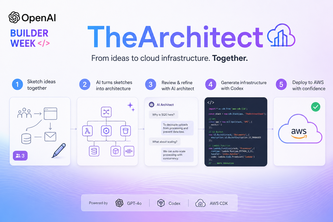
TheArchitect is a self-reported collaborative architecture tool that enables teams to design cloud infrastructure through shared whiteboard sessions, using AI to interpret visual inputs and translate them into deployable code via Codex. The description states it supports real-time multiplayer collaboration, multimodal AI interpretation of whiteboards, explainable AI decisions, and integration with AWS infrastructure tools. It is presented as a tool for bridging business intent and technical implementation in cloud product design.
The single most important open question is: What traction or adoption evidence exists beyond the project description? The self-reported nature of the description means there are no verified metrics, customer names, revenue figures, or usage data to assess commercial viability or market demand.
What The Product Actually Is
The description states that TheArchitect is:
- A multiplayer, AI-powered architecture workspace
- Designed for technical and nontechnical teams to collaborate on cloud product design
- A system that turns whiteboard sketches into structured cloud architectures
- Capable of translating approved designs into deployable infrastructure code using Codex
- Built with React, TypeScript, Tailwind CSS, tldraw, Yjs, Hocuspocus, WebSocket, and AWS CDK
The description also states it uses multimodal AI to interpret whiteboard components, labels, relationships, and constraints, and that it generates a structured architecture model from these inputs.
Positioning & Claim Evolution
The description states that TheArchitect is positioned as:
- A tool that begins the cloud design process earlier—when teams are still deciding what the product should become
- Not replacing architects or engineers, but helping every team member contribute their expertise
- A system that makes AI-generated decisions transparent and preserves human intent behind infrastructure
- A collaborative path from business idea → shared whiteboard → team agreement → cloud architecture → infrastructure code
The claim evolution shows a progression from identifying a problem (loss of context in handoffs) to proposing a solution (collaborative whiteboarding with AI interpretation), then to demonstrating how that solution works (multimodal AI, explainable decisions, Codex integration).
Target Customer & ICP
The description states that TheArchitect targets:
- Teams that include technical and nontechnical participants
- Product managers, operations teams, industry specialists, designers, engineers, and security reviewers
- Users who want to contribute their expertise in cloud product design
- Teams that need to translate business intent into infrastructure
It also mentions that the tool serves people with different levels of technical experience—cloud engineers needing precise resource information and business participants needing explanations connected to goals.
Business Model & Pricing Evidence
Not evidenced. The description does not contain any information about pricing, monetization strategy, or business model.
Technical & Delivery Signals
The description states that TheArchitect uses:
- React, TypeScript, Tailwind CSS for frontend
- tldraw and React Flow for visual environments
- Yjs, Hocuspocus, WebSocket for real-time multiplayer state
- Multimodal AI for whiteboard interpretation
- Codex for infrastructure code generation
- AWS CDK, CloudFormation-compatible infrastructure
- LocalStack for local testing
It also mentions that the system maintains multiple representations of one system (whiteboard, AI interpretation, resource graph, conversation, code, deployed environment) and that it separates explicit components from inferred infrastructure.
Traction & Maturity Signals
Not evidenced. The description does not contain any information about traction, customers, revenue, or usage metrics beyond the project submission to a hackathon.
Competitive Context
Not evidenced. The description does not mention competitors or competitive positioning.
Open Questions & Risks
- The description is entirely self-reported and unverified
- No evidence of traction, customers, or revenue
- The tool appears to be a hackathon project with no commercial history
- The team size is only 2 members, which may limit execution capability
- The use of Codex (presumably OpenAI's model) raises questions about cost, availability, and scalability
- The technical complexity described suggests significant development effort that may not have been completed or tested in production
Questions the description leaves open
- What is the current stage of development beyond the hackathon project?
- Have you validated this concept with potential users or customers?
- How do you plan to monetize this tool?
- What are your plans for scaling beyond a 2-person team?
- How do you handle edge cases in multimodal AI interpretation?
- What is your long-term vision for the product and its market fit?
Overall Assessment
Not evidenced. The description does not provide sufficient information to assess commercial viability, traction, or investment potential. The tool appears to be a hackathon project with no verified business metrics or customer evidence. The self-reported nature of all claims makes it impossible to evaluate the actual commercial due-diligence read without additional verification.
User Stories BotA demo video on every pull request
Get a demo video on every new feature
GitHub App that watches your pull requests and records a narrated, captioned demo.
Save time on demo prep and make informed decisions faster with a video walkthrough of every new feature.
Source
Submitted to the OpenAI 2026 hackathon on Devpost. Project home on Devpost. Back to the full gallery on Devpost.
This competitive analysis was produced by top-founders.com (opens in a new tab)
Generated by a language model from this project's public Devpost page — its tagline, the author's own write-up and any built-with tags listed there — as captured in August 2026. Short quotations are the author's words. It is an opinion on the idea as a business, not on the people behind it, and it reflects the description as published then. If the project has moved on, request a correction below. The analysis is not independent research and contains no verified traction, revenue or customer data.
An independent guide by KFG International LLC — not affiliated with, endorsed by, or connected to Devpost or OpenAI.