

Archive position — measured, not model output
1 like on Devpost
505 of the 7,850 archived projects have more likes, and 1,758 share exactly 1 — so this project's #1,370 place in the like-ranked listing is a tie-break inside that group, not a ranking.
Projects (log scale)
Likes on Devpost. ▲ marks this project's group.
Show the figures
| Likes | Projects | Share of archive |
|---|---|---|
| 0 | 5,587 | 71.2% |
| 1 | 1,758 | 22.4% |
| 2 | 284 | 3.6% |
| 3–4 | 132 | 1.7% |
| 5–9 | 75 | 1.0% |
| 10+ | 14 | 0.2% |
 User Stories BotA demo video on every pull request
Get a demo video on every new feature
GitHub App that watches your pull requests and records a narrated, captioned demo.
Save time on demo prep and make informed decisions faster with a video walkthrough of every new feature.
Executive Summary
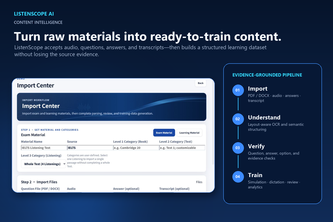
What the company appears to be: ListenScope AI is a self-reported computer-based IELTS listening practice system designed for English learners preparing for academic or professional exams. The product claims to offer mock tests, dictation, mistake diagnosis, vocabulary support, and personalized learning workflows—integrated into a local-first, privacy-focused platform.
What changed: The project evolved from a simple IELTS mock exam tool into a more comprehensive system that connects testing with structured practice and improvement. It was built rapidly using AI assistance (Codex/GPT-5.6), incorporating user experience design, technical architecture, and product development through iterative conversation and testing.
Single most important open question: Is there evidence of actual use or traction beyond the author's own development process?
This analysis is based solely on the self-reported description provided by the project author. No external verification, revenue data, customer feedback, or independent sources are available. All claims in this report are labeled as "the description states" and should be treated as unverified assertions.
What The Product Actually Is
The description states that ListenScope AI is a system for practicing IELTS listening skills using computer-based tests. It includes features such as:
- Mock tests (complete-test, section-based, question-based)
- Sentence-level dictation with synchronized audio
- Mistake analysis and review
- Vocabulary support
- Structured exercises from uploaded materials
- OCR processing for scanned PDFs
- Personalized learning workflows
- Progress tracking
- Local-first file storage and processing
It also claims to connect testing with improvement through a loop: Listen → Answer → Diagnose → Practise → Review → Improve.
The product is described as functional, but no evidence of actual users or usage metrics exists beyond the author’s own development process.
Positioning & Claim Evolution
The description states that the project started as a simple IELTS mock exam tool for personal use. Over time, it evolved into a full learning environment combining assessment, diagnosis, and practice.
It positions itself not just as an exam simulator but as a system that turns every mistake into actionable learning steps. The author emphasizes:
- A shift from “score-only” tools to ones that guide learners toward improvement.
- Integration of AI-assisted development and user experience refinement.
- Emphasis on privacy and local-first design.
This evolution reflects a strategic positioning change from a basic tool to a holistic learning platform, though no evidence supports adoption or market traction.
Target Customer & ICP
The description states that the primary audience is English learners preparing for IELTS exams, particularly those aiming to pursue PhD studies abroad. The author identifies as a construction engineer and postgraduate student who struggles with listening comprehension.
It also mentions potential users beyond exam-takers, including:
- Academic researchers needing to understand lectures
- Independent learners wanting real-world communication skills
No explicit segmentation or targeting data is provided. The IELTS-focused use case appears central, but the broader target market remains undefined.
Business Model & Pricing Evidence
The description does not mention any pricing model, monetization strategy, or business model details. It focuses on functionality and user experience rather than commercial aspects.
There is no evidence of a business model or pricing structure in the provided materials.
Technical & Delivery Signals
The description states that:
- The system was built using Codex/GPT-5.6, which acted as a product manager, developer, tester, and UX reviewer.
- Features include OCR processing, audio synchronization, local file handling, secure API-key management, and UI/UX refinement.
- The entire development cycle took less than one week.
- Testing was conducted via AI-assisted workflows, including screen recordings.
These signals suggest rapid prototyping and AI-driven delivery, but no evidence of scalability, infrastructure, or long-term technical sustainability is presented.
Traction & Maturity Signals
The description states that:
- The system is already functional and includes working examination workflows, document processing, dictation, vocabulary support, local file handling, testing capabilities, and a refined UI.
- A complete system test and screen recording were conducted with Codex.
- The author built the product in less than one week without a traditional development team.
However, there is no mention of:
- Users or customer base
- Revenue or monetization
- Adoption metrics
- Product usage data
No traction or maturity indicators beyond the author’s own development process are evident.
Competitive Context
The description does not provide any information about competitors or market positioning. It does not reference existing IELTS listening tools, language-learning platforms, or edtech products in the space.
There is no evidence of competitive analysis or awareness of existing solutions.
Open Questions & Risks
- Unverified claims: The entire description is self-reported and unverified.
- No traction or revenue: No evidence of users, customers, or monetization exists.
- AI dependency risk: Heavy reliance on AI for development raises questions about scalability and control.
- Local-first design limitations: While privacy-focused, this approach may limit data aggregation and analytics.
- Lack of commercial clarity: No pricing, business model, or go-to-market strategy is evident.
These risks are inferred from the lack of verifiable evidence and reliance on unproven assumptions.
Questions the description leaves open
- What specific user feedback has been gathered during development?
- How many actual users have tested the system beyond the author?
- Are there any plans for monetization or revenue models?
- What are the technical limitations of the local-first approach in terms of scalability and data retention?
- Has the AI-assisted development process led to any known issues with code quality or maintainability?
- How does the product plan to expand beyond IELTS listening into reading, speaking, or writing?
- What is the long-term vision for growth and market expansion?
These questions aim to uncover gaps in the self-reported narrative.
Overall Assessment
The description states that ListenScope AI is a functional system built quickly using AI tools, but there is no evidence of traction, revenue, or customer adoption. The author’s personal journey and rapid development are described, but no external validation or commercial viability is demonstrated.
Based on the self-reported description alone, this project lacks sufficient evidence to support investment or partnership decisions. It remains a concept with strong execution potential, but no demonstrated market presence or business outcomes.
User Stories BotA demo video on every pull request
Get a demo video on every new feature
GitHub App that watches your pull requests and records a narrated, captioned demo.
Save time on demo prep and make informed decisions faster with a video walkthrough of every new feature.
Source
Submitted to the OpenAI 2026 hackathon on Devpost. Project home on Devpost. Back to the full gallery on Devpost.
This competitive analysis was produced by top-founders.com (opens in a new tab)
Generated by a language model from this project's public Devpost page — its tagline, the author's own write-up and any built-with tags listed there — as captured in August 2026. Short quotations are the author's words. It is an opinion on the idea as a business, not on the people behind it, and it reflects the description as published then. If the project has moved on, request a correction below. The analysis is not independent research and contains no verified traction, revenue or customer data.
An independent guide by KFG International LLC — not affiliated with, endorsed by, or connected to Devpost or OpenAI.