

Archive position — measured, not model output
0 likes on Devpost
2,263 of the 7,850 archived projects have more likes, and 5,587 share exactly 0 — so this project's #7,254 place in the like-ranked listing is a tie-break inside that group, not a ranking.
Projects (log scale)
Likes on Devpost. ▲ marks this project's group.
Show the figures
| Likes | Projects | Share of archive |
|---|---|---|
| 0 | 5,587 | 71.2% |
| 1 | 1,758 | 22.4% |
| 2 | 284 | 3.6% |
| 3–4 | 132 | 1.7% |
| 5–9 | 75 | 1.0% |
| 10+ | 14 | 0.2% |
 User Stories BotA demo video on every pull request
Get a demo video on every new feature
GitHub App that watches your pull requests and records a narrated, captioned demo.
Save time on demo prep and make informed decisions faster with a video walkthrough of every new feature.
Executive Summary
The Utopian Society is a self-described speculative civic platform that transforms a fictional constitutional corpus into an interactive digital experience. The project was initially conceived as a body of writing exploring ethical civilization, later evolved into a WordPress alpha site, and then reimagined during OpenAI Build Week as a public beta with interactive elements, a new visual identity, and functional components like a calendar, citizenship certificate flow, and a Transparency Ledger.
The description states that the platform is not yet a functioning government but rather an experimental civic infrastructure designed to explore how ethical governance might be made legible and participatory through software. It includes features such as a seven-Circle governance system, a 13-month calendar, civic comprehension assessment, symbolic citizenship issuance, and a hash-linked ledger for tracking civic events.
The author claims that AI tools (Codex and ChatGPT) were used collaboratively to develop both the philosophical framework and technical implementation. The project is presented as an exploratory tool for testing constitutional concepts rather than a commercial product or service with customers or revenue.
Key open questions include: What is the intended use case beyond experimentation? Is there any plan for monetization or real-world application? How does the author intend to transition from speculative design to functional civic infrastructure?
What The Product Actually Is
The description states that The Utopian Society Civic Portal is a digital platform designed to transform a speculative constitutional corpus into an "explorable—and eventually functional—civic space." It includes:
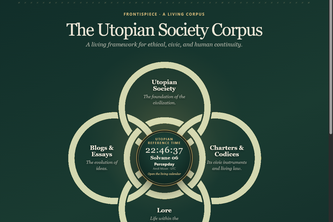
- An interactive Celtic frontispiece with interlocking rings representing major domains
- A seven-Circle constitutional governance system
- A live Utopian Reference Time clock and thirteen-month calendar
- Unified reading experience for Constitution, Articles, Charters, Codices, blogs, and essays
- Distinct civic interfaces for Learning, Healing, Immigration, and other public institutions
- A 100-question civic comprehension assessment
- Voluntary oath and symbolic naturalization certificate issuance
- Public symbolic-citizen population record
- Hash-linked Transparency Ledger recording civic events and platform changes
The description also states that the site uses Next.js, React, TypeScript, custom CSS, interactive SVG, Cloudflare Worker, and D1 database. It was built using OpenAI Codex and ChatGPT as development collaborators.
Inferred: The platform is described as a "living digital civilization" but not yet a functioning government or real civic institution.
Positioning & Claim Evolution
The description states that the project began in 2025 as a body of writing exploring ethical civilization, then became a WordPress alpha website in early 2026. During OpenAI Build Week, it evolved from an "experimental website" into a public beta with:
- A completely new Celtic visual identity
- Interactive multi-level ring navigation
- A reconciled seven-Circle constitutional topology
- Civic landing pages designed for ordinary citizens rather than legal specialists
- Working immigration assessment and certificate flow
- Server-generated, uniqueness-checked certificate numbers
- Persistent public citizen record and population counter
- Automated, hash-linked Transparency Ledger
- Responsive Utopian calendar
- Imported and redesigned corpus and essay pages
The author claims the project demonstrates that building institutions in code can expose weaknesses in governing language more effectively than reading documents in isolation. The long-term goal is described as discovering how much of an ethical civilization can be made legible, participatory, and accountable through software.
Inferred: The positioning has evolved from a literary exploration to a functional digital prototype for testing civic concepts, though it remains clearly speculative and non-functional in its current form.
Target Customer & ICP
The description states that the platform is designed for "ordinary citizens" rather than legal specialists. It includes civic landing pages tailored for everyday users and features such as:
- A 100-question civic comprehension assessment
- Voluntary oath and symbolic naturalization certificate issuance
- Public symbolic-citizen population record
- Civic interfaces for Learning, Healing, Immigration, and other public institutions
The author notes that the platform is not yet a functioning government but an experimental civic infrastructure designed to explore how ethical governance might be made legible and participatory through software.
Inferred: The target audience appears to be individuals interested in speculative or ethical governance concepts, potentially including researchers, policymakers, or citizens engaged with civic innovation. No specific customer segments or personas are identified.
Business Model & Pricing Evidence
The description does not contain any evidence of a business model or pricing structure. It states that the platform is an experimental civic infrastructure designed to explore how ethical governance might be made legible and participatory through software, without indicating any commercial intent or revenue generation mechanism.
Not evidenced: No information about monetization, subscriptions, fees, or commercial relationships.
Technical & Delivery Signals
The description states that the public application uses Next.js, React, TypeScript, custom CSS, and interactive SVG. A Cloudflare Worker and D1 database support certificate issuance, symbolic-citizen record, population reporting, and the Transparency Ledger.
The author reports that OpenAI Codex served as a development, design, and continuity collaborator, helping with document analysis, information architecture, code writing, testing routes, and preparing production releases. The site also contains a custom UTC-based conversion engine for Utopian Reference Time.
During Build Week, the project was transformed from a WordPress alpha to a public beta with:
- Interactive multi-level ring navigation
- A reconciled seven-Circle constitutional topology
- Working immigration assessment and certificate flow
- Server-generated, uniqueness-checked certificate numbers
- Automated, hash-linked Transparency Ledger
- Responsive Utopian calendar
Inferred: The technical implementation appears to be a web-based platform built with modern frontend and backend technologies, though no production deployment details or scalability information are provided.
Traction & Maturity Signals
The description states that the project began as a body of writing in 2025, evolved into a WordPress alpha in early 2026, and became a public beta during OpenAI Build Week. It was submitted to the OpenAI 2026 hackathon on Devpost.
The author notes that the platform is described as an "experimental website" and not yet a functioning government or real civic institution. The current version is presented as a beta with some features working, but many remain clearly identified prototypes.
Not evidenced: No customer data, usage metrics, revenue figures, or adoption statistics are provided beyond the self-reported development timeline and feature descriptions.
Competitive Context
The description does not contain any evidence of competitors or competitive positioning. It focuses on the speculative nature of the project and its unique approach to combining literature with digital civic infrastructure.
Not evidenced: No information about existing platforms, similar projects, or market competition is provided.
Open Questions & Risks
The description states that the most unusual challenge was making symbolism behave like software—specifically, ensuring that interlocking rings could alternately overlap and under convincingly while remaining responsive, clickable, keyboard-accessible, and spacious enough for labels.
Other challenges mentioned include:
- Converting Gregorian time into a coherent thirteen-month calendar
- Preserving long-form documents and mathematical material
- Balancing radical public transparency with responsible handling of personal information
The author also notes that the governance texts had to remain consistent with the interfaces built from them, and implementation became a form of constitutional review.
Inferred: Key risks include technical complexity in implementing symbolic UI elements, potential privacy concerns with citizen records, and the speculative nature of the platform's goals. The project appears to be primarily experimental rather than commercially viable.
Questions the description leaves open
- What is the intended transition from this experimental platform to any form of functional civic infrastructure?
- How does the author plan to address the challenges of balancing transparency with privacy protection?
- What specific use cases or applications beyond experimentation are envisioned for this platform?
- Are there any plans for monetization or commercial partnerships in the future?
- How will the project handle potential legal or regulatory issues related to symbolic citizenship and civic services?
- What is the timeline for moving from beta to a more mature, secure platform with authenticated accounts?
- How does the author intend to validate the constitutional concepts through user interaction?
Overall Assessment
The description states that The Utopian Society is an experimental civic infrastructure designed to explore how ethical governance might be made legible and participatory through software. It is presented as a speculative project rather than a commercial product or service with customers or revenue.
The author explicitly states that the platform is not yet a functioning government but an opportunity to design, test, criticize, and revise the civic operating system that a future nation would need.
Not evidenced: No financial data, customer base, traction metrics, or commercial viability indicators are provided. The project appears to be primarily exploratory in nature, focused on testing constitutional concepts through digital implementation rather than generating revenue or serving customers.
The author's stated long-term goal is not simply to finish a website but to discover how much of an ethical civilization can be made legible, participatory, and accountable through software. This suggests the project may have more academic or philosophical value than commercial potential at this stage.
User Stories BotA demo video on every pull request
Get a demo video on every new feature
GitHub App that watches your pull requests and records a narrated, captioned demo.
Save time on demo prep and make informed decisions faster with a video walkthrough of every new feature.
Source
Submitted to the OpenAI 2026 hackathon on Devpost. Project home on Devpost. Back to the full gallery on Devpost.
This competitive analysis was produced by top-founders.com (opens in a new tab)
Generated by a language model from this project's public Devpost page — its tagline, the author's own write-up and any built-with tags listed there — as captured in August 2026. Short quotations are the author's words. It is an opinion on the idea as a business, not on the people behind it, and it reflects the description as published then. If the project has moved on, request a correction below. The analysis is not independent research and contains no verified traction, revenue or customer data.
An independent guide by KFG International LLC — not affiliated with, endorsed by, or connected to Devpost or OpenAI.