

Archive position — measured, not model output
0 likes on Devpost
2,263 of the 7,850 archived projects have more likes, and 5,587 share exactly 0 — so this project's #3,330 place in the like-ranked listing is a tie-break inside that group, not a ranking.
Projects (log scale)
Likes on Devpost. ▲ marks this project's group.
Show the figures
| Likes | Projects | Share of archive |
|---|---|---|
| 0 | 5,587 | 71.2% |
| 1 | 1,758 | 22.4% |
| 2 | 284 | 3.6% |
| 3–4 | 132 | 1.7% |
| 5–9 | 75 | 1.0% |
| 10+ | 14 | 0.2% |
 User Stories BotA demo video on every pull request
Get a demo video on every new feature
GitHub App that watches your pull requests and records a narrated, captioned demo.
Save time on demo prep and make informed decisions faster with a video walkthrough of every new feature.
Executive Summary
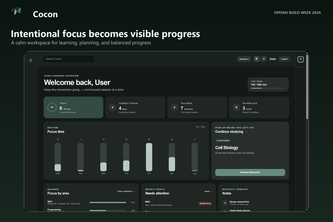
What the company appears to be: Cocon is a self-reported study workspace tool built by one developer (Bakzhanay Sagyndykova) for personal use during her own learning journey. It is described as an adaptive study workspace that connects focus time with learning context, tracking time across topics, sections, and flashcards to reveal what needs attention next.
What changed: The author states she built Cocon over months using ChatGPT and Django while learning the framework. During OpenAI Build Week, she used GPT-5.6 via Codex as a codebase-wide collaborator to refactor and improve the architecture. The tool evolved from feature-by-feature development into a coherent application with hierarchical time attribution, Pomodoro sessions, and automatic study-plan progress tracking.
Single most important open question: Is there evidence of actual user adoption or traction beyond the author's personal use? The description contains no data on users, revenue, customers, or product-market fit beyond self-reported usage.
What The Product Actually Is
The description states that Cocon is a study workspace designed to connect focus time with learning context. It allows users to organize learning as Topic → Section → Subject → Notes / Flashcards and capture materials in their exact context. Key features include:
- Persistent Pomodoro sessions that record intentional focus rather than passive time
- Time attribution rolled up through the hierarchy (e.g., 25 minutes spent reviewing flashcards contributes to multiple levels)
- Automatic study-plan progress updates without double-counting sessions
- Dashboard showing progress, balance, planned work, and underattended areas
- Low-stimulation mode for reducing interface pressure
The tool is built with Python/Django, SQLite, HTML/CSS/JS, and integrates AI tools like ChatGPT and Codex during development.
Evidence: Self-reported by the author. No independent verification or external data provided.
Positioning & Claim Evolution
The author positions Cocon as a solution to two core problems:
- Visibility of completed work: "Knowledge can feel as if it does not count because I no longer remember every evening spent building it."
- Balance across multiple learning goals: "I can spend hours deeply focused on one area and only notice later that another important goal has received almost no attention."
The tool aims to answer not just "How long did I focus?" but also "What was that time for, where does it belong, and what have I actually been building?"
Evolution described:
- Started with feature-by-feature development using ChatGPT
- Later used Gemini as an independent reviewer
- During OpenAI Build Week, GPT-5.6 in Codex helped refactor the Django architecture and implement complex workflows
Inference: The positioning evolved from a personal productivity tool to one that addresses broader learning context management and time attribution challenges.
Target Customer & ICP
The description does not explicitly define target customers or ideal customer profiles (ICP). However, based on the author's stated use cases, it appears aimed at:
- Self-directed learners
- Students preparing for exams (e.g., IMAT)
- Individuals studying programming, languages, music, and exercise
- People who experience hyperfocus but struggle to track progress across multiple domains
The tool is described as being used by its creator, suggesting a strong personal use case rather than a defined market segment.
Evidence: Self-reported usage patterns of the author. No external customer data or segmentation provided.
Business Model & Pricing Evidence
There is no evidence of any business model or pricing structure in the description. The tool is described as a personal project built with AI assistance, and there is no mention of monetization, subscriptions, or sales.
Evidence: Not evidenced.
Technical & Delivery Signals
The author reports:
- Built using Python 3.12, Django 6, SQLite
- Vanilla JavaScript, HTML, CSS
- Server-side ownership validation for user data
- Persistent timer state and focus-session API endpoints
- Context segments for hierarchical time attribution
- Automatic plan progress without double-counting sessions
- 66 automated tests and GitHub Actions integration
- Fresh-database migration verification
The repository is local-first, excluding personal databases, uploads, environment files, and secrets from Git.
Evidence: Self-reported technical details. No third-party validation or infrastructure information provided.
Traction & Maturity Signals
There are no signals of traction or maturity beyond the author's own usage:
- The team size is listed as 1
- The project was submitted to a hackathon (OpenAI 2026)
- No mention of users, customers, revenue, ARR, or adoption metrics
- The author describes ongoing improvements and future plans
Evidence: Not evidenced.
Competitive Context
The description does not provide any information about competitors or competitive positioning. It does not reference existing tools in the study/workspace or productivity space.
Evidence: Not evidenced.
Open Questions & Risks
- Single-person development: Only one team member (the author) is listed, which raises questions about scalability and long-term maintenance.
- No external validation or traction: No evidence of users, customers, or product-market fit beyond personal use.
- Self-reported only: All claims are unverified; no third-party data or audits exist.
- Limited commercialization: No indication of monetization strategy or business model.
- AI dependency: Heavy reliance on AI tools for development suggests potential fragility if those tools change or become unavailable.
Inference: The lack of external validation and traction makes it difficult to assess whether this addresses a real market need beyond the creator’s personal experience.
Questions the description leaves open
- What specific problems have you observed in your own learning that led you to build Cocon?
- Have you tested Cocon with others outside of yourself? If so, how did they respond?
- How do you plan to scale beyond a single-user tool?
- Are there any plans for monetization or commercialization?
- What are the key assumptions about user behavior that underpin your design decisions?
- How do you intend to ensure data privacy and security given that it's a local-first system?
Overall Assessment
Assessment: Not evidenced.
The description provides no information on revenue, customers, traction, or commercial viability. It is a self-reported personal project with no external validation. The tool appears to be in early development stage and lacks any indication of market demand or product-market fit beyond the author’s own use.
This is not a commercial due-diligence-ready opportunity based on the evidence provided. Any investment or partnership decision would require additional data on user adoption, market size, competitive landscape, and business model viability.
Confidence level: Low — the entire analysis rests on unverified self-reporting with no external corroboration.
User Stories BotA demo video on every pull request
Get a demo video on every new feature
GitHub App that watches your pull requests and records a narrated, captioned demo.
Save time on demo prep and make informed decisions faster with a video walkthrough of every new feature.
Source
Submitted to the OpenAI 2026 hackathon on Devpost. Project home on Devpost. Back to the full gallery on Devpost.
This competitive analysis was produced by top-founders.com (opens in a new tab)
Generated by a language model from this project's public Devpost page — its tagline, the author's own write-up and any built-with tags listed there — as captured in August 2026. Short quotations are the author's words. It is an opinion on the idea as a business, not on the people behind it, and it reflects the description as published then. If the project has moved on, request a correction below. The analysis is not independent research and contains no verified traction, revenue or customer data.
An independent guide by KFG International LLC — not affiliated with, endorsed by, or connected to Devpost or OpenAI.