

Archive position — measured, not model output
0 likes on Devpost
2,263 of the 7,850 archived projects have more likes, and 5,587 share exactly 0 — so this project's #7,255 place in the like-ranked listing is a tie-break inside that group, not a ranking.
Projects (log scale)
Likes on Devpost. ▲ marks this project's group.
Show the figures
| Likes | Projects | Share of archive |
|---|---|---|
| 0 | 5,587 | 71.2% |
| 1 | 1,758 | 22.4% |
| 2 | 284 | 3.6% |
| 3–4 | 132 | 1.7% |
| 5–9 | 75 | 1.0% |
| 10+ | 14 | 0.2% |
 User Stories BotA demo video on every pull request
Get a demo video on every new feature
GitHub App that watches your pull requests and records a narrated, captioned demo.
Save time on demo prep and make informed decisions faster with a video walkthrough of every new feature.
Executive Summary
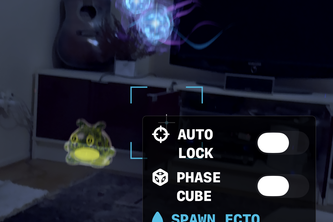
The Veil is an augmented reality (AR) ghost-hunting game for iPhone, built as a hackathon project by one developer, Tilo Delau. The app uses ARKit, RealityKit, and Metal to render spectral anomalies and ghosts in the real world. It includes features like a spectral scanner, animated companion, and ghost manifestation. The project is self-reported as an MVP demonstrating core gameplay mechanics.
The author states that the game aims to make the real world "haunted" for casual, spontaneous play with friends. It leverages GPT-5.6 and Codex to accelerate development, particularly in rendering and experimentation.
Key commercial due-diligence question
Is there a viable path from this hackathon prototype to a sustainable product or business model? The description offers no evidence of revenue, customers, or traction beyond the initial build.
What The Product Actually Is
The description states that The Veil is an AR ghost-hunting game for iPhone. It uses:
- ARKit
- RealityKit
- Swift
- SwiftUI
- Metal shaders
- GPT-5.6
- Codex
Features include:
- Spectral scanner
- Animated Ecto companion
- Spectral anomaly detection
- Custom RealityKit rendering
- Essence collection
- Ghost manifestation
The author describes it as a "mobile AR game" where users can "open up your phone at any time and engage with it."
Inference The product is an experimental, single-developer AR game prototype. It is not evidenced to have reached market or user adoption.
Positioning & Claim Evolution
The description states that the inspiration for The Veil was to create a casual, spontaneous game for friends to play together. The author describes it as a way to "make real life a bit entertaining" and treat the world as a "game world."
The positioning is self-reported: it is an AR ghost-hunting game where users interact with paranormal activity in their environment.
Inference The project is positioned as a casual, social AR game. It is not evidenced to have evolved from any prior product or market positioning.
Target Customer & ICP
The author states that the goal was to create a game for "friends casually and spontaneously." There is no further segmentation of customer type or persona described.
Not evidenced No evidence of target customer demographics, usage patterns, or specific user needs beyond casual play.
Business Model & Pricing Evidence
There is no evidence in the description of any business model or pricing strategy. The project is described as a hackathon MVP with no mention of monetization, subscriptions, or sales.
Inference No commercial model is evident from the description.
Technical & Delivery Signals
The project was built using:
- Swift
- SwiftUI
- ARKit
- RealityKit
- Metal
- GPT-5.6
- Codex
The author notes that:
- Codex accelerated development, particularly in rendering and shader iteration.
- The biggest technical challenge was generating 3D models for ghosts.
- A custom rendering pipeline was built using layered entities, Metal shaders, geometry deformation, emission, and transparency.
Inference The project is technically ambitious for a single developer. It shows early-stage experimentation with AR rendering and AI-assisted development.
Traction & Maturity Signals
The description states that this is a hackathon MVP, not a product in the market. It includes:
- A prototype
- Core gameplay loop
- No evidence of revenue, users, or adoption
Not evidenced No traction data, user metrics, or commercial milestones.
Competitive Context
There is no mention of competitors or market context in the description. The author does not reference existing AR games, ghost-hunting apps, or similar products.
Not evidenced No competitive analysis or positioning relative to other players.
Open Questions & Risks
- Single developer: The project is built by one person (Tilo Delau), which raises questions about scalability and long-term maintenance.
- Hackathon MVP: The product is described as a prototype, not a finished product. No evidence of market readiness or commercial viability.
- Technical complexity: The author notes significant technical challenges in rendering ghosts and building custom pipelines, suggesting high development risk.
- No monetization strategy: There is no evidence of any business model or pricing approach.
Inference The project is at an early stage with no demonstrated path to market traction or revenue.
Questions the description leaves open
- What is the plan for transitioning from this hackathon MVP to a product that can be monetized?
- Are there any plans for user acquisition, community building, or marketing?
- How does the team intend to scale beyond one developer?
- What are the technical and artistic challenges that remain unresolved?
- Is there any interest in partnerships or distribution channels?
Overall Assessment
The description states that The Veil is a hackathon project, not a commercial product. There is no evidence of revenue, customers, or traction. The project is described as an MVP with no business model or monetization strategy.
Inference At this stage, the project has no demonstrated commercial viability or investment potential. It is an experimental prototype with no evidence of market demand or sustainable growth path.
The author states that the goal was to create a casual, spontaneous game for friends, but there is no indication that this idea has evolved into anything beyond a proof-of-concept.
User Stories BotA demo video on every pull request
Get a demo video on every new feature
GitHub App that watches your pull requests and records a narrated, captioned demo.
Save time on demo prep and make informed decisions faster with a video walkthrough of every new feature.
Source
Submitted to the OpenAI 2026 hackathon on Devpost. Project home on Devpost. Back to the full gallery on Devpost.
This competitive analysis was produced by top-founders.com (opens in a new tab)
Generated by a language model from this project's public Devpost page — its tagline, the author's own write-up and any built-with tags listed there — as captured in August 2026. Short quotations are the author's words. It is an opinion on the idea as a business, not on the people behind it, and it reflects the description as published then. If the project has moved on, request a correction below. The analysis is not independent research and contains no verified traction, revenue or customer data.
An independent guide by KFG International LLC — not affiliated with, endorsed by, or connected to Devpost or OpenAI.