

Archive position — measured, not model output
0 likes on Devpost
2,263 of the 7,850 archived projects have more likes, and 5,587 share exactly 0 — so this project's #7,245 place in the like-ranked listing is a tie-break inside that group, not a ranking.
Projects (log scale)
Likes on Devpost. ▲ marks this project's group.
Show the figures
| Likes | Projects | Share of archive |
|---|---|---|
| 0 | 5,587 | 71.2% |
| 1 | 1,758 | 22.4% |
| 2 | 284 | 3.6% |
| 3–4 | 132 | 1.7% |
| 5–9 | 75 | 1.0% |
| 10+ | 14 | 0.2% |
 User Stories BotA demo video on every pull request
Get a demo video on every new feature
GitHub App that watches your pull requests and records a narrated, captioned demo.
Save time on demo prep and make informed decisions faster with a video walkthrough of every new feature.
Executive Summary
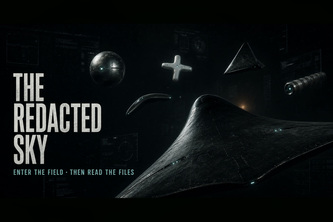
The Redacted Sky is a self-reported 3D immersive experience built as a hackathon submission for the OpenAI 2026 hackathon. The project presents 334 recently declassified UAP (Unidentified Aerial Phenomena) records in an interactive, spatially organized interface using React, Next.js, TypeScript, and Three.js. It allows users to explore official footage and metadata through a cinematic capture sequence, with the ability to classify what they saw as Ordinary, Sensor Ambiguity, Insufficient, or Anomalous — though this classification is stored only on the user's device.
The description states that the experience begins with an artist reconstruction labeled as such, followed by a deep-space field containing all 334 records. Users can interact with live video signals and inspect source context before making their own judgment. The project was built using Cloudflare Workers and OpenAI Codex, with GPT-5.6 Sol High used as the primary design-engineering collaborator.
The most important open question is whether this project has any commercial traction or evidence of a viable business model beyond its hackathon submission. There is no evidence of revenue, customers, or adoption beyond the author's own description.
What The Product Actually Is
- The Redacted Sky is described as an immersive 3D experience that turns 334 declassified UAP records into an interactive field.
- It uses React, Next.js, TypeScript, and Three.js for frontend rendering.
- The interface includes a realistic 3D UAP form labeled as an artist reconstruction.
- Users can hover over live video signals to trigger a cinematic capture sequence that reveals official footage.
- Source metadata and original links remain visible during interaction.
- The experience allows users to classify what they saw into four categories: Ordinary, Sensor Ambiguity, Insufficient, or Anomalous — though this classification is stored only on the user's device.
- It includes six reconstructed UAP morphologies as contextual forms and three official videos as featured signals.
Positioning & Claim Evolution
- The description states that the project was inspired by a public-information problem: fragmented UAP source material across hundreds of media types.
- The design principle is described as "experience first, evidence second, judgment last."
- The goal was to make the archive accessible without sensationalizing it.
- The author claims the experience allows visitors to inspect footage and decide for themselves without the interface making decisions.
- The project positions itself as a way to present official records in an immersive format while preserving uncertainty.
Target Customer & ICP
- Not evidenced. The description does not specify target customers or ideal customer profiles beyond general public interest in UAP content.
Business Model & Pricing Evidence
- Not evidenced. There is no mention of pricing, monetization strategy, or business model in the provided description.
Technical & Delivery Signals
- Built with React, Next.js, TypeScript, and Three.js.
- Uses Cloudflare Workers for deployment.
- OpenAI Codex was used end-to-end for product framing, interaction design, modeling, data pipeline implementation, UI iteration, testing, and deployment.
- GPT-5.6 Sol High was used inside Codex as the primary design-engineering collaborator.
- The project includes deterministic ingestion scripts that normalize JSON output from official releases.
- The browser experience renders 334 records as spatial artifacts and six reconstructed UAP morphologies.
- The final build is Cloudflare Workers-compatible.
Traction & Maturity Signals
- Not evidenced. No data on user engagement, adoption, revenue, or customer base is provided beyond the author's own account.
Competitive Context
- Not evidenced. No information about competitors or market positioning is included in the description.
Open Questions & Risks
- The project is described as a hackathon submission with no evidence of commercial traction.
- The classification system stores responses only on the user’s device, suggesting limited data collection or aggregation capabilities.
- There is no indication that the project has moved beyond prototype or demonstration stage.
- The use of GPT-5.6 Sol High and OpenAI Codex suggests heavy reliance on AI tools rather than traditional product development processes.
Questions the description leaves open
- What is the intended long-term vision for this platform beyond its current hackathon demo?
- Are there plans to monetize or scale this experience, and if so, how?
- How does the team plan to handle potential legal or regulatory issues related to UAP data?
- Has there been any feedback from government agencies or UAP researchers regarding the project?
- What is the roadmap for expanding beyond the current 334 records and three featured signals?
Overall Assessment
- Not evidenced. No information on valuation, funding rounds, or investment interest is available in the description.
- The project appears to be a prototype built as part of a hackathon submission with no evidence of commercial viability or traction.
- The lack of revenue, customer data, or business model details makes it difficult to assess potential for investment or partnership.
User Stories BotA demo video on every pull request
Get a demo video on every new feature
GitHub App that watches your pull requests and records a narrated, captioned demo.
Save time on demo prep and make informed decisions faster with a video walkthrough of every new feature.
Source
Submitted to the OpenAI 2026 hackathon on Devpost. Project home on Devpost. Back to the full gallery on Devpost.
This competitive analysis was produced by top-founders.com (opens in a new tab)
Generated by a language model from this project's public Devpost page — its tagline, the author's own write-up and any built-with tags listed there — as captured in August 2026. Short quotations are the author's words. It is an opinion on the idea as a business, not on the people behind it, and it reflects the description as published then. If the project has moved on, request a correction below. The analysis is not independent research and contains no verified traction, revenue or customer data.
An independent guide by KFG International LLC — not affiliated with, endorsed by, or connected to Devpost or OpenAI.