

Archive position — measured, not model output
0 likes on Devpost
2,263 of the 7,850 archived projects have more likes, and 5,587 share exactly 0 — so this project's #3,321 place in the like-ranked listing is a tie-break inside that group, not a ranking.
Projects (log scale)
Likes on Devpost. ▲ marks this project's group.
Show the figures
| Likes | Projects | Share of archive |
|---|---|---|
| 0 | 5,587 | 71.2% |
| 1 | 1,758 | 22.4% |
| 2 | 284 | 3.6% |
| 3–4 | 132 | 1.7% |
| 5–9 | 75 | 1.0% |
| 10+ | 14 | 0.2% |
 User Stories BotA demo video on every pull request
Get a demo video on every new feature
GitHub App that watches your pull requests and records a narrated, captioned demo.
Save time on demo prep and make informed decisions faster with a video walkthrough of every new feature.
Executive Summary
Company: Cloudkeep Rivals
Self-reported basis: The description is entirely self-reported by the author, Burak Yarbaşı, and unverified. No third-party corroboration exists for any claims made.
What it appears to be: A tactical fantasy strategy game built by a single medical doctor using AI tools (GPT-5.6 in Codex) as an engineering collaborator. The project evolved from a personal experiment into a production-ready system with authenticated progression and backend hardening during a hackathon.
What changed: The author states that the Build Week extension hardened the game's systems to support account-scoped, server-controlled progression, including protections against race conditions, replay risks, and unauthorized client-side economy changes.
Most important open question: Is there any evidence of real user adoption or monetization beyond the author’s own playtesting and submission?
What The Product Actually Is
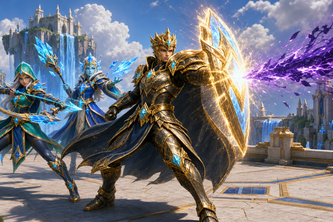
The description states that Cloudkeep Rivals is a tactical fantasy strategy game set on floating islands, where players collect and upgrade heroes, develop their home island, choose battle modes, build teams, and fight lane-based encounters with distinct skills and roles.
It also states:
- The client is built in Unity and C#.
- The backend uses Supabase Edge Functions in Deno/TypeScript with PostgreSQL.
- The game supports both guest mode (for immediate play without account creation) and authenticated progression (with server-scoped state).
- It includes account/session-scoped Unity authority client, server-owned wallet, energy, resources, buildings, hero training, battles, and trusted progression.
Inference: The product is a mobile game with a hybrid architecture that separates guest and authenticated play paths. It uses AI tools (GPT-5.6 in Codex) to assist in building and hardening the backend systems.
Positioning & Claim Evolution
The author states:
- Cloudkeep Rivals began as an experiment to prove that a non-engineer can build a real, playable game using AI.
- It evolved during Build Week into a release-ready system, with a focus on making the game's progression trustworthy and secure.
Claim: The project is positioned as a proof-of-concept for solo developers using AI tools to create production-grade software.
Inference: The positioning has shifted from “personal experiment” to “release-ready product,” based on the author’s own claims, not external validation or adoption.
Target Customer & ICP
The description states:
- Players are tactical fantasy strategy gamers, who engage with heroes, island development, and lane-based battles.
- The game supports both guest mode (for new players/judges) and authenticated progression (for real players).
Inference: The target customer is likely a niche audience of mobile strategy gamers. The ICP appears to be mobile users interested in tactical fantasy games, with an emphasis on authenticated progression for long-term engagement.
Business Model & Pricing Evidence
The description does not state:
- Any pricing model.
- Revenue streams.
- Monetization strategy.
- Whether the game is free-to-play, paid, or subscription-based.
Not evidenced: No business model or pricing evidence is provided in the self-reported description.
Technical & Delivery Signals
The author states:
- The client is built in Unity and C#, backend in Deno/TypeScript with PostgreSQL.
- AI tools (GPT-5.6 in Codex) were used to:
- Map code
- Design migrations
- Generate adversarial contract tests
- Implement and review changes
- Diagnose race conditions and replay risks
- The system includes idempotent receipts, replay protection, concurrency guards, and fail-closed validation.
- There are 133 passing Deno cross-layer contract tests and 48 Unity C# test files with 319 test cases.
Inference: The technical architecture shows a deliberate effort to harden the backend for production use. The use of AI as an engineering collaborator is a key delivery signal, but no evidence of scalability or performance in real-world usage.
Traction & Maturity Signals
The description states:
- The game can be downloaded and played.
- It includes a private review repository with dated source snapshot and test suite.
- The author built it while continuing medical work, suggesting solo development.
Not evidenced: No data on user adoption, retention, downloads, or monetization. No evidence of real players beyond the author’s own playtesting.
Competitive Context
The description does not state:
- Competitors
- Market positioning
- Product differentiation from existing games
- Any mention of similar products in the market
Not evidenced: No competitive context is provided in the self-reported description.
Open Questions & Risks
- Solo developer model: The project is built by a single person (a doctor), which raises questions about long-term maintenance, scalability, and team structure.
- AI dependency: Heavy reliance on AI tools (GPT-5.6 in Codex) may not be sustainable or replicable without access to those tools.
- No monetization or traction evidence: The project is described as a personal experiment with no revenue or user data.
- Unverified claims: All claims are self-reported, and there is no independent verification of the technical or business claims.
Questions the description leaves open
- What is the actual user base or download count for Cloudkeep Rivals?
- How does the AI-assisted development model scale to larger teams or more complex systems?
- Are there any plans for monetization, and how do you intend to acquire users?
- What are the long-term maintenance plans for the backend architecture?
- Is there a plan to transition from solo development to a team structure?
Overall Assessment
Not evidenced: No financial data, revenue, or traction is provided in the self-reported description. The project is described as a personal experiment and hackathon submission with no evidence of commercial viability or market traction.
Confidence level: Low — based entirely on self-reporting and not verified by any external source.
Inference: While the technical execution shows effort and competence, there is no evidence of product-market fit, user adoption, or monetization. The project appears to be a proof-of-concept rather than a commercial entity.
User Stories BotA demo video on every pull request
Get a demo video on every new feature
GitHub App that watches your pull requests and records a narrated, captioned demo.
Save time on demo prep and make informed decisions faster with a video walkthrough of every new feature.
Source
Submitted to the OpenAI 2026 hackathon on Devpost. Project home on Devpost. Back to the full gallery on Devpost.
This competitive analysis was produced by top-founders.com (opens in a new tab)
Generated by a language model from this project's public Devpost page — its tagline, the author's own write-up and any built-with tags listed there — as captured in August 2026. Short quotations are the author's words. It is an opinion on the idea as a business, not on the people behind it, and it reflects the description as published then. If the project has moved on, request a correction below. The analysis is not independent research and contains no verified traction, revenue or customer data.
An independent guide by KFG International LLC — not affiliated with, endorsed by, or connected to Devpost or OpenAI.