

Archive position — measured, not model output
1 like on Devpost
505 of the 7,850 archived projects have more likes, and 1,758 share exactly 1 — so this project's #2,047 place in the like-ranked listing is a tie-break inside that group, not a ranking.
Projects (log scale)
Likes on Devpost. ▲ marks this project's group.
Show the figures
| Likes | Projects | Share of archive |
|---|---|---|
| 0 | 5,587 | 71.2% |
| 1 | 1,758 | 22.4% |
| 2 | 284 | 3.6% |
| 3–4 | 132 | 1.7% |
| 5–9 | 75 | 1.0% |
| 10+ | 14 | 0.2% |
 User Stories BotA demo video on every pull request
Get a demo video on every new feature
GitHub App that watches your pull requests and records a narrated, captioned demo.
Save time on demo prep and make informed decisions faster with a video walkthrough of every new feature.
Executive Summary
What the company appears to be
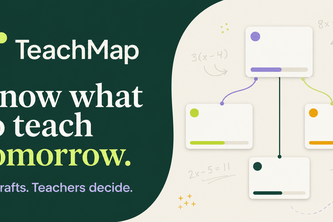
TeachMap is a self-reported mobile-friendly Progressive Web Application (PWA) designed for educators in Kenya’s competency-based curriculum (CBC) environment. It allows teachers to photograph handwritten student work, upload it, and use an AI system (GPT-5.6) to analyze responses, generate rubric-aligned feedback, identify class-wide misconceptions, and suggest reteaching priorities.
What changed
The project was submitted as part of the OpenAI 2026 hackathon by a single founder, Winston W. It is described as a minimal viable product (MVP) built over a short development period (Build Week), with no evidence of prior traction or revenue.
Single most important open question
Is there sufficient evidence that TeachMap has been tested in real classrooms and validated for utility among teachers before considering further investment or partnership?
What The Product Actually Is
The description states that TeachMap is a mobile-friendly Progressive Web Application (PWA). It enables teachers to:
- Photograph or upload handwritten student work.
- Enter or edit a marking rubric in plain language.
- Use GPT-5.6 for handwriting transcription, reasoning analysis, and rubric alignment.
- Review draft assessments with confidence flags for unclear text or uncertain interpretations.
- Receive class-level misconception maps and suggested reteaching plans.
- Export printable feedback sheets and downloadable summaries.
It is built using technologies including Next.js 16, React 19, TypeScript, Tailwind CSS, OpenAI Responses API (GPT-5.6), and Codex for development support.
Inference: The product appears to be a workflow tool that integrates AI into existing teacher practices around formative assessment, aiming to reduce time spent marking while improving insight into student learning patterns.
Positioning & Claim Evolution
The description claims TeachMap aims to solve the challenge of formative assessment in large Kenyan classrooms, where teachers must review many handwritten scripts quickly and provide timely feedback. It positions itself as an alternative to tools that focus only on scoring, instead offering:
- Rubric-based draft assessments
- Individual learner feedback
- Class misconception maps
- Practical teaching guidance
The author notes that the initial scope was narrow — focusing on one-page handwritten algebra responses — but intends to expand into other STEM subjects and support multilingual feedback.
Inference: The positioning evolved from a hackathon MVP to a scalable educational tool, though no evidence supports prior use or validation beyond internal testing.
Target Customer & ICP
The description states that TeachMap targets teachers in Kenya’s public schools, particularly those working under the Competency-Based Curriculum (CBC), where:
- Class sizes can be large (40–80 learners)
- Teachers are expected to assess continuously
- There is limited access to digital infrastructure and devices
- Marking time is constrained
The target user is described as a teacher in a resource-constrained environment, who needs tools that work on phones or computers without requiring scanners or dedicated software.
Inference: The ICP is narrowly defined around Kenyan educators using CBC, but the long-term vision includes broader African markets and curriculum adaptations.
Business Model & Pricing Evidence
No explicit business model or pricing information is provided in the description. The project is described as a hackathon submission with no mention of monetization strategies, customer acquisition plans, or revenue streams.
Inference: There is no evidence of any commercial structure beyond the initial prototype and pilot testing phase.
Technical & Delivery Signals
The product is built as a Progressive Web Application (PWA) using:
- Frontend: React 19, Next.js 16, TypeScript, Tailwind CSS
- Backend/APIs: OpenAI Responses API (GPT-5.6), Codex
- Storage and caching: Browser File Reader API, Cache Storage API, Web Storage API, Service Worker API
- Mobile support: Responsive web design, mobile browsers
It supports batch processing of student work and includes structured outputs to ensure consistency in AI responses.
Inference: The technical stack suggests a lightweight, scalable approach that works offline for basic UI but requires internet access for GPT processing. It is designed with limited connectivity in mind.
Traction & Maturity Signals
The description states that this is a Build Week hackathon MVP, submitted to the OpenAI 2026 competition. There is no evidence of:
- Revenue
- Customers
- Users
- Product adoption
- Market testing
- Prior versions or iterations
The authors mention they are piloting with Kenyan teachers, but no data on pilot outcomes or feedback is included.
Inference: The product exists only as a prototype and has not yet demonstrated traction or maturity in real-world use.
Competitive Context
No competitive landscape is described. However, the author notes that many AI assessment tools focus on producing scores rather than providing actionable insights for teachers.
The solution appears to be differentiated by:
- Emphasis on teacher review and judgment
- Focus on class-level misconception mapping
- Integration with rubric-based formative assessment
- Use of GPT-5.6 for reasoning and feedback generation
Inference: The competitive advantage lies in its alignment with CBC principles and its emphasis on practical utility over automation alone, though no direct competitors are named.
Open Questions & Risks
- Unproven market fit: No evidence of real classroom testing or validated adoption.
- AI reliability concerns: Uncertainty in handwriting recognition and rubric interpretation may lead to incorrect feedback unless thoroughly reviewed by teachers.
- Scalability assumptions: The MVP focuses on algebra; expansion into other subjects and languages is stated but not demonstrated.
- Privacy and data handling: While anonymization is mentioned, no details are given about how student data will be protected or managed at scale.
- Dependency on GPT-5.6: Reliance on a proprietary API may pose risks related to availability, cost, and control.
Inference: The project lacks validation and real-world usage, which raises significant risk for any commercial or investment move.
Questions the description leaves open
- Has TeachMap been tested in actual Kenyan classrooms? If so, what were the results?
- What specific rubrics or curriculum standards does it support currently?
- How is teacher approval integrated into the workflow? Is there a mechanism for correcting AI-generated feedback?
- Are there any privacy or data governance frameworks in place for handling student information?
- What are the plans for scaling beyond Kenya, and how will local curricula be adapted?
- What kind of support does the team have for deploying the tool in schools (e.g., training, partnerships)?
- How is the product being validated with teachers — through surveys, interviews, or usability testing?
Overall Assessment
Not evidenced
There is no evidence of revenue, customers, traction, or validated market demand to support an investment or partnership decision at this stage.
The project is described as a hackathon MVP, and while it shows potential in addressing a real need in Kenyan education, it has not yet demonstrated viability or utility outside of its initial prototype phase.
Confidence level: Low. The self-reported nature of the description and lack of external validation make any conclusion premature.
User Stories BotA demo video on every pull request
Get a demo video on every new feature
GitHub App that watches your pull requests and records a narrated, captioned demo.
Save time on demo prep and make informed decisions faster with a video walkthrough of every new feature.
Source
Submitted to the OpenAI 2026 hackathon on Devpost. Project home on Devpost. Back to the full gallery on Devpost.
This competitive analysis was produced by top-founders.com (opens in a new tab)
Generated by a language model from this project's public Devpost page — its tagline, the author's own write-up and any built-with tags listed there — as captured in August 2026. Short quotations are the author's words. It is an opinion on the idea as a business, not on the people behind it, and it reflects the description as published then. If the project has moved on, request a correction below. The analysis is not independent research and contains no verified traction, revenue or customer data.
An independent guide by KFG International LLC — not affiliated with, endorsed by, or connected to Devpost or OpenAI.