

Archive position — measured, not model output
0 likes on Devpost
2,263 of the 7,850 archived projects have more likes, and 5,587 share exactly 0 — so this project's #4,010 place in the like-ranked listing is a tie-break inside that group, not a ranking.
Projects (log scale)
Likes on Devpost. ▲ marks this project's group.
Show the figures
| Likes | Projects | Share of archive |
|---|---|---|
| 0 | 5,587 | 71.2% |
| 1 | 1,758 | 22.4% |
| 2 | 284 | 3.6% |
| 3–4 | 132 | 1.7% |
| 5–9 | 75 | 1.0% |
| 10+ | 14 | 0.2% |
 User Stories BotA demo video on every pull request
Get a demo video on every new feature
GitHub App that watches your pull requests and records a narrated, captioned demo.
Save time on demo prep and make informed decisions faster with a video walkthrough of every new feature.
Executive Summary
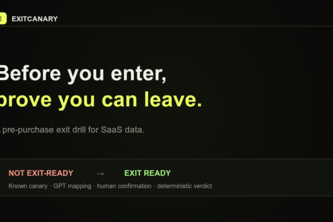
What the company appears to be: ExitCanary is a self-reported SaaS data exit drill tool designed for pre-purchase evaluation of vendor data portability. It allows users to test whether a SaaS vendor’s export functionality preserves operational structure and business relationships, using synthetic data and deterministic checks.
What changed: The project was submitted as part of the OpenAI 2026 hackathon, indicating it is in an early-stage prototype or proof-of-concept phase. No commercial traction, revenue, or customer data are evidenced.
Single most important open question: Is there a real market need for pre-purchase SaaS data exit drills, and if so, how does ExitCanary differentiate from existing vendor compliance or migration tools?
Note: This analysis is based entirely on the self-reported project description provided by the author. No external verification, revenue figures, customer names, or traction data are available.
What The Product Actually Is
The description states that ExitCanary is a bounded pre-purchase exit drill for SaaS data. It works by:
- Placing a versioned synthetic 33-field CRM canary in a trial.
- Requesting the vendor’s advertised CSV, JSON, or ZIP export.
- Uploading the returned packet and reviewing proposed field mappings.
- Receiving a deterministic assessment: EXIT_READY, NOT_EXIT_READY, or NEEDS_REVIEW.
It includes:
- A deterministic evaluator that runs nine bounded checks.
- A receipt with SHA-256 digest over canary, evaluator, normalized packet, confirmed mapping, and assessment.
- No evidence persistence, store:false, and zero automatic retries.
- A public judge build that is intentionally keyless and fallback-only.
Inference: The tool is a data portability testing mechanism, not a migration or export tool per se. It is designed to assess the quality of vendor exports rather than perform actual migrations.
Positioning & Claim Evolution
The author states:
- SaaS buying usually asks whether a team can get data in.
- ExitCanary asks the harder question: can the team get its operational structure back out?
- It is designed to detect silent data flattening, dropped custom fields, or changed semantics during migration.
Claim: The tool addresses a gap in SaaS purchasing decisions — specifically, the lack of reliable pre-purchase exit testing.
Inference: ExitCanary positions itself as a pre-purchase risk mitigation tool for enterprise buyers concerned about vendor lock-in and data portability. It is not a general-purpose data export or migration tool.
Target Customer & ICP
The description states:
- The tool is designed to be useful at a real buying moment: before money and data become locked into a system.
- It targets SaaS buyers, particularly those using CRM systems.
- It is built for enterprise buyers, not individual users.
Inference: The ICP appears to be enterprise procurement teams or IT decision-makers evaluating SaaS vendors with CRM or data-heavy tools. It may also appeal to compliance or security teams concerned with vendor lock-in.
Not evidenced: No specific customer personas, buyer roles, or use cases beyond CRM are detailed.
Business Model & Pricing Evidence
The description states:
- The public judge build is intentionally keyless and fallback-only.
- The video labels a controlled synthetic live GPT-5.6 run.
- The project was built for the OpenAI 2026 hackathon, suggesting it is not yet monetized.
Not evidenced: No pricing model, monetization strategy, or commercial roadmap is described.
Inference: If monetized, ExitCanary may be a SaaS tool with usage-based or subscription pricing. The public demo suggests a freemium or open-source model for early access.
Technical & Delivery Signals
The author states:
- Built with: codex, gpt-5.6, jszip, next.js, node.js, openai, papa, react, responses, tailwind, typescript, vercel, vitest, zod.
- Uses strict schemas, bounded parsing, origin checks, no evidence persistence, store:false, and zero automatic retries.
- GPT-5.6 is used only for proposing semantic mappings; it does not decide or change the assessment.
- The evaluator runs nine bounded checks and creates a deterministic receipt with SHA-256 digest.
Inference: The tool is built with strong technical rigor, including deterministic evaluation, bounded inputs, and adversarial testing. It uses AI as an assistant, not a decision-maker.
Traction & Maturity Signals
The description states:
- The project was submitted to the OpenAI 2026 hackathon.
- The flawed synthetic fixture produces six failures and three passes.
- The complete fixture produces nine passes and a new digest.
- Tested source passed 12 Vitest files / 86 tests, five public-preflight tests, seven public-smoke tests, a production build, and a production dependency audit.
Not evidenced: No revenue, customers, or adoption data are provided. The tool is not yet in production or commercial use.
Inference: The project shows early-stage maturity with testing, validation, and a functional prototype. It is not yet a product in the market.
Competitive Context
The description does not mention competitors directly. However, it implies a gap in the market for:
- Pre-purchase SaaS data exit testing.
- Tools that validate vendor export quality before contract signing.
Inference: ExitCanary may compete with or complement existing tools like:
- Vendor compliance checkers
- Data migration platforms
- Enterprise procurement or risk management tools
Not evidenced: No competitive landscape, market size, or direct competitor names are provided.
Open Questions & Risks
- The tool is in a prototype or hackathon stage, with no commercial traction.
- It is not yet monetized and has no evidence of revenue or pricing.
- The public demo is intentionally keyless and fallback-only — may not reflect full functionality.
- The use of GPT-5.6 for mapping implies dependency on AI outputs, which may not scale or be reliable in production.
- No evidence of customer feedback, user testing, or real-world adoption.
Inference: The project has strong technical design but lacks commercial viability or market traction.
Questions the description leaves open
- What is the actual market need for pre-purchase SaaS data exit drills?
- How does ExitCanary compare to existing vendor compliance or migration tools?
- Is there a plan to monetize this tool, and what pricing model are you considering?
- How do you intend to scale beyond the current prototype?
- What is your go-to-market strategy for enterprise buyers?
- Are there any real-world SaaS vendors who have expressed interest in using this tool?
Overall Assessment
Not evidenced: No financials, funding rounds, or investment history are provided.
Inference: This is an early-stage prototype with strong technical design and a clear problem statement. It may be attractive to investors or partners looking for innovation in SaaS data portability or procurement risk management. However, it is not yet a product in the market and lacks commercial traction or evidence of customer demand.
Confidence level: Low — based on self-reported evidence only, with no third-party validation or commercial data.
User Stories BotA demo video on every pull request
Get a demo video on every new feature
GitHub App that watches your pull requests and records a narrated, captioned demo.
Save time on demo prep and make informed decisions faster with a video walkthrough of every new feature.
Source
Submitted to the OpenAI 2026 hackathon on Devpost. Project home on Devpost. Back to the full gallery on Devpost.
This competitive analysis was produced by top-founders.com (opens in a new tab)
Generated by a language model from this project's public Devpost page — its tagline, the author's own write-up and any built-with tags listed there — as captured in August 2026. Short quotations are the author's words. It is an opinion on the idea as a business, not on the people behind it, and it reflects the description as published then. If the project has moved on, request a correction below. The analysis is not independent research and contains no verified traction, revenue or customer data.
An independent guide by KFG International LLC — not affiliated with, endorsed by, or connected to Devpost or OpenAI.