

Archive position — measured, not model output
0 likes on Devpost
2,263 of the 7,850 archived projects have more likes, and 5,587 share exactly 0 — so this project's #7,157 place in the like-ranked listing is a tie-break inside that group, not a ranking.
Projects (log scale)
Likes on Devpost. ▲ marks this project's group.
Show the figures
| Likes | Projects | Share of archive |
|---|---|---|
| 0 | 5,587 | 71.2% |
| 1 | 1,758 | 22.4% |
| 2 | 284 | 3.6% |
| 3–4 | 132 | 1.7% |
| 5–9 | 75 | 1.0% |
| 10+ | 14 | 0.2% |
 User Stories BotA demo video on every pull request
Get a demo video on every new feature
GitHub App that watches your pull requests and records a narrated, captioned demo.
Save time on demo prep and make informed decisions faster with a video walkthrough of every new feature.
Executive Summary
What the company appears to be
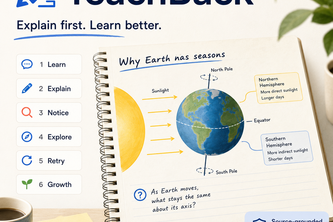
TeachBack is a self-reported educational tool built as a hackathon project that uses AI to support formative learning by having learners explain ideas first, then identifying one conceptual gap and offering targeted visual feedback before asking them to retry their explanation.
What changed
The project is described as an MVP submitted to the OpenAI 2026 hackathon. It includes a six-stage loop (Learn → Explain → Notice → Explore → Retry → Growth) with AI-powered concept analysis and deterministic visual interventions, but no evidence of commercial traction or product-market fit beyond its demo.
Single most important open question
Is there any evidence that this approach to formative learning has been validated in real-world educational settings, or whether learners actually benefit from the specific design choices made (e.g., byte-for-byte preservation of attempts, strict validation, no grades)?
What The Product Actually Is
The description states that TeachBack is a responsive web application built with Next.js 16, React 19, and TypeScript, deployed on Vercel. It uses GPT-5.6 via the OpenAI Responses API for server-side processing of learner explanations.
It implements a six-stage learning loop:
- Learn: review trusted lesson content and source fragments.
- Explain: describe the idea without seeing help.
- Notice: GPT-5.6 identifies one supported idea, one misconception, with citations.
- Explore: deterministic axial-tilt visual targeted to that gap.
- Retry: explain again without model answer to copy.
- Growth: compare both unchanged attempts against same lesson and show observations about what changed.
The application enforces strict validation rules:
- Only known source IDs allowed.
- Learner excerpts must appear exactly in unchanged text.
- Guidance limited to 120 words, one reflection question.
- No grades, scores, mastery claims, ability labels, or diagnostic judgments.
- Safe interrupted-request recovery without losing learner work.
It includes a deterministic SVG visual for Earth seasons and printable records (Learner and Teacher views). The system is described as having 21 unit tests and an 8-test browser suite.
The product is account-free, uses fictional responses in its demo, and was built by a team led by Codex (a developer role), who also implemented the architecture, state machine, validation logic, interface, and documentation.
Positioning & Claim Evolution
The description states that TeachBack works differently from traditional AI tutoring systems. It claims to address the problem of answer-first AI tools making misconceptions worse by requiring learners to explain first before receiving help.
It positions itself as a formative support tool, not a grader, test engine, diagnosis tool, or general-purpose answer generator.
The author's own write-up suggests that the product is designed around the idea that:
- The meaningful artifact is not the generated explanation but the learner’s conceptual change.
- Provenance and refusal behavior must be visible product states.
- AI should reveal thinking instead of replacing it.
There is no evidence of prior positioning or evolution in claims beyond this single project submission.
Target Customer & ICP
The description does not state a specific target customer or ideal customer profile (ICP). It mentions:
- A public demo teaching "Why Earth has seasons".
- The system supports learners who are explaining ideas.
- It includes printable records for both Learner and Teacher views.
However, there is no indication of:
- Who the intended users are beyond general learners.
- Whether it targets K–12, higher education, corporate training, or other segments.
- Any segmentation strategy or user persona development.
Business Model & Pricing Evidence
There is no evidence in the description of a business model or pricing structure. The project is described as an MVP submitted to a hackathon and does not mention:
- Revenue streams.
- Customer acquisition plans.
- Subscription tiers or usage-based pricing.
- Licensing models.
- Monetization strategy.
Technical & Delivery Signals
The system is built using:
- Next.js 16, React 19, TypeScript
- GPT-5.6 via OpenAI Responses API
- Playwright for testing
- Zod for structured outputs
- Vercel for deployment
Key technical features include:
- Server-side processing of GPT responses.
- Strict validation of learner inputs and model outputs.
- Deterministic visuals (SVG axial tilt explorer).
- Byte-for-byte preservation of learner attempts.
- Safe handling of interrupted requests.
- Accessible design with reduced-motion support.
The project includes:
- 21 unit tests.
- 8 browser tests (desktop/mobile).
- A state machine.
- Typed contracts.
- Implementation led by Codex.
Traction & Maturity Signals
There is no evidence of traction or maturity beyond the hackathon submission. The description states:
- Team size: 0
- No named members
- No revenue, customers, or adoption data
- No prior funding rounds or valuation
- No production usage outside of demo
- No mention of user feedback, retention, or engagement metrics
The project is described as a single-lesson MVP with plans for future features, but no indication that any of those have been implemented or tested.
Competitive Context
There is no evidence in the description of competitive analysis or awareness of existing tools. The author does not reference:
- Competitors in AI tutoring.
- Platforms like Khan Academy, Duolingo, Coursera, or others.
- Existing formative assessment tools.
- Prior art in educational technology.
The project appears to be self-contained and unanchored to any known market context.
Open Questions & Risks
Several risks and open questions are evident from the description:
- No team or headcount: The project is described as having zero team members, which raises questions about execution capability.
- Unproven educational impact: There is no evidence that learners actually benefit from this approach or that the design choices improve learning outcomes.
- Limited scope: The MVP only covers one lesson (Earth seasons), and there are no signs of scalability or broader curriculum support.
- No commercial viability: No business model, pricing, or monetization strategy is evident.
- High technical complexity with low validation: While it implements strict validation, there is no evidence that this has been tested in real-world settings.
Questions the description leaves open
- What is the rationale behind choosing GPT-5.6 over other models for concept identification?
- How does the team plan to validate that learners actually change their conceptual understanding through this process?
- Are there any plans to test this with real students or educators before scaling?
- What are the key assumptions about how learners interact with the system, and how were they validated?
- How will the product scale beyond a single lesson if it is designed around deterministic visuals and strict validation?
- Is there any intention to integrate with existing LMS platforms or educational institutions?
- What would constitute success for this product in terms of adoption or impact?
Overall Assessment
There is no evidence that TeachBack has reached a stage suitable for investment or partnership. The project is described as an MVP submitted to a hackathon, with no traction, revenue, customers, or validated business model.
The description indicates:
- A strong technical foundation and clear design intent.
- A unique approach to formative learning.
- No indication of commercial readiness or market validation.
Assessment: Not ready for investment or partnership. This is an early-stage concept with potential but no demonstrated path to product-market fit or scalability. Further due diligence would require evidence of real-world testing, user feedback, and a defined go-to-market strategy.
User Stories BotA demo video on every pull request
Get a demo video on every new feature
GitHub App that watches your pull requests and records a narrated, captioned demo.
Save time on demo prep and make informed decisions faster with a video walkthrough of every new feature.
Source
Submitted to the OpenAI 2026 hackathon on Devpost. Project home on Devpost. Back to the full gallery on Devpost.
This competitive analysis was produced by top-founders.com (opens in a new tab)
Generated by a language model from this project's public Devpost page — its tagline, the author's own write-up and any built-with tags listed there — as captured in August 2026. Short quotations are the author's words. It is an opinion on the idea as a business, not on the people behind it, and it reflects the description as published then. If the project has moved on, request a correction below. The analysis is not independent research and contains no verified traction, revenue or customer data.
An independent guide by KFG International LLC — not affiliated with, endorsed by, or connected to Devpost or OpenAI.