

Archive position — measured, not model output
0 likes on Devpost
2,263 of the 7,850 archived projects have more likes, and 5,587 share exactly 0 — so this project's #3,233 place in the like-ranked listing is a tie-break inside that group, not a ranking.
Projects (log scale)
Likes on Devpost. ▲ marks this project's group.
Show the figures
| Likes | Projects | Share of archive |
|---|---|---|
| 0 | 5,587 | 71.2% |
| 1 | 1,758 | 22.4% |
| 2 | 284 | 3.6% |
| 3–4 | 132 | 1.7% |
| 5–9 | 75 | 1.0% |
| 10+ | 14 | 0.2% |
 User Stories BotA demo video on every pull request
Get a demo video on every new feature
GitHub App that watches your pull requests and records a narrated, captioned demo.
Save time on demo prep and make informed decisions faster with a video walkthrough of every new feature.
Executive Summary
What the company appears to be
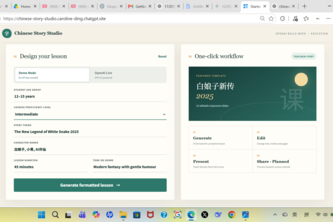
Chinese Story Studio is a self-reported tool built by one developer (Caroline Ding) that uses AI to generate structured, editable 12-page Chinese classroom slide decks from teacher inputs. It is positioned as an educational aid for Chinese language teachers aiming to reduce time spent on lesson preparation.
What changed
The project was submitted as part of the OpenAI 2026 hackathon and describes a functional prototype built using AI tools like GPT-5.6 and Codex, with no evidence of prior commercial traction or revenue.
The single most important open question — the commercial due-diligence read
Is there any evidence that this tool has been adopted by teachers or schools, or that it generates any revenue? The description contains no data on usage, customers, pricing, or monetization.
What The Product Actually Is
The description states that Chinese Story Studio is a web application that turns a teacher’s lesson idea into a structured, editable 12-page classroom slide deck designed for a 45-minute Chinese lesson. It includes:
- Inputs: student age group, proficiency level, lesson theme, character names, duration, tone or genre.
- Outputs: cover page, learning goals, character introductions, three story sections, dialogue, vocabulary with pinyin and English, storyboard, comprehension questions, classroom activity, lesson wrap-up.
- Features: editable text, reorder/duplicate pages, media links, presentation mode, teacher-only notes, download/export.
The product is described as not replacing teachers but providing a framework for lesson planning while allowing teachers to retain control over content and adaptation.
Evidence
- The author describes the inputs, outputs, and features.
- It was built using chatgpt-sites, CSS3, GPT-5.6, HTML5, OpenAI Codex, React, TypeScript, Vite, Web Speech API.
- The tool is said to be designed for a teacher-first workflow.
Inference It appears to be an AI-assisted lesson-planning tool tailored for Chinese language educators in classroom settings.
Positioning & Claim Evolution
The author states that the goal was to reduce repetitive slide preparation while keeping teachers in control of the final lesson. The product is positioned as a solution to the time-consuming task of organizing teaching ideas into structured presentations.
It claims to be built from real teaching experience and designed to meet specific classroom needs such as structure, readability, timing, editability, and presentation controls.
The author also emphasizes that the tool does not generate unlimited plans but provides a strong 12-page framework, leaving room for teacher customization.
Evidence
- “I built Chinese Story Studio from my own experience as a Chinese language teacher and multimedia lesson creator.”
- “The goal was simple: From teaching idea to classroom-ready Chinese slides in one click.”
- “It provides a strong 12-page teaching framework, while teachers keep professional control over additional content and classroom adaptation.”
Inference The positioning evolved from solving a personal problem into a tool for educators seeking efficiency in lesson planning.
Target Customer & ICP
The description states that the primary users are Chinese language teachers who spend significant time preparing classroom presentations. The tool targets those looking to streamline lesson creation without sacrificing control or pedagogical judgment.
It is designed for use in 45-minute lessons and supports various age groups and proficiency levels.
Evidence
- “Chinese language teachers often spend many hours turning a teaching idea into a complete classroom presentation.”
- “The product is not designed to replace teachers or generate an unlimited lesson plan.”
- “Teachers enter student age group, Chinese proficiency level, lesson theme…”
Inference The ICP likely includes educators in K–12 or adult education contexts who teach Chinese as a second language and require structured, editable materials.
Business Model & Pricing Evidence
There is no evidence of pricing, monetization strategy, or business model in the description. The author does not mention any revenue streams, subscriptions, licensing fees, or sales channels.
Evidence
- No mention of pricing.
- No indication of how the tool would be sold or distributed.
- No reference to enterprise or individual user tiers.
Inference The project appears to be a prototype with no commercial model described. It may be intended for personal use or future monetization, but there is no evidence of either.
Technical & Delivery Signals
The application was built using React, TypeScript, Vite, and various OpenAI APIs including Codex and GPT-5.6. The author notes that the development process involved defining scope, designing lesson structure, building input forms, implementing demo/live modes, creating workspace, adding controls, testing in browser, and refining content.
Challenges included handling Chinese characters, pinyin, media embedding, API response formatting, and ensuring content fits within slide containers.
Evidence
- Built with: chatgpt-sites, CSS3, GPT-5.6, HTML5, OpenAI Codex, React, TypeScript, Vite, Web Speech API.
- Development process included defining scope, designing lesson structure, building input form, implementing modes, workspace creation, controls, testing, and content refinement.
- Technical issues included API responses returning HTML instead of JSON, overflow problems, pinyin spacing, media handling.
Inference The tool is a browser-based web app built with modern frontend technologies and AI integration. It has undergone iterative development and testing.
Traction & Maturity Signals
There is no evidence of traction or adoption beyond the author’s own development and testing. No customer base, usage metrics, or feedback from users are mentioned.
Evidence
- The project was submitted to a hackathon.
- The author built it alone (team size: 1).
- No mention of users, downloads, or engagement data.
- No revenue, ARR, or funding rounds are referenced.
Inference This is a prototype or early-stage product with no demonstrated market traction or commercial success.
Competitive Context
The description does not provide information about competitors or similar tools in the educational technology space. It does not reference existing platforms for lesson planning or AI-powered teaching aids.
Evidence
- No mention of competitors.
- No comparison to other tools or platforms.
- No indication of market saturation or differentiation strategy.
Inference It is unclear whether this tool competes with existing lesson-planning software or fills a gap in the market. There is no competitive positioning data.
Open Questions & Risks
Key risks include:
- Lack of commercial viability: No evidence of revenue, customers, or monetization strategy.
- Single-person development: The tool was built by one person, raising questions about scalability and long-term maintenance.
- Unproven market demand: No indication that teachers are actively using or requesting such a tool.
- AI dependency risk: Heavy reliance on GPT-5.6 and Codex may pose risks if these tools change or become unavailable.
- Limited scope: The product is narrowly focused on 12-page Chinese slide decks, which may limit its appeal or utility.
Evidence
- No revenue, customers, or monetization strategy.
- One-person team.
- Prototype nature (submitted to hackathon).
- No mention of market research or user feedback.
Inference Without traction or a clear path to monetization, the tool is at high risk of remaining a prototype without commercial viability.
Questions the description leaves open
- Has the tool been tested with actual teachers? What was their feedback?
- Are there any plans for monetization or distribution beyond personal use?
- How does the tool handle multilingual content beyond Chinese?
- What are the technical limitations of using GPT-5.6 and Codex in a classroom context?
- Is there any plan to expand beyond 12-page slide decks or support other subjects?
- What is the long-term vision for scaling this product?
Overall Assessment
Not evidenced.
There is no evidence of revenue, customers, traction, or business model to assess potential investment value or partnership opportunity.
The project appears to be a prototype built by one individual as part of a hackathon submission. It lacks commercial signals and has not demonstrated adoption or monetization.
Confidence level Low — based on self-reported description only, with no external validation or data on usage, customers, or financials.
User Stories BotA demo video on every pull request
Get a demo video on every new feature
GitHub App that watches your pull requests and records a narrated, captioned demo.
Save time on demo prep and make informed decisions faster with a video walkthrough of every new feature.
Source
Submitted to the OpenAI 2026 hackathon on Devpost. Project home on Devpost. Back to the full gallery on Devpost.
This competitive analysis was produced by top-founders.com (opens in a new tab)
Generated by a language model from this project's public Devpost page — its tagline, the author's own write-up and any built-with tags listed there — as captured in August 2026. Short quotations are the author's words. It is an opinion on the idea as a business, not on the people behind it, and it reflects the description as published then. If the project has moved on, request a correction below. The analysis is not independent research and contains no verified traction, revenue or customer data.
An independent guide by KFG International LLC — not affiliated with, endorsed by, or connected to Devpost or OpenAI.