

Archive position — measured, not model output
1 like on Devpost
505 of the 7,850 archived projects have more likes, and 1,758 share exactly 1 — so this project's #1,270 place in the like-ranked listing is a tie-break inside that group, not a ranking.
Projects (log scale)
Likes on Devpost. ▲ marks this project's group.
Show the figures
| Likes | Projects | Share of archive |
|---|---|---|
| 0 | 5,587 | 71.2% |
| 1 | 1,758 | 22.4% |
| 2 | 284 | 3.6% |
| 3–4 | 132 | 1.7% |
| 5–9 | 75 | 1.0% |
| 10+ | 14 | 0.2% |
 User Stories BotA demo video on every pull request
Get a demo video on every new feature
GitHub App that watches your pull requests and records a narrated, captioned demo.
Save time on demo prep and make informed decisions faster with a video walkthrough of every new feature.
Executive Summary
Project: Kaaval
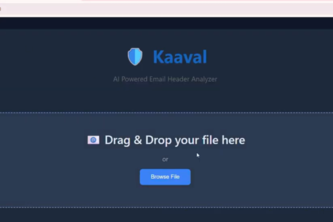
Author's Self-Reported Purpose: An AI-powered email header analyzer built for cybersecurity professionals to detect phishing, validate SPF/DKIM/DMARC, extract IOCs, and generate SOC investigation reports.
Key Claim: The tool automates email security analysis using local LLMs (Gemma 3) and FastAPI, reducing analyst time.
What Changed: The author states they built this as a personal project for a cybersecurity hackathon, integrating AI into email header parsing and threat detection.
Single Most Important Open Question: Is there any evidence of real-world usage or integration with existing security tools?
This is a self-reported, unverified account of a single-person cybersecurity tool project submitted to a hackathon. No revenue, customers, traction, or product-market fit data are available beyond the author’s own description.
What The Product Actually Is
The description states that Kaaval is an AI-powered email header analyzer. It uses:
- Python
- FastAPI
- Ollama
- Gemma 3 (4B parameter model)
- ChatGPT for development assistance
It claims to:
- Analyze email headers
- Validate SPF/DKIM/DMARC
- Extract IOCs (Indicators of Compromise)
- Detect phishing indicators
- Generate AI-assisted SOC investigation reports
Inference: The tool appears to be a proof-of-concept or prototype built for a hackathon, not a commercial product. It is not evidenced to be in production or used by others.
Positioning & Claim Evolution
The author states:
- They were "fascinated with email analysis" and wanted to automate phishing detection.
- The tool helps security analysts reduce time spent on investigation.
- It integrates local LLMs into cybersecurity workflows.
Claim: Kaaval is positioned as a cybersecurity automation tool for SOC analysts, using AI to improve email threat detection and reporting.
Inference: This is a self-positioning statement. No evidence of market validation, customer feedback or product positioning beyond the author’s own description.
Target Customer & ICP
The description states:
- It helps security analysts
- Specifically those working in SOC (Security Operations Center) environments
- Aims to reduce analyst time on email analysis
Inference: The target customer is likely a cybersecurity professional or SOC team member, but there is no evidence of actual customers, use cases, or feedback from such users.
Business Model & Pricing Evidence
The description does not mention:
- Any pricing model
- Revenue streams
- Monetization strategy
- Subscription plans or licensing
Not evidenced: No indication of how the tool would be sold or monetized.
Technical & Delivery Signals
The author states:
- Built with Python, FastAPI, Ollama, Gemma 3
- Used ChatGPT as a programming assistant
- Integrated local LLMs for email analysis
- Handles varied email header formats
- Parses headers and extracts IOCs
Inference: The tool is technically feasible and uses modern stack components. However, it is not evidenced to be in production or scalable beyond the author’s own use.
Traction & Maturity Signals
The description states:
- It was built for a hackathon
- Submitted to the OpenAI 2026 hackathon
- No mention of:
- Customers
- Users
- Product adoption
- Revenue
- Product iteration or feedback loops
Not evidenced: No traction, usage data, or product maturity beyond a prototype.
Competitive Context
The description does not mention:
- Competitors
- Existing tools in the email security or SOC automation space
- Market positioning relative to other solutions
Not evidenced: No competitive analysis or market context provided.
Open Questions & Risks
- Single-person project: No team, no product-market fit evidence.
- Hackathon prototype: Not a commercial-grade tool.
- No revenue or traction: No data on adoption or usage.
- Unverified claims: All functionality is self-reported without independent validation.
- Limited scope: Focuses only on email headers and IOC extraction — not a full security platform.
Questions the description leaves open
- What specific email formats or header structures does the tool support?
- How accurate is the phishing detection and IOC extraction in real-world scenarios?
- Has the tool been tested with actual SOC workflows or integrated into existing systems?
- Are there any plans to expand beyond email headers (e.g., attachments, URLs)?
- What are the limitations of using a local LLM like Gemma 3 for this use case?
- Is there any feedback from cybersecurity professionals who have tried it?
Overall Assessment
Not evidenced: No evidence of product-market fit, revenue, traction or commercial viability.
Inference: This is a personal hackathon project, not a scalable or commercially viable product. It may be a useful prototype for future development but lacks any indication of readiness for investment or partnership.
It is not evident that this tool has moved beyond the idea or prototype stage, nor does it show signs of having been adopted by users or integrated into existing systems.
User Stories BotA demo video on every pull request
Get a demo video on every new feature
GitHub App that watches your pull requests and records a narrated, captioned demo.
Save time on demo prep and make informed decisions faster with a video walkthrough of every new feature.
Source
Submitted to the OpenAI 2026 hackathon on Devpost. Project home on Devpost. Back to the full gallery on Devpost.
This competitive analysis was produced by top-founders.com (opens in a new tab)
Generated by a language model from this project's public Devpost page — its tagline, the author's own write-up and any built-with tags listed there — as captured in August 2026. Short quotations are the author's words. It is an opinion on the idea as a business, not on the people behind it, and it reflects the description as published then. If the project has moved on, request a correction below. The analysis is not independent research and contains no verified traction, revenue or customer data.
An independent guide by KFG International LLC — not affiliated with, endorsed by, or connected to Devpost or OpenAI.