

Archive position — measured, not model output
1 like on Devpost
505 of the 7,850 archived projects have more likes, and 1,758 share exactly 1 — so this project's #1,594 place in the like-ranked listing is a tie-break inside that group, not a ranking.
Projects (log scale)
Likes on Devpost. ▲ marks this project's group.
Show the figures
| Likes | Projects | Share of archive |
|---|---|---|
| 0 | 5,587 | 71.2% |
| 1 | 1,758 | 22.4% |
| 2 | 284 | 3.6% |
| 3–4 | 132 | 1.7% |
| 5–9 | 75 | 1.0% |
| 10+ | 14 | 0.2% |
 User Stories BotA demo video on every pull request
Get a demo video on every new feature
GitHub App that watches your pull requests and records a narrated, captioned demo.
Save time on demo prep and make informed decisions faster with a video walkthrough of every new feature.
Executive Summary
What the company appears to be
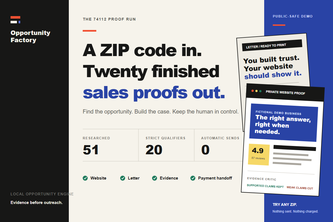
Opportunity Factory is a self-reported AI-powered tool that automatically generates custom websites for local businesses using GPT-5.6 and Codex. It targets reputable businesses with strong public reviews but no independent website, aiming to sell them a $500 setup fee + $25 monthly maintenance plan. The system uses ZIP code as input, discovers qualifying businesses through authorized sources, researches them via AI, creates private concept sites, and sends personalized pitch letters.
What changed
The author describes building an automated workflow that combines AI research, lead generation, and sales conversion into a single system. It includes a dashboard for managing campaigns, evidence tracking, and state transitions between manual and automated steps.
Single most important open question
Is there any actual traction or revenue from the described process? The description states 20 qualified businesses in the 74112 ZIP code have received private sites and letters, but no sales data, customer feedback, or conversion metrics are provided. This is a critical gap for assessing commercial viability.
What The Product Actually Is
The description states that Opportunity Factory uses GPT-5.6 and Codex to build an engine that:
- Discovers businesses through authorized sources
- Applies strict qualification gates (e.g., review rating >4.0, at least 10 reviews, recent review)
- Preserves evidence behind every decision instead of generating unsupported copy
- Builds private, conversion-focused concept sites with industry-specific structure and metadata
- Creates personalized one-page letters with customer URL and QR code
- Merges selected letters into print packets
- Records what actually happened by phone, email, letter, or in person
- Prepares Stripe Checkout plans for $500 setup fee + $25 monthly maintenance
The system is described as being built using Astro, Drizzle-ORM, Netlify, Node.js, OpenAI Codex, OpenAI Responses API, PDF-lib, Playwright, React, SQLite, Stripe, Structured Outputs, TypeScript, Vite, Vitest, Zod.
Inference This appears to be a hybrid system combining AI research and automation with manual outreach and sales steps. It is not a fully autonomous SaaS product but rather an operator tool for generating leads and converting them into website sales.
Positioning & Claim Evolution
The author states:
- Local businesses with strong public reviews are "almost invisible online"
- There's a large gap in the market where these businesses lack independent websites
- AI can quickly and cheaply close this gap
- The project sees this as an opportunity for a win-win partnership between businesses and AI-enabled developers
Inference The positioning is that of a local business enabler using AI to bridge digital visibility gaps. It positions itself as solving a problem in the "local business" segment, not general SaaS or marketplace dynamics.
Target Customer & ICP
The description states:
- The target customer is reputable local businesses with strong public reviews
- These businesses must have high ratings, years of review history, fresh positive feedback, and photos of real work
- They must not currently have an independent website (aside from social media)
- The system starts with a ZIP code as input
Inference
The ICP is defined by:
- Local businesses in a specific geographic area
- Businesses with strong public reviews (rating >4.0, at least 10 reviews, recent review)
- Businesses without independent websites
- Businesses likely to be approached via direct outreach or print letters
Business Model & Pricing Evidence
The description states:
- The business model involves selling custom websites for a $500 setup fee and $25 monthly maintenance
- The system tracks leads/sales through phone, email, letter, or in person
- Stripe Checkout is used for payment processing
- A private concept site is built before the sale
Inference This is a B2B service model where the company acts as an intermediary between local businesses and website creation. It's not a SaaS subscription but rather a one-time setup + recurring fee model.
Technical & Delivery Signals
The description states:
- The system uses GPT-5.6 for research and prep work
- Codex was used during development for implementing packages, coordinating parallel research, and driving Playwright tests
- The dashboard sends compact sales briefs plus evidence ledger through the Responses API
- Structured Outputs are enforced with strict validation
- The tool includes audit trails and explicit state transitions
- There are 186 passing unit/integration tests and 15 passing Playwright checks
Inference There is a strong technical foundation built around AI, automation, and testing. However, the system is described as being in early development (e.g., only one campaign run so far), and no production data or scalability evidence is provided.
Traction & Maturity Signals
The description states:
- The 74112 campaign proves the loop with 51 researched businesses and 20 strict qualifiers
- All 20 now have a private site and print-ready letter
- The author plans to personally reach out to them this week
- No actual sales or customer feedback are reported
Inference There is no evidence of revenue, customers, or conversion. The system has been tested on one ZIP code with 20 businesses, but no verified sales or business responses are documented.
Competitive Context
The description does not mention any competitors or direct market analysis.
Not evidenced
Open Questions & Risks
- No traction or revenue: The author reports only a single campaign run with 20 businesses, but no sales or customer feedback.
- Manual outreach dependency: The system relies heavily on manual outreach (e.g., printing letters), which limits scalability.
- Unproven business model: There is no evidence that businesses will actually purchase the websites or that the pricing model works at scale.
- AI dependency without validation: While GPT-5.6 is used, there's no indication of how well it performs in real-world scenarios or whether it consistently produces high-quality results.
- Limited geographic scope: The system starts with a ZIP code and has not expanded beyond one area.
Questions the description leaves open
- What are the actual conversion rates from outreach to sale?
- How many businesses have you personally contacted, and what were their responses?
- Are there any existing customers or testimonials?
- How do you plan to scale this model beyond one ZIP code?
- What is your strategy for handling objections or rejections from businesses?
- Do you have a plan for verifying the accuracy of AI-generated content?
- How are you ensuring compliance with data privacy regulations (e.g., GDPR, CCPA)?
- What is the expected time investment per business to complete the process?
Overall Assessment
Not evidenced
The description provides no information about revenue, customers, or traction. It describes a system that has been tested on one ZIP code with 20 businesses but does not report any verified sales or customer feedback. The author states they plan to personally reach out to the businesses, but there is no evidence of actual conversions.
This project appears to be in an early stage of development and lacks commercial proof-of-concept. Without data on conversion rates, customer acquisition costs, or revenue, it's impossible to assess its viability as a business model or investment opportunity.
The system shows technical capability and design maturity, but the lack of real-world performance data makes it difficult to evaluate whether this approach will scale or generate returns.
User Stories BotA demo video on every pull request
Get a demo video on every new feature
GitHub App that watches your pull requests and records a narrated, captioned demo.
Save time on demo prep and make informed decisions faster with a video walkthrough of every new feature.
Source
Submitted to the OpenAI 2026 hackathon on Devpost. Project home on Devpost. Back to the full gallery on Devpost.
This competitive analysis was produced by top-founders.com (opens in a new tab)
Generated by a language model from this project's public Devpost page — its tagline, the author's own write-up and any built-with tags listed there — as captured in August 2026. Short quotations are the author's words. It is an opinion on the idea as a business, not on the people behind it, and it reflects the description as published then. If the project has moved on, request a correction below. The analysis is not independent research and contains no verified traction, revenue or customer data.
An independent guide by KFG International LLC — not affiliated with, endorsed by, or connected to Devpost or OpenAI.