

Archive position — measured, not model output
1 like on Devpost
505 of the 7,850 archived projects have more likes, and 1,758 share exactly 1 — so this project's #1,595 place in the like-ranked listing is a tie-break inside that group, not a ranking.
Projects (log scale)
Likes on Devpost. ▲ marks this project's group.
Show the figures
| Likes | Projects | Share of archive |
|---|---|---|
| 0 | 5,587 | 71.2% |
| 1 | 1,758 | 22.4% |
| 2 | 284 | 3.6% |
| 3–4 | 132 | 1.7% |
| 5–9 | 75 | 1.0% |
| 10+ | 14 | 0.2% |
 User Stories BotA demo video on every pull request
Get a demo video on every new feature
GitHub App that watches your pull requests and records a narrated, captioned demo.
Save time on demo prep and make informed decisions faster with a video walkthrough of every new feature.
Executive Summary
What the company appears to be
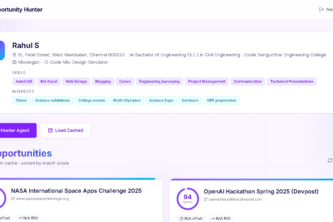
Opportunity Hunter is a self-reported AI-powered platform designed to help users find scholarships, internships, hackathons, and jobs that match their profile. The author states it uses AI to identify opportunities, explain qualification criteria, and assist with application submission before deadlines.
What changed
This project was submitted to the OpenAI 2026 hackathon on Devpost. No prior version or evolution is described; this is a new entry.
Single most important open question
Is there any evidence of user adoption, revenue, or traction beyond the hackathon submission?
What The Product Actually Is
The description states that Opportunity Hunter is an AI tool that finds opportunities (scholarships, internships, hackathons, jobs) that fit a user’s profile. It claims to tell users why they qualify and helps them submit applications before deadlines.
- Evidenced from: Tagline and project submission context.
- Inferred The product likely involves matching algorithms or AI models trained on opportunity data and user profiles.
- Not evidenced Specific features, UI/UX, or functionality beyond the tagline.
Positioning & Claim Evolution
The author positions Opportunity Hunter as an AI assistant that streamlines access to opportunities for students and job seekers. The tagline emphasizes personalization ("that actually fit you"), qualification insight ("tells you why you qualify"), and application support ("helps you get the application in before the deadline").
- Evidenced from: Tagline.
- Inferred The product is positioned as a time-saving, personalized opportunity discovery tool for individuals seeking education or career advancement.
- Not evidenced Market positioning strategy, competitive differentiation, or prior versions of this claim.
Target Customer & ICP
The author implies the primary users are students and job seekers looking for scholarships, internships, hackathons, and jobs. The focus is on people who may not know where to look or how to apply in time.
- Evidenced from: Tagline and context of opportunity types.
- Inferred The target audience is likely young professionals or students with limited access to opportunity networks.
- Not evidenced Specific customer segments, personas, or user research.
Business Model & Pricing Evidence
No information is provided about pricing, monetization, or business model. The description does not mention any paid features, subscriptions, or revenue streams.
- Evidenced from: None.
- Inferred If the product is commercialized, it might be freemium or ad-supported, but this is speculative.
- Not evidenced Business model, pricing tiers, or monetization strategy.
Technical & Delivery Signals
The author lists several technologies used in building the project:
- AI models: deepseek-v4-pro, gpt-oss, minimax-m3, mistral-large-3, openai, openrouter
- Frameworks: fastapi, next.js, react, typescript, python
- Infrastructure: railway, vercel, supabase, pgvector, nvidia-nim
- Tools: tailwind-css, gpt-oss
- Evidenced from: Technology tags.
- Inferred The product likely uses a combination of LLMs and vector databases for matching and personalization.
- Not evidenced Technical architecture, data pipelines, or delivery mechanisms beyond the tech stack.
Traction & Maturity Signals
The only evidence of traction is that this project was submitted to the OpenAI 2026 hackathon. No user base, revenue, or adoption metrics are mentioned.
- Evidenced from: Devpost submission.
- Inferred The product may be in early development or prototype stage.
- Not evidenced Users, customers, ARR, headcount, or usage data.
Competitive Context
No information is provided about competitors or market positioning. The description does not mention existing tools for opportunity discovery or how Opportunity Hunter compares to them.
- Evidenced from: None.
- Inferred There may be existing platforms in this space (e.g., LinkedIn, Handshake, scholarship sites), but no evidence of awareness or comparison.
- Not evidenced Competitive landscape, market size, or differentiation strategy.
Open Questions & Risks
- No revenue or user traction — the product is only a hackathon submission.
- Unproven AI utility — no demonstration of how AI matches users to opportunities.
- Single-founder team — limited capacity for execution and scaling.
- Lack of business model clarity — unclear path to monetization.
- No evidence of market demand — no sign that users are actively seeking this tool.
Questions the description leaves open
- What specific data sources does the AI use to match opportunities to users?
- How is the product currently being tested or validated with real users?
- Is there a plan for monetization, and what is the intended business model?
- What are the key assumptions about user behavior and opportunity discovery?
- How does the team intend to scale beyond the hackathon prototype?
Overall Assessment
Not evidenced.
The project is described as a hackathon submission with no evidence of traction, revenue, or user adoption. The author makes claims about AI matching and personalization but provides no demonstration or validation. There is insufficient evidence to assess commercial viability or investment potential at this stage.
- Confidence: Low.
- Next step: If further information becomes available, revisit the business model, traction signals, and competitive positioning.
User Stories BotA demo video on every pull request
Get a demo video on every new feature
GitHub App that watches your pull requests and records a narrated, captioned demo.
Save time on demo prep and make informed decisions faster with a video walkthrough of every new feature.
Source
Submitted to the OpenAI 2026 hackathon on Devpost. Project home on Devpost. Back to the full gallery on Devpost.
This competitive analysis was produced by top-founders.com (opens in a new tab)
Generated by a language model from this project's public Devpost page — its tagline and any built-with tags listed there, since the author published no write-up — as captured in August 2026. Short quotations are the author's words. It is an opinion on the idea as a business, not on the people behind it, and it reflects the description as published then. If the project has moved on, request a correction below. The analysis is not independent research and contains no verified traction, revenue or customer data.
An independent guide by KFG International LLC — not affiliated with, endorsed by, or connected to Devpost or OpenAI.