

Archive position — measured, not model output
0 likes on Devpost
2,263 of the 7,850 archived projects have more likes, and 5,587 share exactly 0 — so this project's #7,084 place in the like-ranked listing is a tie-break inside that group, not a ranking.
Projects (log scale)
Likes on Devpost. ▲ marks this project's group.
Show the figures
| Likes | Projects | Share of archive |
|---|---|---|
| 0 | 5,587 | 71.2% |
| 1 | 1,758 | 22.4% |
| 2 | 284 | 3.6% |
| 3–4 | 132 | 1.7% |
| 5–9 | 75 | 1.0% |
| 10+ | 14 | 0.2% |
 User Stories BotA demo video on every pull request
Get a demo video on every new feature
GitHub App that watches your pull requests and records a narrated, captioned demo.
Save time on demo prep and make informed decisions faster with a video walkthrough of every new feature.
Executive Summary
What the company appears to be
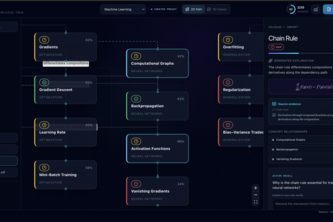
Synapse — Spatial Knowledge Twin is a self-reported educational tool that transforms unstructured text (PDFs, research papers, notes) into interactive 3D and 2D visual knowledge graphs. It supports active recall learning by representing concepts as nodes with mastery states (gap, review, mastered, locked), and allows learners to navigate through prerequisite relationships in real time.
What changed
The project is a hackathon submission, described as a prototype built in one week. The author states it was developed for the OpenAI 2026 hackathon and includes a range of technical claims about local processing, synchronization between views, and fallback systems for AI dependencies.
Single most important open question
Is there any evidence of user adoption, revenue, or traction beyond the single developer’s self-reported prototype?
What The Product Actually Is
The description states that Synapse transforms educational material (PDFs, research papers, notes) into an interactive visual knowledge graph. It offers two views:
- A 3D Galaxy View, powered by
react-force-graph-3d - A 2D Flowchart View, using
@xyflow/react
Each concept is represented as a node with color-coded mastery states:
- 🔴 Knowledge Gap
- 🟡 Review
- 🟢 Mastered
- 🔒 Locked
Clicking a node opens an Active Recall Inspector that includes explanations, KaTeX-rendered formulas, citations, and recall questions. The system updates mastery in real time, unlocks connected concepts, and animates the repair path.
The tool processes documents locally using pdfjs-dist, extracts structured data via a GPT-based workflow (server-side), and validates output with Zod. It uses Dexie and IndexedDB for local progress persistence.
Inference The product is described as a browser-based application built in React/TypeScript, not a SaaS offering or hosted platform.
Positioning & Claim Evolution
The author positions Synapse as an alternative to passive reading and generic AI chatbots. It aims to make learning more active by enabling spatial exploration of concepts and real-time mastery tracking.
Key claims:
- “Stop passively reading. Start navigating your learning.”
- “Transform linear text into an interactive 3D knowledge galaxy”
- “Creates a more visual, spatial learning experience”
These are marketing-style positioning statements rather than evidence of traction or product-market fit.
Inference The project evolved from a hackathon idea into a prototype with technical depth, but no indication it has moved beyond that stage.
Target Customer & ICP
The description states Synapse is intended for students studying long textbook chapters or dense research papers. It is designed to help them:
- Explore concepts
- Identify weak prerequisites
- Master what they are learning
It also mentions potential future use cases like teachers creating knowledge graphs and classroom analytics.
Inference The primary ICP appears to be individual learners (students), with a possible expansion toward educators or curriculum developers. No evidence of specific customer segments beyond this.
Business Model & Pricing Evidence
There is no mention of pricing, monetization, or business model in the description.
Not evidenced
Technical & Delivery Signals
The author built Synapse using:
- Frontend: React, TypeScript, Vite, Tailwind CSS
- 3D Visualization:
react-force-graph-3d - 2D Visualization:
@xyflow/react - PDF Parsing:
pdfjs-dist - AI Processing: GPT-based workflow (server-side)
- Validation: Zod schema validation
- Local Storage: Dexie + IndexedDB
- Math Rendering: KaTeX
- Architecture Tools: Codex
Challenges addressed include:
- Maintaining synchronization between 2D and 3D views
- Performance optimization for WebGL rendering
- Handling complex PDF layouts and formatting
- Free-response answer evaluation with rubrics and misconception detection
Inference The tool is a client-side web application that can function without backend services, though it relies on AI APIs during processing.
Traction & Maturity Signals
The project is described as a hackathon submission, built in one week. It includes:
- A functional prototype
- Local processing capabilities
- Multi-view UI with real-time updates
- Fallback architecture for API failures
However, there is no evidence of:
- Users or customers
- Revenue or monetization
- Product adoption metrics
- Customer feedback or usage data
Not evidenced
Competitive Context
The description does not mention any competitors. It implies Synapse aims to improve upon generic AI tools and traditional reading methods.
Not evidenced
Open Questions & Risks
- Single Developer: Only one team member is listed, suggesting limited development capacity or scalability.
- Prototype Status: The tool is described as a hackathon prototype with no evidence of further development or traction.
- AI Dependency Risk: While fallbacks exist, the system still depends heavily on external AI APIs for processing and evaluation.
- No Commercial Evidence: No revenue, customers, or product-market fit data are provided.
- Unproven Market Demand: The author makes claims about user needs but provides no evidence of demand or market validation.
Questions the description leaves open
- What is the actual user base or pilot group for this tool?
- Has there been any feedback from students or educators on usability or effectiveness?
- How does Synapse handle complex document types like scanned PDFs, tables, diagrams, or multilingual content?
- Are there plans to integrate with existing LMS platforms or educational institutions?
- What are the technical limitations of the current prototype that would need to be addressed for production use?
- Is there any plan to monetize or scale beyond a personal tool?
Overall Assessment
This is a self-reported hackathon prototype with no evidence of commercial traction, revenue, customers, or product-market fit.
The author describes a technically ambitious and conceptually interesting idea, but the project remains in early-stage development. No indication exists that it has moved beyond the prototype phase or gained any form of user adoption.
Confidence Level Low
Assessment Not ready for investment or partnership consideration without further evidence of traction, product-market fit, or commercial viability.
User Stories BotA demo video on every pull request
Get a demo video on every new feature
GitHub App that watches your pull requests and records a narrated, captioned demo.
Save time on demo prep and make informed decisions faster with a video walkthrough of every new feature.
Source
Submitted to the OpenAI 2026 hackathon on Devpost. Project home on Devpost. Back to the full gallery on Devpost.
This competitive analysis was produced by top-founders.com (opens in a new tab)
Generated by a language model from this project's public Devpost page — its tagline, the author's own write-up and any built-with tags listed there — as captured in August 2026. Short quotations are the author's words. It is an opinion on the idea as a business, not on the people behind it, and it reflects the description as published then. If the project has moved on, request a correction below. The analysis is not independent research and contains no verified traction, revenue or customer data.
An independent guide by KFG International LLC — not affiliated with, endorsed by, or connected to Devpost or OpenAI.