

Archive position — measured, not model output
0 likes on Devpost
2,263 of the 7,850 archived projects have more likes, and 5,587 share exactly 0 — so this project's #3,160 place in the like-ranked listing is a tie-break inside that group, not a ranking.
Projects (log scale)
Likes on Devpost. ▲ marks this project's group.
Show the figures
| Likes | Projects | Share of archive |
|---|---|---|
| 0 | 5,587 | 71.2% |
| 1 | 1,758 | 22.4% |
| 2 | 284 | 3.6% |
| 3–4 | 132 | 1.7% |
| 5–9 | 75 | 1.0% |
| 10+ | 14 | 0.2% |
 User Stories BotA demo video on every pull request
Get a demo video on every new feature
GitHub App that watches your pull requests and records a narrated, captioned demo.
Save time on demo prep and make informed decisions faster with a video walkthrough of every new feature.
Executive Summary
Company: CascadeOps
Self-reported basis: The description is entirely self-reported by the author, unverified, and drawn from a Devpost submission for the OpenAI 2026 hackathon. No external evidence or third-party corroboration exists.
What it appears to be: A proof-of-concept tool that uses AI to automate policy change propagation across dependent documents, with deterministic verification and human approval gates. It is built as a Next.js/TypeScript application and demonstrates a simulated workflow for updating a refund clause.
What changed: The project is a prototype submitted to a hackathon; it does not appear to have evolved beyond its initial demo state.
Single most important open question: Is there evidence of real-world adoption, traction or product-market fit beyond the demo?
What The Product Actually Is
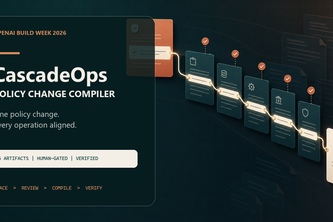
The description states that CascadeOps is a tool that treats policy changes as source code and traces dependencies to propose edits across artifacts. It uses a compiler-like model where:
- A policy change is the source.
- Dependent artifacts are traced.
- AI (GPT-5.6) generates patch proposals tied to exact anchors.
- Human decisions are required before compilation.
- Verification runs deterministic assertions to ensure correctness.
- The system exports a JSON receipt with evidence and checksums.
It is built as a strict Next.js and TypeScript application using Zod schemas, Vitest for testing, Playwright for browser QA, and GitHub Actions for CI/CD. It operates in two modes:
- Simulated Replay (default, credential-free).
- Live GPT-5.6 with structured outputs and no fallback.
The system does not write to external systems, provides no legal advice, and is limited to in-memory artifact handling.
Evidence: Self-reported by the author.
Inference: The tool is a proof-of-concept for AI-assisted policy change management, built as a web application with deterministic verification and human approval gates.
Positioning & Claim Evolution
The tagline “One policy change. Every operation aligned.” positions CascadeOps as a solution to the problem of fragmented policy updates across documents. The author claims that:
- Policy changes are not isolated.
- Manual tracking is slow and hard to audit.
- The system uses a compiler-like mental model for traceability and automation.
The project evolved from a hackathon submission, with no indication of prior product development or market traction. It is described as a focused demo, not a production-ready tool.
Evidence: Self-reported by the author.
Inference: The positioning is aspirational — it claims to solve a real problem in policy governance but has no evidence of adoption or commercial use beyond the demo.
Target Customer & ICP
The description does not name specific customers or personas. It implies a target audience of organizations with:
- Policy-heavy operations.
- Need for auditability and traceability of changes.
- Use of SOPs, templates, checklists, etc., that may be affected by policy updates.
It is not clear whether the tool targets legal teams, compliance officers, HR departments, or IT operations. The demo focuses on refund window changes, but no customer segment is explicitly named.
Evidence: Not evidenced.
Inference: Likely aimed at enterprises with complex internal documentation and governance needs, but no explicit ICP defined.
Business Model & Pricing Evidence
There is no evidence of a business model or pricing structure in the description. The project is described as a hackathon demo with no mention of monetization, licensing, or customer acquisition.
Evidence: Not evidenced.
Inference: No commercial model is evident beyond the demo.
Technical & Delivery Signals
The system is built with:
- Next.js and TypeScript.
- Zod schemas for validation.
- Vitest for testing.
- Playwright for browser QA.
- GitHub Actions for CI/CD.
- Structured Outputs from GPT-5.6.
- Deterministic verification logic in TypeScript.
It uses a strict state machine to enforce approval gates, separates compilation from verification, and avoids silent fallbacks.
Evidence: Self-reported by the author.
Inference: The technical stack is modern and well-structured for a prototype. It shows attention to safety, determinism, and QA.
Traction & Maturity Signals
The project is described as a hackathon submission with no evidence of traction or adoption. It includes:
- A public MIT repository.
- 24 passing tests.
- Desktop/mobile Playwright tests.
- Accessibility checks.
- Simulated and live demo paths.
It has not been deployed in production, nor does it have any user base, revenue, or customer data.
Evidence: Not evidenced.
Inference: The project is a prototype with no signs of real-world use or product-market fit.
Competitive Context
The description does not mention competitors or market positioning. It is unclear whether CascadeOps is solving an existing problem in the marketplace or introducing a new category.
Evidence: Not evidenced.
Inference: No competitive context is provided, making it difficult to assess its relevance or differentiation in the market.
Open Questions & Risks
- No traction or adoption: The project is a demo with no evidence of real-world use.
- Limited scope: It only handles in-memory artifacts and does not integrate with external systems.
- Unproven commercial viability: No business model, pricing, or customer data are provided.
- High technical risk: Reliance on GPT-5.6 for bounded tasks may be fragile without real-world validation.
- No team or funding: The team is listed as one person (Atchayam Ganesh), with no indication of additional support or investment.
Evidence: Not evidenced.
Inference: The project lacks commercial viability, traction and scalability indicators.
Questions the description leaves open
- What real-world use cases have you identified for this tool beyond the demo?
- Have you tested it with any actual enterprise users or internal teams?
- How would you scale this beyond a single-person prototype?
- Are there plans to integrate with existing document management or compliance tools?
- What is your long-term vision for monetization or product development?
Overall Assessment
Not evidenced.
This project is a hackathon demo with no evidence of traction, revenue, customers, or commercial viability. It is not clear whether the tool has evolved beyond its initial prototype state or whether it addresses a real market need. The author's claims are self-reported and unverified, and there is no indication of any team, funding, or product-market fit.
Confidence: Low.
Next step: If this is a pre-product idea, further due diligence would require evidence of early traction, customer interviews, or a working prototype in a real environment.
User Stories BotA demo video on every pull request
Get a demo video on every new feature
GitHub App that watches your pull requests and records a narrated, captioned demo.
Save time on demo prep and make informed decisions faster with a video walkthrough of every new feature.
Source
Submitted to the OpenAI 2026 hackathon on Devpost. Project home on Devpost. Back to the full gallery on Devpost.
This competitive analysis was produced by top-founders.com (opens in a new tab)
Generated by a language model from this project's public Devpost page — its tagline, the author's own write-up and any built-with tags listed there — as captured in August 2026. Short quotations are the author's words. It is an opinion on the idea as a business, not on the people behind it, and it reflects the description as published then. If the project has moved on, request a correction below. The analysis is not independent research and contains no verified traction, revenue or customer data.
An independent guide by KFG International LLC — not affiliated with, endorsed by, or connected to Devpost or OpenAI.