

Archive position — measured, not model output
2 likes on Devpost
221 of the 7,850 archived projects have more likes, and 284 share exactly 2 — so this project's #478 place in the like-ranked listing is a tie-break inside that group, not a ranking.
Projects (log scale)
Likes on Devpost. ▲ marks this project's group.
Show the figures
| Likes | Projects | Share of archive |
|---|---|---|
| 0 | 5,587 | 71.2% |
| 1 | 1,758 | 22.4% |
| 2 | 284 | 3.6% |
| 3–4 | 132 | 1.7% |
| 5–9 | 75 | 1.0% |
| 10+ | 14 | 0.2% |
 User Stories BotA demo video on every pull request
Get a demo video on every new feature
GitHub App that watches your pull requests and records a narrated, captioned demo.
Save time on demo prep and make informed decisions faster with a video walkthrough of every new feature.
Executive Summary
What the company appears to be
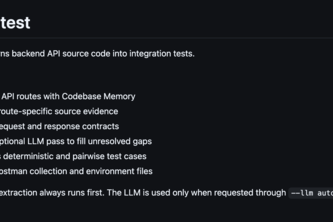
Sydes-test is a Python-based command-line tool that analyzes backend API code repositories (supporting Express, FastAPI, Spring Boot) to extract API contracts, generate test cases, and export Postman collections. It uses deterministic code extraction first, with optional LLM assistance for unresolved gaps.
What changed
The project was built as part of the OpenAI 2026 hackathon. The author states it was developed iteratively using Codex and GPT-5.6 for architecture and debugging decisions, with a focus on framework-neutral extraction strategies and integration with LLMs for handling edge cases.
Single most important open question
Is there any evidence of real-world usage or adoption beyond the hackathon context? The description does not indicate any revenue, customers, or product-market fit beyond the author's own development work.
What The Product Actually Is
The description states that Sydes-test is a Python CLI tool that:
- Analyzes backend repositories to discover API routes.
- Reconstructs request and response contracts.
- Generates test cases.
- Exports Postman files (collections and environments).
- Uses deterministic extraction as the primary method, with optional LLM steps for unresolved gaps.
It supports Express, FastAPI, and Spring Boot frameworks. The tool is described as having a workflow involving three main commands: init, scan, and generate.
The author notes that Codex implemented most of the CLI functionality, including contract extraction, response normalization, test generation, Postman export, debug artifacts, and regression tests.
Inference It appears to be a developer tool aimed at automating API testing workflows by reducing manual effort in understanding and documenting backend APIs. It is not a SaaS product or hosted service but a local CLI utility.
Positioning & Claim Evolution
The tagline states: “Turn backend API code into contracts, test cases, and Postman collections.”
The author's own write-up claims that Sydes-test was inspired by the need to understand backend API structure before generating useful tests. It emphasizes:
- A deterministic-first approach.
- Use of LLMs only for filling gaps.
- Framework-neutral design.
- Integration with CI pipelines and coding agents (future plans).
Inference The positioning appears to be that Sydes-test is a developer productivity tool focused on API contract discovery and automated testing. It positions itself as an aid for developers working with backend APIs, especially in complex or multi-framework environments.
Target Customer & ICP
The description does not state the target customer or ideal customer profile (ICP). The author describes it as a CLI tool used during development, but no explicit user persona is given.
Inference Based on the tool's nature and use case, the likely users are backend developers, QA engineers, or devops teams working with APIs in Express, FastAPI, or Spring Boot frameworks. However, this is inferred from the context and not explicitly stated.
Business Model & Pricing Evidence
There is no evidence of a business model or pricing structure in the description. The tool is presented as a hackathon project, and no mention is made of monetization, subscriptions, or paid features.
Inference It appears to be an open-source or internal tool at this stage, with no commercial model evident from the description.
Technical & Delivery Signals
The author states:
- Built using Python CLI, Codex, and GPT-5.6.
- Uses a deterministic extraction approach first, followed by optional LLM steps.
- Implements route-specific evidence retrieval.
- Supports Express, FastAPI, Spring Boot frameworks.
- Includes debug artifacts, regression tests, and Postman export.
- The LLM is used only for filling unresolved gaps, not for full contract generation.
Inference The tool shows technical maturity in handling multiple frameworks, deterministic logic, and LLM integration. It suggests a modular architecture with clear separation of concerns between deterministic logic and model-assisted steps.
Traction & Maturity Signals
The author states:
- The project has 161 passing tests.
- It generated:
- 9 tests for an Express login route
- 16 tests for a FastAPI user route
- A complete array-of-Book response contract for a Spring WebFlux route using LLM completion
It was built as part of a hackathon, and no evidence of revenue, customers, or product-market fit is provided.
Inference The tool shows some level of development maturity, with test coverage and cross-framework support. However, there is no evidence of real-world usage or adoption beyond the hackathon context.
Competitive Context
There is no mention of competitors in the description. The author does not reference existing tools for API contract generation or automated testing.
Inference The competitive landscape is unclear from this description. It may compete with tools like Postman, Insomnia, Swagger/OpenAPI, or LLM-powered code agents (e.g., GitHub Copilot, Tabnine), but no direct comparison or positioning is made.
Open Questions & Risks
- No commercial traction: The tool was built for a hackathon and lacks evidence of real-world adoption.
- Limited scope: It is a CLI tool with no mention of SaaS or hosted versions.
- Unclear monetization path: No indication of how the product would be monetized.
- Dependency on LLMs: Reliance on GPT-5.6 for some steps may create scalability or cost concerns in future versions.
- No external validation: The description is entirely self-reported, with no third-party verification.
Questions the description leaves open
- What is the intended path to market for Sydes-test? Is it a CLI tool, SaaS product, or integration into existing platforms?
- Has there been any real-world usage beyond the hackathon? Any feedback from developers who tried it?
- How does the tool handle edge cases in large, complex repositories?
- Are there plans to support more frameworks or integrate with CI/CD pipelines?
- What is the long-term vision for monetization or product development?
Overall Assessment
Not evidenced
The description provides no evidence of revenue, customers, traction, or commercial viability beyond a hackathon project. The tool is described as a developer utility built in a short timeframe and lacks any indication of product-market fit or scalability.
Confidence Low This analysis is based entirely on self-reported information with no external validation or historical data. Any inference or assumption must be treated as speculative, not factual.
User Stories BotA demo video on every pull request
Get a demo video on every new feature
GitHub App that watches your pull requests and records a narrated, captioned demo.
Save time on demo prep and make informed decisions faster with a video walkthrough of every new feature.
Source
Submitted to the OpenAI 2026 hackathon on Devpost. Project home on Devpost. Back to the full gallery on Devpost.
This competitive analysis was produced by top-founders.com (opens in a new tab)
Generated by a language model from this project's public Devpost page — its tagline, the author's own write-up and any built-with tags listed there — as captured in August 2026. Short quotations are the author's words. It is an opinion on the idea as a business, not on the people behind it, and it reflects the description as published then. If the project has moved on, request a correction below. The analysis is not independent research and contains no verified traction, revenue or customer data.
An independent guide by KFG International LLC — not affiliated with, endorsed by, or connected to Devpost or OpenAI.