

Archive position — measured, not model output
0 likes on Devpost
2,263 of the 7,850 archived projects have more likes, and 5,587 share exactly 0 — so this project's #7,068 place in the like-ranked listing is a tie-break inside that group, not a ranking.
Projects (log scale)
Likes on Devpost. ▲ marks this project's group.
Show the figures
| Likes | Projects | Share of archive |
|---|---|---|
| 0 | 5,587 | 71.2% |
| 1 | 1,758 | 22.4% |
| 2 | 284 | 3.6% |
| 3–4 | 132 | 1.7% |
| 5–9 | 75 | 1.0% |
| 10+ | 14 | 0.2% |
 User Stories BotA demo video on every pull request
Get a demo video on every new feature
GitHub App that watches your pull requests and records a narrated, captioned demo.
Save time on demo prep and make informed decisions faster with a video walkthrough of every new feature.
Executive Summary
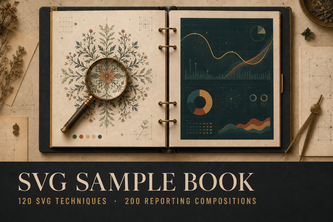
The description states that SVG Sample Book is a tactile interactive catalog presented as a physical wallpaper binder, containing 320 interactive SVG and reporting compositions with reusable code and Codex prompts. It was built by one team member, Dance Doctors East Valley, for the OpenAI 2026 hackathon. The product appears to be an experimental tool aimed at designers and developers seeking visual inspiration and implementation guidance, using technologies like React, Three.js, WebGL, and GPT-5.6. There is no evidence of revenue, customers, or traction beyond the authors' own claims.
Key open question
What is the commercial viability of this tool as a standalone product or service, given its experimental nature and lack of demonstrated market demand?
What The Product Actually Is
The description states that SVG Sample Book is:
- A tactile interactive catalog presented as a physical wallpaper binder
- Contains 320 interactive SVG and reporting compositions
- Includes reusable code and Codex prompts
- Has 120 live SVG, WebGL, shader, geometry, particle, motion, and interaction experiments (Volume I)
- Adds 200 reporting and dashboard compositions using safe fictional example data (Volume II)
- Provides searchable, runnable visual starting points with controls, source code, copyable Codex prompts, favorites, and named project collections
- Offers responsive desktop and mobile experiences
The product is described as a digital tool that mimics the experience of a physical sample book but with interactive elements and implementation guidance.
Positioning & Claim Evolution
The description states:
- The product connects visual inspiration directly to implementation
- It addresses the problem that designers often know what they want visually but not the technical vocabulary needed to begin
- Most inspiration galleries provide finished pictures and stop there, while this one provides working examples with code
- It serves as a bridge between visual recognition and working implementation
- The authors claim it allows designers to point at a treatment, understand its ingredients, manipulate it, and leave with enough code and language to continue
The positioning appears to be that of an educational or implementation tool for designers and developers rather than a commercial product.
Target Customer & ICP
The description states:
- The target audience is designers who know the feeling, movement, or reporting treatment they want but not the technical vocabulary needed to begin
- It serves as a bridge between visual recognition and working implementation
- Designers should be able to point at a treatment, understand its ingredients, manipulate it, and leave with enough code and language to continue
No specific customer segments beyond "designers" are identified in the description.
Business Model & Pricing Evidence
Not evidenced. The description does not contain any information about pricing, monetization strategy, or business model.
Technical & Delivery Signals
The description states:
- Built with React, TypeScript, Vite, native SVG, Three.js, React Three Fiber, WebGL, and GLSL
- Uses typed registries to keep metadata, controls, prompts, renderer, and example data synchronized
- Only the active specimen is mounted
- Motion starts on visitor action
- Reduced-motion preferences are respected
- Direct-manipulation elements remain bounded
- Every interactive page provides a visible reset
- Codex with GPT-5.6 was used as an active design and engineering collaborator
- GPT-5.6 helped translate physical sample-book direction into working React architecture
- GPT-5.6 expanded and audited both catalogs, implemented renderers, and kept controls, metadata, prompts, datasets, and renderers aligned
- Codex supported systematic browser verification across all entries
- Production build checks, responsive QA, and final submission media workflow were supported
Traction & Maturity Signals
Not evidenced. The description does not contain any information about revenue, customers, usage metrics, or product maturity beyond the authors' own claims.
Competitive Context
Not evidenced. The description does not contain any information about competitors or market positioning relative to existing tools.
Open Questions & Risks
- The project was built for a hackathon and is described as experimental
- No evidence of revenue, customers, or traction
- The team size is listed as one person
- The product appears to be a prototype rather than a commercial offering
- The use of GPT-5.6 suggests dependency on AI tools that may not be scalable or commercially viable
- The description does not indicate any clear path to monetization
Questions the description leaves open
- What is the intended commercial model for this product?
- Have you identified specific user personas beyond "designers"?
- How do you plan to scale beyond a single person team?
- What are your plans for monetization or revenue generation?
- Are there any existing users or customers who have expressed interest in using this tool?
- How do you plan to maintain and update the content over time?
- What is your strategy for competing with existing design inspiration tools?
Overall Assessment
Not evidenced. The description does not contain sufficient information to assess investment or partnership potential, as there is no evidence of traction, revenue, customer base, or clear commercial viability beyond the authors' own claims.
User Stories BotA demo video on every pull request
Get a demo video on every new feature
GitHub App that watches your pull requests and records a narrated, captioned demo.
Save time on demo prep and make informed decisions faster with a video walkthrough of every new feature.
Source
Submitted to the OpenAI 2026 hackathon on Devpost. Project home on Devpost. Back to the full gallery on Devpost.
This competitive analysis was produced by top-founders.com (opens in a new tab)
Generated by a language model from this project's public Devpost page — its tagline, the author's own write-up and any built-with tags listed there — as captured in August 2026. Short quotations are the author's words. It is an opinion on the idea as a business, not on the people behind it, and it reflects the description as published then. If the project has moved on, request a correction below. The analysis is not independent research and contains no verified traction, revenue or customer data.
An independent guide by KFG International LLC — not affiliated with, endorsed by, or connected to Devpost or OpenAI.