

Archive position — measured, not model output
0 likes on Devpost
2,263 of the 7,850 archived projects have more likes, and 5,587 share exactly 0 — so this project's #3,144 place in the like-ranked listing is a tie-break inside that group, not a ranking.
Projects (log scale)
Likes on Devpost. ▲ marks this project's group.
Show the figures
| Likes | Projects | Share of archive |
|---|---|---|
| 0 | 5,587 | 71.2% |
| 1 | 1,758 | 22.4% |
| 2 | 284 | 3.6% |
| 3–4 | 132 | 1.7% |
| 5–9 | 75 | 1.0% |
| 10+ | 14 | 0.2% |
 User Stories BotA demo video on every pull request
Get a demo video on every new feature
GitHub App that watches your pull requests and records a narrated, captioned demo.
Save time on demo prep and make informed decisions faster with a video walkthrough of every new feature.
Executive Summary
What the company appears to be
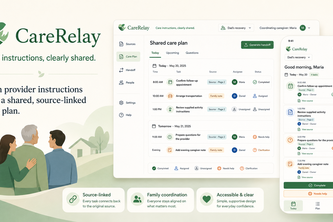
CareRelay is a self-reported web application built as a hackathon project that uses AI (specifically GPT-5.6) to extract structured care instructions from medical documents and turn them into a human-reviewed, source-linked family coordination plan.
What changed
The project was submitted to the OpenAI 2026 hackathon by an author who describes it as a response to personal family experience with hospital discharge instructions. It is presented as a proof-of-concept tool that demonstrates how AI can reduce coordination burden without making medical decisions for families.
Single most important open question
Is there any evidence of traction, revenue, or customer adoption beyond the self-reported hackathon demo?
What The Product Actually Is
The description states that CareRelay is a responsive web application built with Next.js and TypeScript, deployed on Vercel. It uses GPT-5.6 via the OpenAI Responses API to process medical documents (PDFs, images) and extract structured information such as actions, schedules, appointments, restrictions, warning signs, and clarification needs.
Key technical elements include:
- Use of Zod for schema validation
- Codex as implementation lead
- A deterministic application layer that enforces safety boundaries:
- No confirmation without source reference
- No shared task without human confirmation
- Contradictions or insufficient support prevent publishing
- Source text remains immutable
- Family notes and edits remain visibly separate
The system allows caregivers to:
- Load documents (fictional only in demo)
- Review AI-generated drafts linked directly to document pages
- Confirm, edit, or reject each draft before it enters the shared plan
- Assign tasks to family members
- Generate a caregiver handoff report with source links
Not evidenced No information about actual users, real-world data usage, or production deployment beyond the demo.
Positioning & Claim Evolution
The author claims CareRelay was inspired by a personal family experience involving hospital discharge instructions. The stated goal is to reduce coordination burden without making medical decisions for the family, positioning AI as a tool for structuring and reviewing information rather than automating care.
Key claims:
- AI does not make medical decisions
- It turns unstructured material into reviewable drafts
- Evidence is made easy to inspect
- Uncertainty becomes an explicit product state
The project is described as a hackathon MVP, with future plans including authentication, multi-user persistence, notifications, and calendar integration.
Not evidenced No claims about market positioning beyond the hackathon submission; no evidence of customer feedback or competitive differentiation.
Target Customer & ICP
The description states that CareRelay targets families coordinating care after hospital discharge, particularly those dealing with complex instructions spread across multiple pages, unclear dates, and contradictory information.
It is designed for caregivers who:
- Receive bundled medical documents
- Need to coordinate tasks among family members
- Want to avoid missing or misinterpreting critical details
The demo uses fictional content only, but the interface supports uploading real documents.
Not evidenced No evidence of actual customers, user personas, or segmentation beyond the author’s personal experience.
Business Model & Pricing Evidence
There is no evidence of a business model or pricing structure in the description. The project is presented as a hackathon submission, and all features are described without reference to monetization.
The author notes that the MVP intentionally excludes:
- Real patient accounts
- EHR connections
- Messaging
- Calendar sync
- Medical reasoning
Future production versions would add authentication, consent-aware multi-user persistence, access controls, and notifications, but no pricing or revenue model is mentioned.
Not evidenced No indication of how the product would be monetized or whether it has any commercial viability beyond a demo.
Technical & Delivery Signals
The project was built using:
- Next.js
- TypeScript
- React
- Tailwind CSS
- Vercel
- GPT-5.6 via OpenAI Responses API
- Codex for implementation
- Zod for validation
Key technical design decisions include:
- Deterministic code enforcement of safety gates
- Source-linked drafts with verbatim excerpts
- Immutable source text
- Separation of family notes from provider text
- Invariant tests and browser acceptance checks
The demo is described as a no-login, one-click experience that judges can complete in under three minutes.
Not evidenced No evidence of scalability, performance metrics, or production deployment beyond the demo.
Traction & Maturity Signals
The project is explicitly described as a hackathon MVP, and the author states:
- The public demo uses fictional information only
- No real patient accounts or EHR integration are included
- No login required for the demo
- No evidence of user adoption, retention, or usage beyond the submission
There is no mention of:
- Customers
- Revenue
- User engagement
- Product iterations
- Market validation
Not evidenced No traction data or maturity indicators beyond a self-reported demo.
Competitive Context
The description does not provide any information about competitors or existing solutions in the space. It does not reference:
- Other tools for managing medical care coordination
- EHR integrations
- AI-powered document processing platforms
- Family care management apps
Not evidenced No competitive landscape analysis, market size, or differentiation from existing offerings.
Open Questions & Risks
Several risks and open questions are present based on the self-reported description:
- No real-world testing or user feedback: The entire product is a demo with fictional data.
- Unproven commercial viability: No evidence of revenue, customers, or monetization strategy.
- AI dependency without validation: GPT-5.6 is used for extraction, but no mention of accuracy, reliability, or error handling in real-world use.
- Limited scope and functionality: The MVP excludes core features like EHR integration, messaging, and calendar sync.
- No team or headcount: The project lists a team size of 0, with no named members.
Not evidenced No evidence of risk mitigation strategies or commercialization plans beyond the hackathon.
Questions the description leaves open
- What is the actual source of the medical documents used in the demo? Are they real or synthetic?
- Has there been any user testing with caregivers or family members?
- How does the team plan to validate the accuracy of AI-generated content in real-world use?
- Is there a roadmap for integrating with EHR systems or healthcare providers?
- What are the legal and privacy implications of handling sensitive health data, even in a demo?
- Are there any plans to monetize this product beyond the hackathon?
- How does the team intend to scale the AI processing and ensure consistent performance?
Overall Assessment
Not evidenced: There is no evidence of revenue, traction, or customer adoption beyond the self-reported hackathon demo.
This project is described as a proof-of-concept, not a product in development. It lacks any commercial due-diligence signals such as:
- Revenue
- Customers
- Product-market fit
- Scalability
- Team structure
The description indicates that this is a self-contained hackathon submission with no indication of ongoing development or commercial intent.
Confidence level: Low — based entirely on self-reported, unverified information. The project shows potential in concept but lacks any evidence of real-world application or viability as a business.
User Stories BotA demo video on every pull request
Get a demo video on every new feature
GitHub App that watches your pull requests and records a narrated, captioned demo.
Save time on demo prep and make informed decisions faster with a video walkthrough of every new feature.
Source
Submitted to the OpenAI 2026 hackathon on Devpost. Project home on Devpost. Back to the full gallery on Devpost.
This competitive analysis was produced by top-founders.com (opens in a new tab)
Generated by a language model from this project's public Devpost page — its tagline, the author's own write-up and any built-with tags listed there — as captured in August 2026. Short quotations are the author's words. It is an opinion on the idea as a business, not on the people behind it, and it reflects the description as published then. If the project has moved on, request a correction below. The analysis is not independent research and contains no verified traction, revenue or customer data.
An independent guide by KFG International LLC — not affiliated with, endorsed by, or connected to Devpost or OpenAI.